

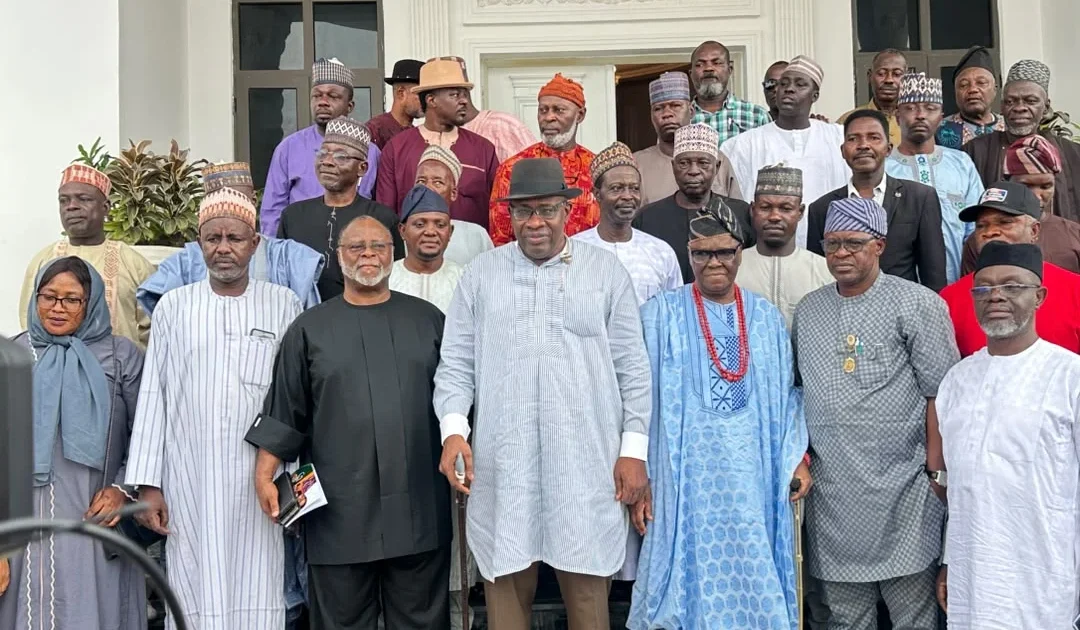
The National Leader of the Nigeria Democratic Congress, Senator Seriake Dickson, has reunited with former leaders and founding members of the defunct Alliance for Democracy after about 27 years, pledging to revive their democratic conversation and contribute to the survival of Nigeria’s democracy.
The reunion, held on Saturday, brought together some prominent members of the old AD political family, including Chief Michael Odurinde, a former Senior Special Adviser to the late Pa Ayo Adebanjo, an Afenifere leader and founding father of the Alliance for Democracy.
Dickson, who served as a founding State Chairman of the AD and later became its National Legal Adviser, said the gathering provided an opportunity for former colleagues to reconnect, rebuild old networks and reflect on the journey of Nigeria’s Fourth Republic.
He said, “Over the last few hours, I have had the privilege of hosting some of our leaders and colleagues from the old Alliance for Democracy. As many of you will recall, at the dawn of this democratic dispensation in 1998 and 1999, Nigeria had only three political parties.
“I was privileged to serve as a founding State Chairman of the Alliance for Democracy and later as its National Legal Adviser. Many of the distinguished personalities gathered here today were my leaders, mentors, and colleagues in that historic journey.
“We are especially honoured by the presence of our revered elder, Baba (Odurinde), who at 86 years remains a shining symbol of dedication and service. Since we began working together some 27 years ago, we rarely had the opportunity to gather in this manner. Life took us in different directions but we remained committed.”
Dickson stressed that the reunion was not convened to discuss partisan politics or any possible alliance between the defunct AD and the NDC.
He recalled that the AD was one of the three political parties involved in Nigeria’s transition to democratic rule in 1998 and 1999, describing the party as an important part of the country’s Fourth Republic history.
Midway through his address, the senator called for a minute’s silence in honour of departed leaders of the movement, including Chief Bola Ige, Pa Ayo Adebanjo and Chief Abraham Adesanya.
“Many people may not fully appreciate the sacrifices made by these men and women. The history of this democratic era cannot be properly told without recognising their courage, commitment, and selflessness. As we stood together in solemn reflection, we honoured their memory and reaffirmed our gratitude for the legacy they left behind.
“However, I wish to emphasise that today’s gathering was not convened to take major political decisions. It was primarily a reunion—a chance to reconnect, rebuild relationships, strengthen old networks, and celebrate a shared history of service to our country,” he said.
Also speaking, a former National Secretary of the AD, Professor Udenta Udenta, dismissed suggestions that the reunion was primarily about reviving the defunct party or forming an immediate political alliance.
Udenta noted that although the AD no longer exists as a political party, many of its founding members and ideological supporters remain active in the country’s political and democratic space.
“You said AD is a defunct party, but I’m not defunct,” he said, adding that several other former members remained “alive and well” across the country.
He said the gathering was designed to reconnect members of the old AD political family, honour the sacrifices of its founding leaders and reflect on the state of Nigeria’s democracy.
Udenta contrasted the ideological foundation of the AD with what he described as the character of the All Progressives Congress.
“Alliance for Democracy was a carefully constructed, civic-minded, and ideologically grounded political party. In contrast, the APC was essentially created as a special-purpose political vehicle. In my view, it lacks the ideological depth and moral clarity that defined AD.
“Therefore, many of those who moved from AD to APC did so in pursuit of political power rather than ideological conviction.
“President Bola Tinubu was indeed a member of AD and, in my opinion, performed remarkably well as Governor of Lagos State under that platform. As for the APC era, Nigerians themselves must judge the performance of successive administrations,” he stated.
Udenta, however, ruled out any immediate coalition between former AD members and the National Democratic Congress, saying the reunion was essentially a gathering of old colleagues, not a partisan political meeting.
The Alliance for Democracy was one of the political parties that emerged during Nigeria’s transition to civil rule and was particularly associated with progressive politics in the South-West.
Its prominent figures included Bola Ige, Ayo Adebanjo and Abraham Adesanya, while several of its members later moved into other political platforms following the party’s decline.
The reunion therefore gave members of the old political bloc an opportunity to reflect on the democratic journey since 1999, while paying tribute to the leaders who helped shape the country’s return to civilian rule.