

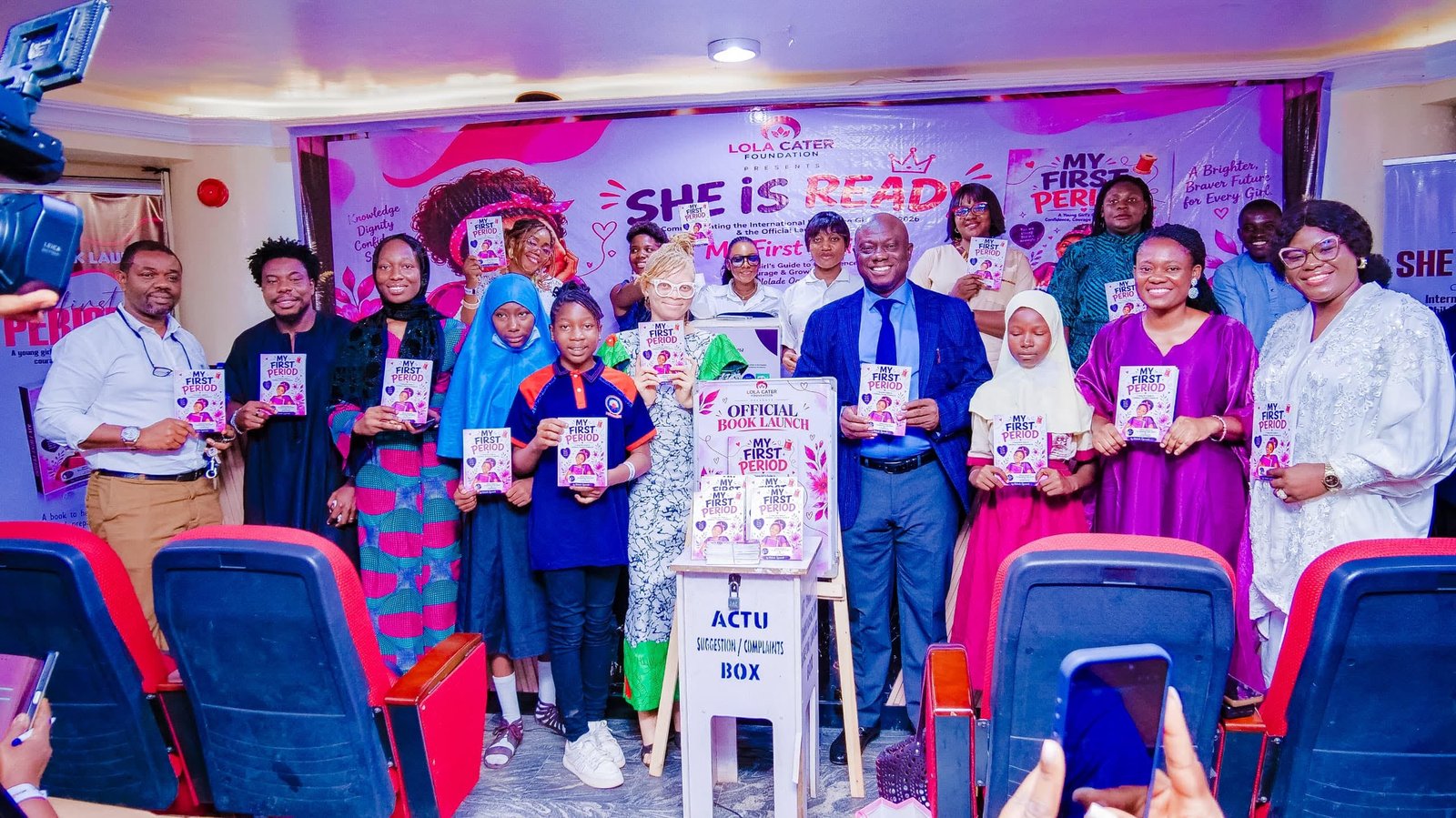
The Federal Government has called for stronger partnerships among government institutions, parents, schools, traditional rulers, corporate organisations and development partners to end period stigma and improve menstrual health education among Nigerian girls.
The call was made at the She Is Ready 2026 event organised by the Lola Cater Foundation in Abuja to commemorate the International Day of the Girl Child, where stakeholders stressed the need to ensure that girls have access to accurate information, menstrual hygiene products and supportive environments to discuss menstruation without shame.
The event also featured the launch of a book titled My First Period: A Young Girl’s Guide to Confidence, Courage and Growing Up, alongside the announcement of a target to reach 5,000 girls across Nigeria with menstrual health education, books and hygiene support by May 28, 2027.
ALSO READ: Kogi students hail Ododo over 100% increase in monthly subvention
The Permanent Secretary, Federal Ministry of Youth Development, Dr Maryam Keshinro, represented by the Director of Youth Health, Mental and Psychosocial Affairs Department, Mr Emmanuel Essien, said menstrual stigma, misconceptions and inadequate access to hygiene products and appropriate facilities continued to undermine girls’ confidence, school attendance and participation in society.
She said every girl deserved accurate information, essential hygiene resources and a supportive environment where menstruation could be discussed openly without shame.
“Girls are not merely beneficiaries of development. They are active contributors to national progress. Their rights must therefore be protected, their voices heard and their opportunities expanded,” she said.
Keshinro reaffirmed the ministry’s commitment to promoting the well-being, inclusion, leadership and empowerment of young people, particularly adolescent girls and young women.
She urged stakeholders to invest in girls’ education, menstrual health, life skills and mentorship, while strengthening efforts to protect them against gender-based violence, harmful practices and child marriage.
Similarly, the Head of the Adolescent and School Health Branch of the Federal Ministry of Health and Social Welfare, Joy Kalu, represented by an Assistant Director, Charity Okala, described the initiative as timely, stressing the need for stronger collaboration among government agencies, parents, schools, development partners and young people.
She said access to accurate health information would enable young people to make informed decisions about their well-being and prepare adequately for adulthood.
“We all have a role to play. We need to bring that together to ensure that our roles complement each other,” she said.
The Chief Executive Director of Lola Cater Foundation, Ms Ololade Ogunnubi, said the initiative was informed by gaps in menstrual health knowledge, persistent misconceptions and the effects of period stigma observed during the organisation’s community outreaches and school engagements.
She said the foundation had reached more than 20,000 people across over 15 states in the last six years through community outreaches, school visits and menstrual health awareness campaigns.
According to her, the engagements showed that menstrual health education must involve both girls and boys, as well as parents, teachers and other trusted adults.
“Girls need to understand their bodies, while boys also need to understand what happens before, during and after menstruation and how they can support the girl child,” she said.
Ogunnubi recalled an outreach where a male pupil described menstruation as a dirty substance that came out of girls every month, saying the experience demonstrated the need to address misconceptions from an early age.
She also cited instances where girls lacked basic knowledge of menstrual hygiene, including how frequently sanitary pads should be changed.
“These experiences remind us that menstrual health education is not just about distributing sanitary pads. It is about knowledge, confidence, understanding and creating an environment where girls can ask questions without fear or embarrassment,” she said.
She identified inadequate communication between parents and schools as another challenge, noting that some parents expected schools to educate their children about menstruation, while some schools considered it primarily a parental responsibility.
The book, My First Period, she explained, was developed as a practical resource to help young girls understand puberty, menstruation, personal hygiene and the emotional changes associated with growing up.
It is also designed to support parents, teachers, counsellors and other trusted adults in having informed and age-appropriate conversations with girls.
Softcare representative Osasona Micheal Dolapo emphasized that every girl deserves access to reliable menstrual hygiene products, accurate health information, and a supportive environment where she is treated with understanding and respect.
Girls should never feel ashamed of menstruation, nor should a lack of hygiene products prevent them from attending school or participating in everyday activities.
Reliable menstrual hygiene products are essential to safeguarding girls’ menstrual health and personal dignity. For Softcare, its commitment to caring for women is reflected not only in community initiatives but also in its continuous efforts to improve product quality and enhance consumer comfort.
The organisers also acknowledged that 7Up Bottling Company provided drinks and bottled water for guests.
Speaking on behalf of the Association of Wives of FCT Traditional Rulers (WOFCTTRA), Patricia Narai, wife of the Sakari of Karu, called for more open conversations about menstruation to prepare girls for their first menstrual experience.
Narai recalled that her first period left her confused because she did not understand the changes taking place in her body, adding that many girls still experienced similar situations due to inadequate information and guidance.
“Menstruation is not a source of shame. It is a natural biological process that deserves understanding, care and respect,” she said.
She urged parents, teachers, traditional institutions and community leaders to improve access to accurate information, menstrual hygiene products and safe sanitary facilities.
The event featured a learning session on the body, menstruation and confidence, as well as a panel discussion themed, “Creating a World Where Every Girl Is Ready.”
As part of the national outreach, the foundation said it would prioritise girls in underserved and rural communities, displaced communities and girls with disabilities through book distribution, menstrual hygiene support and school-based and community education.
Ogunnubi called on government institutions, corporate organisations, development partners, healthcare professionals, traditional institutions and civil society organisations to support the target of reaching 5,000 girls by May 28, 2027.
“Every girl deserves to meet her first period with knowledge, dignity, confidence and support. We cannot achieve this alone. It will take parents, schools, government, traditional institutions, healthcare professionals, organisations and individuals working together,” she said.
The foundation said individuals and organisations could support the initiative by sponsoring copies of the book at N3,000 each, donating menstrual hygiene kits or establishing partnerships to reach more girls.
A major highlight of the event was the support of the member representing Ede North, Ede South, Egbedore and Ejigbo Federal Constituency of Osun State, Hon. Bamidele Salam, who facilitated the purchase of 500 copies of the book through his foundation, Children of Africa Leadership and Values Development Initiative (CALDEV Africa).
The contribution is expected to expand access to age-appropriate menstrual health information and make the resource available to more girls.
WATCH TOP VIDEOS FROM NIGERIAN TRIBUNE TV