

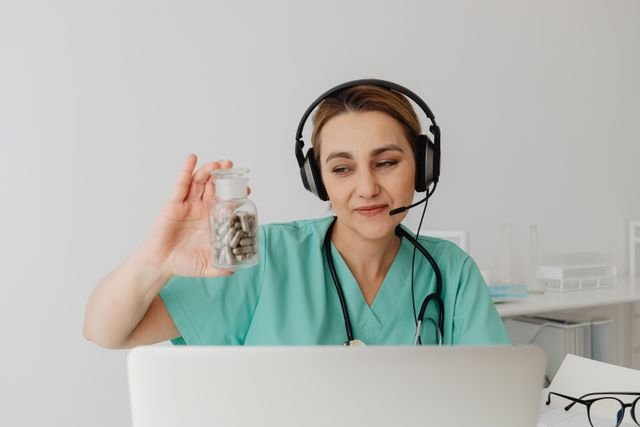
In the second quarter of 2018, US telehealth primary care visits ran at roughly 1.4 million per quarter, according to IQVIA data. Two years later, in the second quarter of 2020, the figure had jumped to around 35 million. The pandemic forced that surge, but the habits it created have outlasted the emergency. By 2021, the CDC’s National Health Interview Survey found that 37.0 percent of US adults had used telemedicine in the previous 12 months. Few areas of healthcare have shifted so quickly from exception to expectation.
That shift now extends well beyond video check-ins. Increasingly, the whole prescription journey, from assessment to dispensing to delivery, happens without the patient leaving home. Weight-management care, including newer formats such as oral tirzepatide prescribed online, has become one of the most visible examples.
Who Is Using At-Home Care
The CDC’s 2021 data reveal a more nuanced picture than the stereotype of young, tech-savvy early adopters.
- Older adults led usage. Telemedicine use rose with age, from 29.4 percent among adults aged 18 to 29 to 43.3 percent among those aged 65 and over.
- Women used it more than men, at 42.0 percent compared with 31.7 percent.
- Income mattered. Use reached 40.7 percent among adults with family incomes at or above 400 percent of the federal poverty level, compared with roughly a third among lower-income groups.
- Rural adults used it less. Use fell from 40.3 percent in central counties of large metropolitan areas to 27.5 percent in noncore rural counties, a gap that points to broadband and awareness barriers rather than lack of need.
The infrastructure for this behaviour is nearly universal. Pew Research Center’s 2025 survey found that 91 percent of US adults own a smartphone, meaning the device needed to complete an intake form or message a clinician is already in most people’s pockets.
Why Consumers Are Moving Prescriptions Home
Time and Access
Traditional care requires booking an appointment, travelling, waiting and often returning for follow-up. For chronic conditions that need regular check-ins, that burden accumulates. Asynchronous models, in which a patient submits information and a clinician reviews it within a set window, remove much of that time cost.
Cost Pressure
Affordability is a powerful driver. KFF’s Survey of Health Access and Caregiving, fielded in May 2026, found that 28 percent of US adults had skipped or delayed needed care in the previous 12 months because of cost. Services with clear, cash-pay pricing and no separate visit fees appeal to patients who are already rationing care.
Privacy and Comfort
Weight, sexual health and hormone therapy are areas where some patients feel uncomfortable discussing concerns face to face. Online intake and discreet home delivery lower that barrier. For weight management in particular, the stigma that can surround in-person conversations is widely recognised as a barrier to seeking care.
Delivery as the Default
Consumers have grown used to home delivery for groceries, retail and household goods. Pharmacy delivery is a natural extension, and for medicines that require temperature control, specialised shipping can arguably handle the cold chain more consistently than a patient’s car on a summer afternoon.
Inside The At-Home Prescription Model
Although services differ in their details, most at-home prescription programs share a common structure.
Digital Intake
The process usually begins with a structured questionnaire covering medical history, current medicines, allergies and relevant measurements. Well-designed intake forms include screening questions intended to identify patients for whom a treatment would not be appropriate, so that those cases are flagged before a prescription is considered.
Clinical Review
A licensed clinician then reviews the information. Depending on the service and state requirements, this may involve a video consultation, a phone call or asynchronous messaging. The clinician may request additional information, such as recent lab results, before deciding. Crucially, the outcome is not predetermined; a responsible service expects some patients to be told that a treatment is not suitable.
Dispensing and Delivery
If a prescription is issued, it is typically sent to a partner pharmacy, which dispenses and ships the medicine directly to the patient. Tracking, discreet packaging and temperature control where needed have become standard expectations.
Ongoing Follow-up
For long-term therapies, follow-up is where the model is tested. Regular check-ins allow clinicians to review side effects, adjust plans and decide whether continuing is appropriate. Refill timing is usually linked to these check-ins rather than left entirely to the patient.
The Changing Shape Of A Prescription
The at-home model has also influenced which formats patients ask about. When a medicine arrives by mail and is managed entirely at home, ease of use matters more. Needle-free formats remove the need for injection training and sharps disposal, and the arrival of oral options across the GLP-1 class has made that preference more visible. Compounding pharmacies have prepared oral and sublingual peptide formulations for individual patients on prescription.
These are different categories. Compounded preparations are made by licensed pharmacies for a specific patient, are not approved by the FDA and do not go through its premarket review, and are prescribed only when a licensed clinician determines that they are appropriate. That distinction is central to how responsible at-home services present their options.
How It Works In Practice
HealSend, a US direct-to-consumer telehealth platform, illustrates the at-home model from start to finish. A patient begins with an online intake covering health profile, height and weight, and screening questions about conditions such as kidney disease, type 1 diabetes and medullary thyroid cancer. The service limits eligibility to adults within a defined age range and asks for the patient’s state, because availability depends on state rules and the service operates only in the US.
A licensed medical provider then reviews the information online and determines whether a personalized treatment plan is appropriate. For patients interested in oral tirzepatide prescribed online, the company describes a needle-free daily format compounded by a licensed US pharmacy and states that it is prescribed only after one of its clinicians reviews the patient’s health history. If a prescription is issued, it ships free in discreet packaging, and refills are coordinated by the service.
The financial side reflects the consumer shift too. Plans are cash-pay and month-to-month with cancellation available in the patient’s account, HSA and FSA cards are accepted at checkout, and buy-now-pay-later providers Klarna and Afterpay appear among the payment options. Ongoing access to clinicians is handled online rather than through repeat office visits.
The Friction That Remains
The at-home model is not frictionless, and several issues deserve attention.
Uneven Access
The CDC’s rural data show that the people who might benefit most from remote care, those far from clinics, are currently least likely to use it. Broadband gaps and limited awareness both play a role.
State-by-State Rules
Clinicians must generally be licensed in the state where the patient is located, and pharmacy and compounding rules differ across states. This creates a patchwork in which availability varies by address.
Continuity of Care
When prescriptions come from a telehealth provider rather than a primary care physician, information can become fragmented. Patients are generally advised to tell all their clinicians about every medicine they take, including those prescribed online.
Digital Confidence
Owning a smartphone is not the same as feeling confident using it for healthcare. Completing a detailed medical questionnaire, uploading documents or messaging a clinician can be daunting for some patients, particularly those managing several conditions. Services that offer phone support alongside digital tools, and that write intake questions in plain language, make at-home care accessible to a wider group. The CDC finding that adults aged 65 and over were the heaviest users of telemedicine in 2021 suggests that age alone is not the barrier it is sometimes assumed to be; design and support matter more.
Policy Uncertainty
Federal telehealth flexibilities introduced during the pandemic have repeatedly relied on temporary extensions rather than permanent legislation, and rules on remote prescribing and compounding continue to evolve. Providers and patients alike operate in a shifting environment.
What Comes Next
Several trends suggest at-home prescription care will continue to deepen. Remote monitoring tools, from connected scales to glucose sensors, are making it easier for clinicians to follow progress without in-person visits. Employers and benefit platforms are paying more attention to direct-to-consumer services, and the use of tax-advantaged accounts for telehealth purchases is becoming routine. Format innovation, especially in oral and sublingual delivery, is making medicines easier to manage outside clinical settings.
At the same time, scrutiny is increasing. Regulators, pharmacy boards and verification bodies are looking more closely at how online services screen patients, describe compounded medicines and handle follow-up. Services that build careful clinical review into the process are likely to be best positioned as that scrutiny grows.
Conclusion
The move from waiting room to doorstep is one of the most significant consumer shifts in modern healthcare. It is driven by time pressure, cost concerns, privacy and the near-universal reach of smartphones, and it has already changed how millions of Americans access prescriptions. Yet the convenience of at-home care does not replace the clinical judgment at its core. Rural access gaps, state-by-state rules and continuity of care remain real challenges, and every prescription, whatever the format or channel, still depends on a licensed clinician’s assessment of whether it is appropriate for the individual patient.