

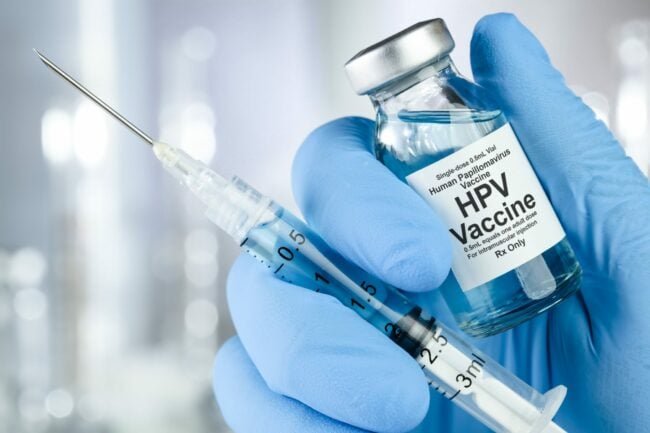
The Federal Government has vaccinated more than 18 million adolescent girls against Human Papillomavirus (HPV), while expanding cervical cancer screening, early diagnosis and treatment as part of efforts to eliminate the disease in Nigeria.
The Director, Disease Control and Immunisation, National Primary Health Care Development Agency (NPHCDA), Dr Rufai Ahmed Garba, disclosed this on Tuesday at a strategic policy roundtable organised by MSD in conjunction with Africa Health Business (AHB), with the theme, “Accelerating Cervical Cancer Elimination in Nigeria: Uniting Public and Private Sectors for Equitable Access.”
Garba said the 18 million girls vaccinated represented about 76 per cent of the target population, describing the development as a significant milestone since Nigeria introduced the HPV vaccine into its national programme in October 2023.
“Today, we are around 76 per cent coverage of our target, but in terms of numbers, we have crossed 18 million adolescent girls, which is equivalent to three countries in Africa,” he said.
He said the vaccine had become part of the routine immunisation schedule and was available free of charge to nine-year-old girls at public health facilities, while private facilities could provide it to people outside the routine target age.
Garba, however, said the country’s response to cervical cancer must go beyond vaccination to include screening, early diagnosis, treatment and follow-up.
“We see around 12,000 new cases every year in Nigeria, and we lose close to 8,000 women on a yearly basis. So, that’s how serious it is,” he said.
“If it is not diagnosed early, if it is not treated early, it leads to death. So, that’s what all of this is about—not just the vaccination, which NPHCDA does, but also how we are able to get women to screen them, to catch them early, treat them and follow them up till they actually get better.”
He identified getting healthy nine-year-old girls into health facilities for preventive vaccination as one of the major gaps in the programme.
According to him, the agency has therefore adopted school-based vaccination and outreach campaigns to improve access and coverage.
“You know that it’s very difficult to get a child into a facility when they’re well. This is like putting a needle into somebody that is very okay, running up and down and dancing, and you say, ‘Come, we want to protect you for 10 years, for your lifetime,’” he said.
Garba said the government also needed to strengthen adolescent-friendly health services to encourage young people to seek preventive healthcare.
“We need to start looking at adolescent healthcare a lot more seriously, having a safe space where adolescents can actually come to the public health facilities and have somebody to talk to and they will not be judged,” he said.
He said school vaccination exercises, the Maternal, Newborn and Child Health Week and other campaigns were being used to bridge the access gap.
“We use that to bridge the gap. But we’re getting there, we just need to do more work in terms of sensitisation and awareness creation,” he said.
On the decision to make nine years the routine age for HPV vaccination, Garba said the policy was designed to ensure girls were protected before sexual activity.
“The best time to actually give the vaccine is before the person becomes active sexually. The reason being that 98 per cent of the time the infection is from sexual intercourse,” he said.
On reports of vaccine shortages in some states, he said the NPHCDA had a logistics system for monitoring stock levels, forecasting demand and redistributing vaccines according to consumption.
“Sometimes we run short of different antigens. But there’s a system in place that already tracks it. The logistics team has a dashboard where they see when it is getting reduced and when you need to restock,” Garba said.
He added that vaccines could be redistributed from states with lower consumption to states where demand was higher.
“We balance from time to time. And just like you said, when we look at consumption rate and we see how high some are, and some are not as high as that, we call it redistribution to move the vaccine from one state to another where they have been highly used,” he said.
Garba also described Nigeria’s cold-chain system as strong, saying solar-powered equipment had been deployed to some primary healthcare centres.
“Our cold chain is almost the best in Africa,” he said, adding that the agency was still working to extend solar-powered cold-chain facilities to more parts of the country.
He also urged the media to investigate cases where private health facilities charge patients for HPV vaccines supplied by the government free of charge.
“All of the health facilities that conduct routine immunisation have HPV vaccines. We give them,” he said.
Garba said the NPHCDA could withdraw vaccine supplies from facilities found to be charging for the government-provided vaccines, although the agency lacked enforcement powers.
“We will need you guys to bust that story. Unfortunately, NPHCDA does not have enforcement powers, but what we can do is we can stop giving them vaccines when we find out that they’re selling vaccines that are supposed to be free. But we’re not everywhere, and we need your help to do that,” he said.
Also speaking, the Director of Cancer Prevention and Control, National Institute for Cancer Research and Treatment (NICRAT), Dr Usman Muhammad Waziri, who represented the Director-General of the institute, Professor Usman Malami Aliyu, said NICRAT was working to address barriers to cancer prevention, early detection and treatment.
Waziri said the institute’s mandate covered the entire cancer-care continuum, including prevention, research, awareness, screening, treatment, palliative care and survivorship.
“Part of the mandate is to engage every partner and stakeholder within the country, looking at international partners, other government agencies, ministries and departments that have an interest and are working in the cancer ecosystem, to work together and ensure we streamline our activities, efforts, as well as all our programmes to make it more robust, effective and impactful,” he said.
ALSO READ: Kogi: NEMA conducts on-the-spot assessment of flood-ravaged communities
He identified inadequate awareness, affordability and access to quality care as major barriers to improved cancer outcomes in Nigeria.
“There are a lot of multifactors that have contributed to that. Generally, when it comes to access to care in a country—not only limited to Nigeria—it starts with decision-making by affected individuals. And those decisions have to be informed decisions,” he said.
Waziri said financial constraints could also delay access to treatment, particularly when patients present at advanced stages of the disease.
“Affordability, because when people decide late, even if they go to the best of facilities, the disease will be late-stage,” he said.
He disclosed that NICRAT was partnering with the American Association for Cancer Research and other organisations to develop a community cancer communication strategy aimed at improving public understanding of cancer.
“We need to come together, streamline our efforts and standardise the information that goes out. Because most often, it’s not just the information that goes out, but appropriate information that is population- or community-centred,” Waziri said.
He said the strategy would address misconceptions and beliefs that could prevent people from seeking appropriate care.
“Perhaps you’ll see a community, even the elite segment, that will tell you, ‘No, cancer is usually a spiritual issue, don’t go for standard care,’” he said.
On cancer treatment infrastructure, Waziri said the government was expanding multidisciplinary cancer treatment centres across the country.
He said additional centres were being developed, with Katsina already included in the expansion programme.
“By before the end of this administration, six additional centres will be the focus,” he said.
Waziri also disclosed that NICRAT had introduced the National Initiative for Cancer Early Detection, Screening and Coordinated Access to Network of Care (NISCAN) to improve access to screening and early diagnosis.
“Presently, the philosophy behind that is to now make sure we routinise cancer screening for people at risk through standardised national guidelines, so that those who are at risk can now go into the hospital before they even become cancerous and get themselves checked,” he said.
He said the initiative was being piloted in the FCT, with additional centres planned across the country.
Waziri explained that NISCAN would operate through a hub-and-spoke model, with primary healthcare facilities serving as entry points for screening and specialised centres providing further diagnosis and treatment.
He said suspected cases identified through the FCT programme were referred to the Federal Medical Centre, Jabi.
“Every woman with a suspected cervical lesion will get there and get evaluated to the point of histological diagnosis under one roof. If it is cancerous, she gets connected to treatment. If it is not cancerous, she gets counselled and continued on follow-up based on national guidelines,” he said.
Waziri said Nigeria was working towards the World Health Organisation’s 90-70-90 targets for cervical cancer elimination by 2030.
“By 2030, the target is we should be able to screen and vaccinate 90 per cent of girls that are age-appropriate and eligible against Human Papillomavirus, then get 70 per cent of the women eligible for screening screened, and 90 per cent of those that are screened positive, either for precancerous lesions or cancerous lesions, get access to treatment,” he said.
He disclosed that the National Task Force on Cervical Cancer Elimination had established the Partnership for Elimination of Cervical Cancer in Nigeria, with support from First Lady Oluremi Tinubu.
Waziri said government-led cervical cancer screening had commenced in Imo State and would be expanded to other states, with Niger State next in line.
“Cervical screening championed by the Nigerian government is currently ongoing in Imo State, as well as other centres where the Institute is campaigning. We’ve itemised that we will be moving to six further states; the next state is Niger State, and then some other states will follow,” he said.
He said the objective was to take screening services to communities across the country.
“We want to have this cervical cancer rollout reach all the nooks and crannies of the country,” he said.
Waziri also disclosed that the Cancer Health Fund, which assists indigent Nigerians to access cancer treatment, was currently being implemented in six facilities and covered breast, cervical and prostate cancers.
He said inadequate funding remained a constraint to expanding the programme.
“The funding allocated to the programme is not yet optimal enough to go round and assist the bulk of the populace that is affected, especially the indigent,” he said.
The Director, External Affairs, Sub-Saharan Africa, MSD, Vuyo Mjekula, said stronger private-sector participation was needed to accelerate cervical cancer elimination in Nigeria.
Mjekula said the policy dialogue brought together government agencies, scientific leaders, civil society organisations, private-sector representatives and other partners to examine ways of building on the country’s HPV vaccination programme.
“What we were trying to explore together is, how do we build on the firm foundation that has already been built within Nigeria and work towards accelerating cervical cancer elimination in Nigeria?” she said.
She said Nigeria’s HPV vaccination programme had achieved substantial coverage since its introduction.
“We know that the National Primary Health Care Development Agency initiated the national HPV programme in 2023. Within that first year, the NPHCDA managed to vaccinate 12 million girls. Three years later, they have vaccinated, I believe it’s now around 18 million girls,” Mjekula said.
She said expanding screening, diagnosis and treatment was critical to complement the gains made through vaccination.
“The main thing was, how do we build upon that foundation and even the work of these various task groups? And one of the areas which we believe was a gap or is a gap is we see that there’s a great opportunity for the increased involvement of the private sector,” she said.
Mjekula said the changing global funding environment had increased the importance of domestic resource mobilisation and partnerships.
“COVID-19 showed us that it is possible for countries and for Ministries of Health to bring in the private sector and many other social partners to address a health threat,” she said.
She called for greater integration of women’s healthcare services so that preventive interventions could be incorporated into routine healthcare encounters.
“We don’t look at women in a siloed way,” she said, urging healthcare providers to integrate HPV screening and other preventive interventions into maternal and broader reproductive healthcare services where appropriate.
Mjekula also advocated the inclusion of private-sector representatives in the national cervical cancer task force, partnership and technical working groups.
“The private sector would have a seat at the table in the respective task forces, in the partnership for the elimination of cervical cancer in Nigeria, in various technical working groups,” she said.
She added that greater collaboration could help reduce fragmentation and improve the use of available resources.
“There’s a huge opportunity to break down fragmentation, galvanise and integrate resources so that the resources can be deployed to the most impactful areas and build efficiencies in general,” Mjekula said.
She disclosed that MSD had supported catch-up HPV vaccination for girls up to age 20 who were not covered when Nigeria introduced the programme.
Mjekula also said MSD was working with Gavi and UNICEF to promote access to higher-valency HPV vaccines in Africa.
She disclosed that MSD had invested more than $44 million in Nigeria over the past decade through its MSD for Mothers initiative to support civil society organisations working in maternal healthcare.
On cancer care more broadly, she said MSD was working with City Cancer Challenge in Abuja to identify gaps and develop solutions for improving oncology services.
She said the company would continue to support partnerships aimed at strengthening cervical cancer prevention, screening and treatment.
“We believe that conversations like the one we’ve started today can really grow and gain momentum, so that we can ensure that our policies are not limited by what we have, but are aspirational to achieve the world that we want,” Mjekula said.
WATCH TOP VIDEOS FROM NIGERIAN TRIBUNE TV