

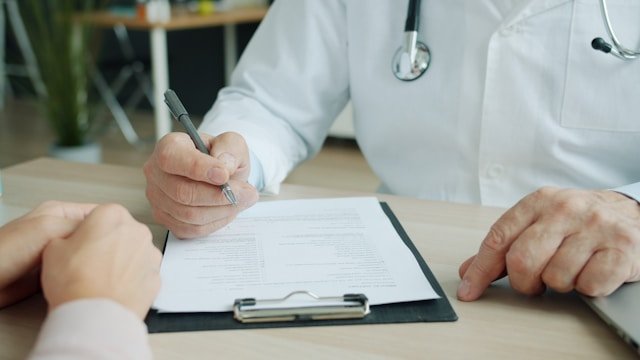
Your visit notes are probably three clicks away in a patient portal you rarely open. Most people never read them, and those who do are often startled, because a clinical note is written for other clinicians. It is still worth reading, and not out of curiosity alone: in a large survey, one patient in five who read their notes found something they believed was wrong. Knowing how a note gets produced, including who typed it and whether the practice was using a medical scribe or software to draft it, makes those errors far easier to spot.
One Reader In Five Spots Something Wrong
The figure comes from a survey of 22,889 patients across three American health systems, published in JAMA Network Open in 2020. Among patients who had read at least one note, 21.1 percent perceived a mistake in it. Of the mistakes reported, 42.3 percent were felt to be serious by the person who found them, and just under 10 percent were rated very serious.
The categories are more useful than the headline. Among the errors patients rated very serious, 27.5 percent concerned a diagnosis and 23.9 percent the medical history. Medications or allergies accounted for 14 percent, and tests, procedures or results for 8.4 percent. Close to 59 percent of the reports included at least one perceived error with a potential link to the diagnostic process, which is what makes this something other than a filing problem.
How Does An Error Get Into A Note?
Rarely through carelessness in a single moment. A problem list written five years ago is carried forward from visit to visit because nobody has a reason to question it. A template supplies a normal examination finding for something that was not examined. A dictated word comes back as a word that sounds like it. A history taken at speed records the condition your mother had as one of yours.
Then there is the sheer volume of it. Physicians in ambulatory practice spend roughly half the office day on the record and desk work, plus one to two hours on it at night, according to a time and motion study published in Annals of Internal Medicine. A note completed late in the evening, about a visit that happened hours earlier, is where the small slips settle.
The People Who Write Your Record
The note is not always typed by the person who examined you. Medical scribes have been part of American clinics for years: a trained documentarian, present in the room or listening remotely, who writes the encounter up while the clinician concentrates on the patient. More recently the drafting is done by software and finished by a person, which is how a service such as Scribe-X organises it, with the balance between automation and human completion set separately for each provider.
One thing about that changes something for you. When a person completes the note during the visit or immediately after it, the record captures the conversation while it is still fresh, and there is a defined step where the entry, the orders and the codes get checked by somebody whose job is that check. Everyone touching your chart works under HIPAA either way, and an outside service signs a business associate agreement with the practice before any patient encounter.
Reading Your Notes Is Not The Same As Diagnosing Yourself
Two things make the first read uncomfortable. Clinical shorthand sounds blunt when you are its subject, and a differential diagnosis lists possibilities the clinician has usually already discounted. Neither is a verdict on you.
A useful way in is to read for the facts. Is the diagnosis the one you were given out loud in the room? Is the medication list what you actually take, at the doses you actually take? Are your allergies recorded? Does the family history describe your relatives and not you? Those four checks cover the categories that patients in the survey most often flagged as serious, which makes them a better use of ten minutes than reading the whole note end to end.
Can You Get A Mistake Corrected?
Yes, and asking is rather the point of reading. Under the HIPAA privacy rule you can request an amendment to your record in writing, and the practice is required to respond to that request. The researchers behind the JAMA Network Open survey made this argument directly: inviting patients to report what they see turns reading into a safety mechanism, because the patient is the only person involved who holds their own history in full.
Put the request in writing rather than mentioning it as you leave, name the note and its date, and state what should be recorded instead. An amendment is usually added to the record rather than replacing the original text, which is normal and not a fudge. A medical record is a history, and that includes a history of its own corrections.