

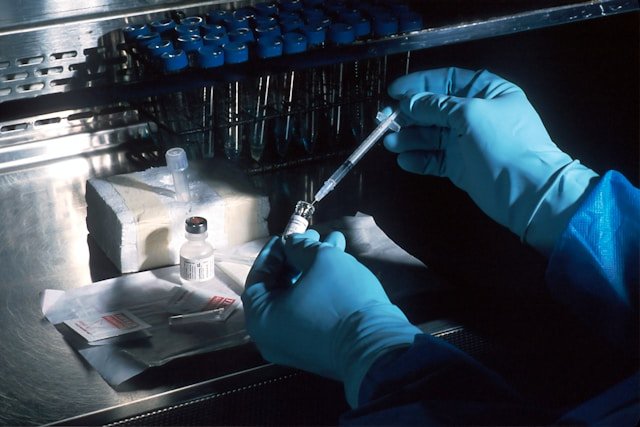
The material of a tube can affect the analytical result, especially when the sample contains a small amount of protein, peptide, or drug. Some analytes may adsorb onto the vessel walls, meaning that less of the substance reaches the next stage than would be expected from the prepared solution. For this reason, the choice between standard polypropylene and a low-bind version should take into account the properties of the compound being tested, the sample volume, and the storage conditions. In the case of high-value or limited-availability material, the right tube surface can have a direct impact on analyte recovery.
The Effect Of Tube Material On The Adsorption Of Proteins And Drugs
Polypropylene is widely used in laboratories because of its chemical resistance and relatively low level of adsorption compared with some other materials. However, its surface is not completely inert. Compounds with hydrophobic properties in particular, including some proteins, peptides, and lipophilic drugs, may remain on the walls of vessels made from it.
The level of adsorption is influenced primarily by:
- the type of polymer and its surface properties,
- the method of modification or processing of the material,
- the nature and concentration of the analyte,
- the pH and ionic strength of the solution,
- the composition of the buffer used,
- temperature and contact time,
- the ratio of wall surface area to sample volume,
- the number of freeze-thaw cycles.
Differences may also be significant between specific tube types.
Comparison Of Low-Bind And Standard Polypropylene Properties
Standard PP performs well in many routine laboratory applications. It is suitable, among other situations, when the analyte is present in a larger amount, contact with the tube is brief, and minor losses do not significantly affect interpretation of the result.
Low-bind tubes have a surface designed to reduce non-specific binding of analytes. Depending on the manufacturer’s solution, this effect may result from surface modification, a specific polypropylene formulation, or the way the material is processed. However, the low-bind label alone does not guarantee the same level of recovery for every compound.
| Feature | Standard PP | Low-Bind PP |
| Protein and peptide adsorption | Depends on the analyte | Usually reduced |
| Recovery from small sample volumes | May be lower | Usually more favorable |
| Hydrophobic drugs | Possible losses due to surface adsorption | Lower risk of adsorption |
| Cost | Usually lower | Usually higher |
| Typical application | Routine sample preparation | Trace-level samples and valuable analytes |
| Suitability | Recommended | Recommended for specific analytes |
When Should You Choose Low-Bind Tubes For Working With Biological Samples?
The low-bind version of a tube is particularly useful when the amount of available material is small or the analyte has high research value. This applies, among others, to purified proteins, peptides, biomarkers, and drugs present at low concentrations.
Typical applications for this type of tube include:
- preparation of proteomic samples,
- storage of proteins and peptides,
- LC-MS and LC-MS/MS analyses,
- studies of biomarkers present in small amounts,
- work with DNA and RNA,
- analysis of hydrophobic drugs,
- pharmacokinetic and pharmacodynamic studies,
- analysis of plasma, serum, and cerebrospinal fluid,
- long-term sample storage,
- repeated freezing and thawing.
Standard PP may still be the right solution for high-concentration solutions, short-term contact, and preparation of typical buffers. In such cases, additional reduction of adsorption may not have a meaningful impact on the result.
Typical Applications And Benefits In Protein And Drug Analysis
In protein analysis, reducing adsorption can minimize losses during incubation, mixing, centrifugation, and storage. This matters in techniques such as Western blot, ELISA, mass spectrometry, or enzyme activity assays, when the amount of available material affects the next stage of the procedure.
In proteomics, adsorption selectivity is also important. If certain peptides or proteins are lost to a greater extent than other components, the resulting profile may differ from the actual composition of the sample. This issue is particularly important in the analysis of very small amounts of material, including nano- and single-cell proteomics studies.
In the case of drugs, adsorption can affect the amount of substance available for chromatographic determination. This is especially relevant for lipophilic compounds, therapeutic peptides, and analytes present at low concentrations.
However, a flat-bottom tube is not the only element that can cause analyte loss. The substance may also adsorb onto pipette tips, filters, seals, autosampler vials, or other surfaces that come into contact with the sample. Therefore, in methods requiring high accuracy, it is worth evaluating recovery across the entire sample preparation process.
How To Choose A Flat-Bottom Tube For A Specific Laboratory Application
When selecting a flat-bottom tube, both the material and the experimental conditions must be taken into account. A flat bottom provides stable positioning of the vessel and may make sample observation easier, but its use should be compatible with the requirements of the equipment being used.
Before purchasing, it is worth checking 7 factors.
- Type of analyte – for proteins, peptides, and drugs present in small amounts, low-bind may be a beneficial solution.
- Sample volume – the capacity should match the amount of material in order to limit unnecessary contact of the liquid with a large surface area.
- Compatibility with equipment – the tube must fit the rack, centrifuge, thermoblock, shaker, or automated system.
- Temperature range – check whether it can be used during cooling, freezing, and incubation.
- Type of closure – for storage, tight sealing and proper cap fit to the tube design are important.
- Material purity – in molecular biology, requirements regarding DNases, RNases, endotoxins, or other contaminants may be important.
- Recovery data – for valuable samples, it is worth comparing the manufacturer’s information for the specific analyte type.
The choice should result from the procedure, not solely from whether the material is labeled as PP or low-bind. For small volumes of proteins and peptides, a flat-bottom PP low-bind tube with a capacity matched to the sample may be the right choice. For standard solutions and larger amounts of analyte, regular polypropylene may be sufficient.
Noex Labware offers laboratory plastic containers intended for various applications, so when choosing a specific variant, it is worth checking its technical parameters, compatibility with the planned procedure, and information regarding the material surface.
Flat-bottom PP Or Low-Bind Tubes – What To Choose And When?
- The material and surface properties of a tube can affect the amount of proteins, peptides, and drugs that remain in solution.
- Standard PP is suitable for many routine applications, while low-bind reduces non-specific binding of analytes to the wall.
- Choosing low-bind is particularly important for small volumes, low concentrations, and analysis of valuable biological and pharmaceutical samples.
- The right tube should be selected with consideration for the analyte, volume, temperature, contact time, equipment, and recovery data.
FAQ
How do low-bind tubes differ from standard PP tubes?
Low-bind tubes are designed to reduce the binding of proteins, peptides, and drugs to the vessel surface. Standard PP is also characterized by relatively low adsorption, but under certain conditions it may cause greater analyte loss.
When is it worth using low-bind tubes?
They are worth using for valuable or low-concentration proteins, peptides, and drugs, especially when the sample volume is small. They are used, among other areas, in proteomics, molecular biology, and pharmaceutical research.
Does the choice of tube material affect analysis results?
Yes, adsorption of the analyte onto the wall can reduce the amount available for further determination. As a result, the measured value may be underestimated and the repeatability of the analysis may worsen.
How can I tell if I need low-bind tubes?
They are worth considering when, despite a correctly performed procedure, protein or drug recovery is lower than expected. This is particularly important for samples with small volume, low concentration, and limited material availability.