

No fewer than 3.64 million Nigerians, representing about 1.5 per cent of the country’s population, are currently living with corneal blindness, the Eye Bank for Restoring Sight in Nigeria has said.
The organisation also disclosed that more than 200 patients are currently on its waiting list for corneal transplants, underscoring the urgent need to promote corneal donation and increase public awareness.
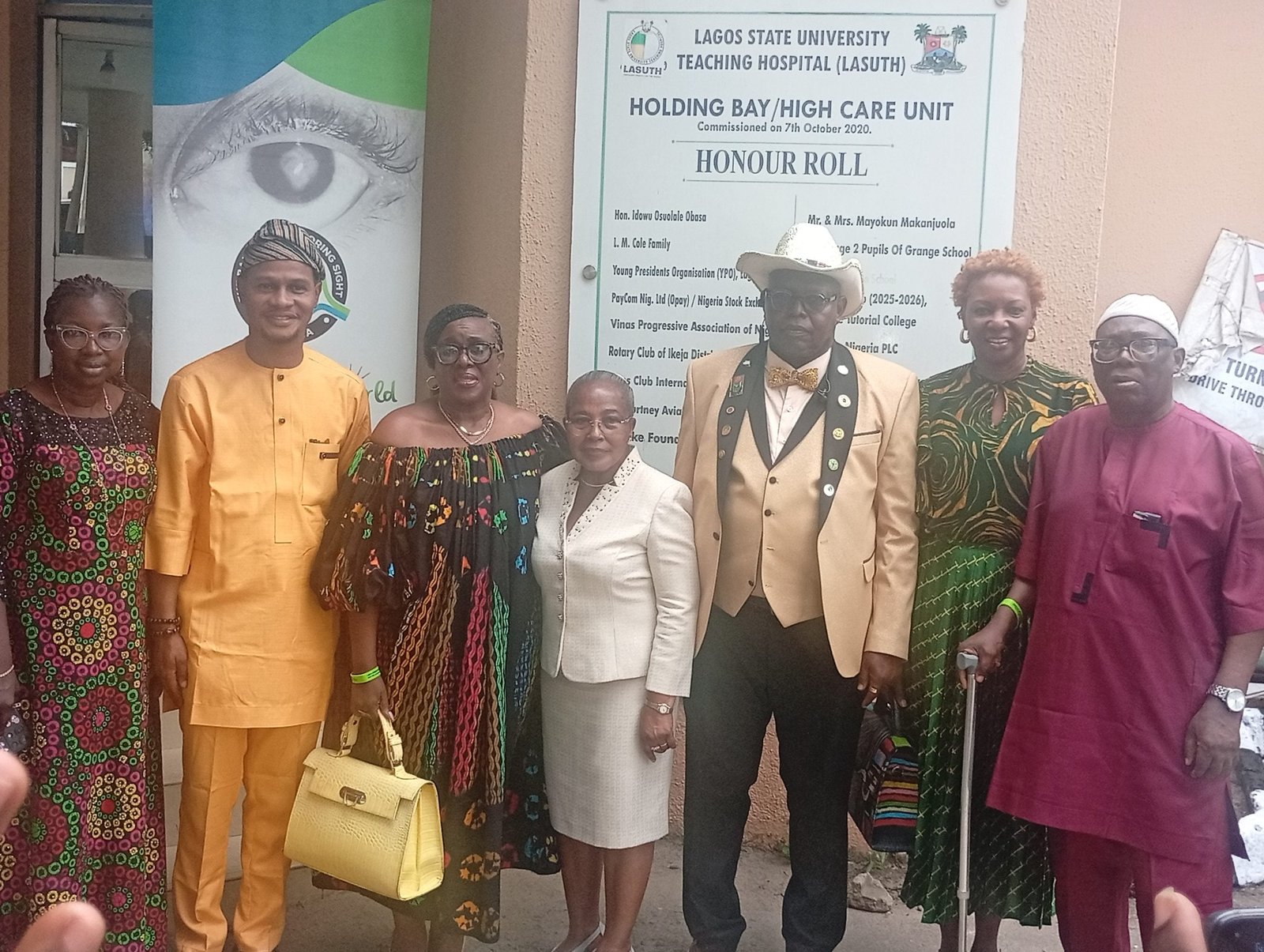
Chairman, Board of Governors, Eye Bank for Restoring Sight in Nigeria, Festus Odunayo Oshoba, disclosed this on Thursday at the official unveiling of Nollywood actress, veteran Joke Silva, as the organisation’s brand ambassador for corneal donation and transplantation.
Oshoba said the Eye Bank had facilitated more than 95 successful corneal transplants over the years, including 19 involving children aged between 30 months and 18 years.
He added that corneas had also been successfully harvested from two Nigerian donors who had pledged their corneas for donation before their deaths in 2010 and 2012.
According to him, the organisation is working towards developing a national register to provide accurate data on Nigerians who have undergone corneal transplantation and those who have regained their sight.
“1.5 per cent of the country’s population are currently living with corneal blindness. We have facilitated about a hundred. We are still trying to collate [the data] to have a national register to know how many have regained their sight and those that have had transplants,” he said.
Oshoba urged Nigerians to embrace corneal donation, stressing that the act could enable a person to regain sight after the donor’s death.
“We need to talk to our people that somebody you know might be a beneficiary of the organ you are donating. We have tarried enough; now we have to run. That we live for one another is the whole essence of humanity,” he said.
He, however, identified cultural, religious and misconceptions surrounding organ harvesting as some of the major challenges confronting corneal donation in the country.
He said the organisation was particularly concerned about how to facilitate timely corneal retrieval in cases where religious practices require the deceased to be buried within a short period.
A beneficiary of the programme, Mr Raphael Oguntimi, who regained his sight following a corneal transplant after suffering from an eye ulcer and infection, recounted his experience.
Oguntimi said he developed blindness following a stroke and initially believed he would have to travel abroad for treatment.
“When my son was finding a solution on Google, he got to know that we could only find a solution in India. Eventually, my son’s friend introduced a hospital to us in Victoria Island,” he said.
He said he underwent a corneal transplant in 2022 and began seeing immediately after the procedure.
“Initially, I couldn’t see the food I ate. I couldn’t go to the toilet without assistance. But immediately they did the transplant, I could read and walk without any aid. Nobody assists me in doing anything. I’m grateful to God,” Oguntimi said.
He expressed appreciation to the Eye Bank for facilitating access to the donated cornea, which was sourced from abroad.
Also speaking, Lion Kunle Ola Shodipo, whose brother became one of Nigeria’s earliest corneal donors after his death in 2010, recounted how his family decided to honour the deceased’s pledge.
Shodipo said his brother had been assassinated in Dopemu, Lagos, and that the family’s lawyer subsequently informed them that he had pledged to donate his corneas.
“The process was less than 15 minutes. It was when I realised that what they removed wasn’t the whole eyeball but the black spot of the eye,” he said.
Shodipo said he was proud that, despite his brother’s death, his decision to donate had enabled another person to benefit.
Vice Chairman of the Eye Bank, Mrs Fola Akande, urged beneficiaries of corneal donation to share their experiences in order to encourage more Nigerians to become donors.
“At death, we are still relevant. It is important to give so that someone else can live. Don’t let your sight die with your passing,” she said.
Unveiling Silva as the organisation’s brand ambassador, the Eye Bank said her involvement would strengthen advocacy and public awareness campaigns on corneal donation.
Silva pledged to use her platform to promote the cause and challenge misconceptions surrounding organ and corneal donation.
ALSO READ: Sanwo-Olu gifts LASU’s two best graduating students N20m each
“I am going to amplify what has been done. There is going to be continuous advocacy and awareness building,” she said.
According to the actress, cultural beliefs and misconceptions about the removal of body parts after death have contributed to resistance to organ donation.
She said Nigeria, with a population of more than 200 million people, should develop the capacity to meet its own need for corneal tissues rather than depend heavily on foreign sources.
“The medical practitioner cannot do it alone. There is the advocacy where people need to get aware. Advocacy is so important that Nigeria does what Nigeria can do for Nigerians,” Silva said.
“We need to stop depending on the rest of the world. We are over 200 million people. Why must we depend on what we can do by ourselves?”
She urged Nigerians to consider corneal donation as a way of helping others after death, noting that the donation does not prevent families from giving their deceased loved ones a dignified burial.
Represented at the event, Lagos State University Teaching Hospital (LASUTH) Chief Medical Director, Professor Tokunbo Fabanwo, encouraged the general public to embrace the initiative while urging the newly unveiled ambassador to leverage her good name and brand to promote corneal donation.
WATCH TOP VIDEOS FROM NIGERIAN TRIBUNE TV