

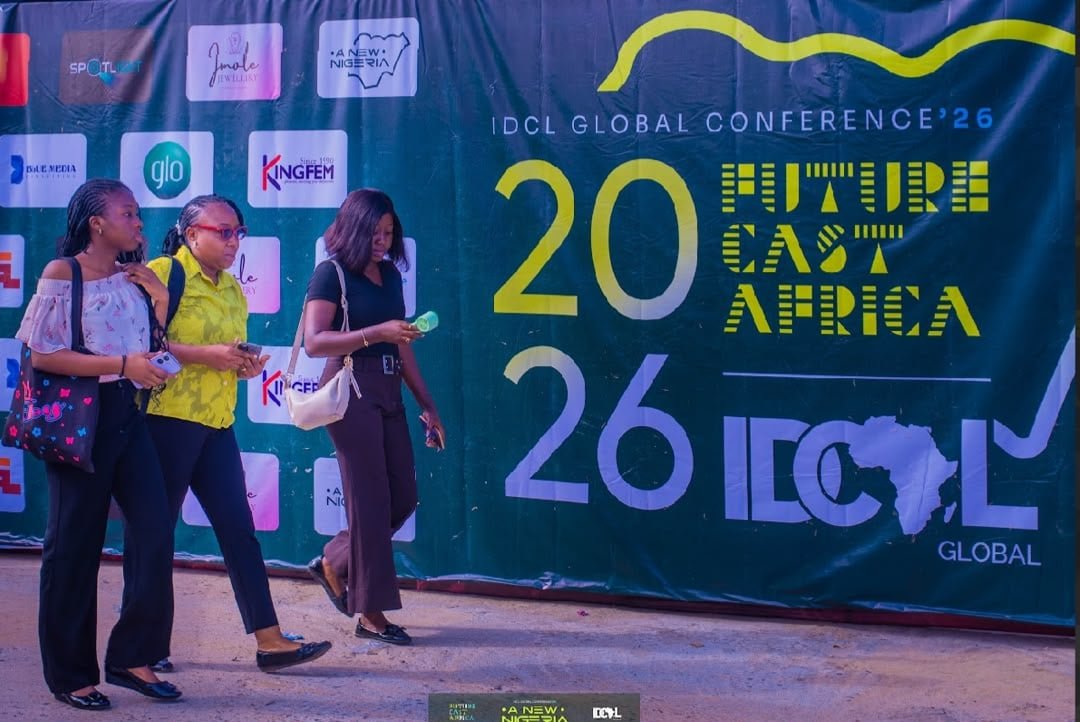
Stakeholders at the IDCL Global Conference ’26 have called on the Federal Government and Nigerians to harness the creativity, innovation and entrepreneurial potential of young people to accelerate national development.
The stakeholders made the call on Thursday at the conference, themed “A New Nigeria”, held in Abuja.
The conference brought together entrepreneurs, business leaders, development experts, youth advocates and policy stakeholders to explore practical pathways to economic growth, innovation, governance reforms and national transformation.
Speaking at the event, the Convener of the Made in Abuja Creative and Entertainment Industry Conference and Award, Gabriel Obochi, said creating an enabling environment was essential to unlocking the innovative potential of young Nigerians.
Obochi said exposure to people who create and add value could inspire others to develop their own ideas and businesses.
“The environment inspires a whole lot of innovation and creativity. When you come into the midst of people who create, who produce, who virtually create anything, it inspires you to start creating or wanting to go into creating as well,” he said.
He urged young Nigerians not to allow setbacks and failures to discourage them from pursuing their ambitions, stressing that risk-taking was an inevitable part of success.
“Everything in life is a risk. If you are pulled down by it, you will never get to achieve anything,” he said.
Obochi said successful entrepreneurs distinguished themselves by remaining focused despite losses and building businesses capable of surviving difficult economic conditions.
He also called for reforms in the electricity sector, urging the Federal Government to liberalise power generation by allowing smaller companies and private ventures to participate more actively in electricity production.
“The power sector should be democratised and allow some other smaller companies or ventures to also generate power. That is the only thing that will help us stabilise the power problem and electricity generation in Nigeria,” he said.
Earlier, the Convener of the IDCL Global Conference ’26, Oluwakemi Olorode, said the event was designed to encourage Nigerians to collectively change the narrative about the country.
She said the theme, “A New Nigeria”, reflected the contributions individuals and groups were making towards national transformation.
“It’s A New Nigeria. That’s the topic, where Nigerians, as individuals and collectively, are making an impact and changing the narrative,” Olorode said.
According to her, the conference provided a platform for business owners, professionals and young people to exchange ideas, build partnerships and contribute to national development.
“So, it’s not a one-person narrative. It’s a narrative for everybody,” she added.
While acknowledging some improvements by the government, Olorode expressed concern over the continued inadequacy of electricity supply in the country.
“We still don’t have 24-hour electricity, even with Band A. We are still pleading with the government to help us make sure that Nigeria is thriving and becomes a success story,” she said.
In a panel session, the Executive Director of the Private and Public Development Centre, Mrs Lucy Abagi James, called for urgent reforms in Nigeria’s justice system.
Abagi said Nigeria had enough policies and should instead concentrate on implementing existing frameworks.
“There are already policies. There is no need for another policy framework again. We need to advocate more for judges to be able to digitise their courts,” she said.
She also urged Nigerians to understand and assert their legal rights, including access to legal representation and a speedy trial.
Abagi attributed much of the corruption in the justice sector to institutional weaknesses, saying, “One of the problems we are having with corruption is system failure.”
She said the digitisation of the courts, alongside stronger public advocacy, would improve access to justice, strengthen accountability and reduce opportunities for corruption.
Also speaking, development advocate Aisha Sabo argued that Nigeria’s greatest resource was not its mineral deposits but the imagination and creativity of its people.
“I don’t even believe that minerals are our greatest asset. Our greatest asset and resource is actually our imagination,” she said.
Sabo challenged young Nigerians to think beyond existing limitations and explore innovative solutions to the country’s challenges.
She cited Rwanda’s use of drones to deliver medical supplies as an example of how creative thinking could overcome infrastructure limitations.
“The landscape didn’t change, but the way people imagined it did,” she said.
According to her, Africa’s growing youthful population presents a major opportunity for economic transformation if properly equipped and harnessed.
Financial market trader and public speaker Paschalene Chiemela similarly urged young Nigerians to stop relying solely on the government to create opportunities, saying individuals could contribute to solving some of the country’s challenges.
“It doesn’t always have to revolve around the government or policies. It can start with us,” she said.
Chiemela encouraged young people to build strong personal brands, acquire relevant skills and focus on creating value that would distinguish them in an increasingly competitive labour market.
“I know the general saying is, ‘There’s no job.’ But what can you do? Build a brand. What can you offer?” she asked.
She maintained that sustainable success begins with the ability to create value, develop useful skills and look beyond immediate challenges.
WATCH TOP VIDEOS FROM NIGERIAN TRIBUNE TV