

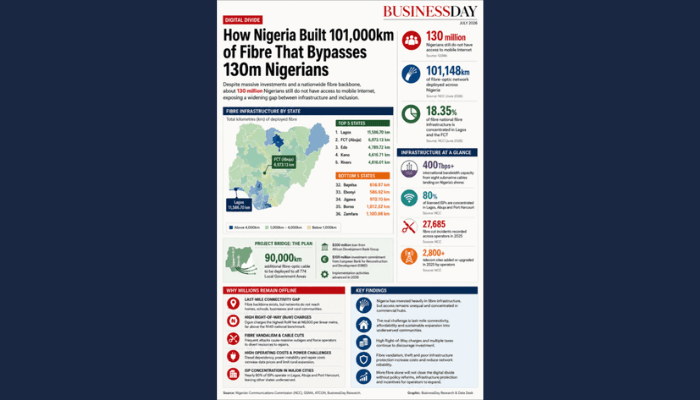
Nigeria has built one of Africa’s largest fibre-optic networks, stretching more than 101,000 kilometres across its 36 states and the Federal Capital Territory (FCT).
It has welcomed eight international submarine cables carrying more than 400 terabits of internet capacity to its shores. Telecom operators invested more than N2.5 trillion in network expansion last year alone.
Yet about 130 million Nigerians still do not have access to mobile internet, according to a new report by the GSMA, exposing a striking disconnect between massive infrastructure investment and meaningful digital inclusion.
The figures point to a deeper structural problem. While Nigeria has spent years expanding broadband backbone infrastructure, much of that capacity remains concentrated in a handful of commercial centres, leaving millions of people in smaller cities and rural communities disconnected from the digital economy.
State-by-state infrastructure data released by the Nigerian Communications Commission (NCC) shows Nigeria has deployed 101,148.36 kilometres of fibre nationwide. However, Lagos and the FCT alone account for 18,559.83 kilometres, or 18.35 percent of the country’s total fibre infrastructure.
Lagos remains Nigeria’s fibre capital with 11,586.70 kilometres of fibre, representing 11.46 percent of the national network. Abuja follows with 6,973.13 kilometres, or 6.89 percent.
The two cities have attracted more fibre investment than many geopolitical zones combined because they host the country’s largest concentration of banks, multinational companies, government institutions, hyperscale data centres and internet exchange points.
Behind them are Edo with 4,789.72 kilometres, Kano with 4,616.71 kilometres, Rivers with 4,616.01 kilometres, Kaduna with 4,339.85 kilometres and Ogun with 4,246.48 kilometres.
At the opposite end are Bayelsa with just 656.87 kilometres of fibre, Ebonyi with 586.92 kilometres, Jigawa with 970.10 kilometres, Borno with 1,012.52 kilometres and Zamfara with 1,100.98 kilometres.
More than a dozen states still have less than 2,000 kilometres of fibre infrastructure, limiting broadband availability, network resilience and internet quality.
The uneven spread of infrastructure has reinforced a two-speed digital economy where businesses and households in Lagos and Abuja increasingly enjoy high-capacity broadband while many communities outside major cities continue to rely on slower and less reliable mobile connections.
The imbalance comes despite growing demand for digital services driven by remote work, artificial intelligence, cloud computing, digital payments, online education and streaming services.
Read also: States advocate transparent fibre duct pricing to support 90,000km rollout
Connectivity has become essential
For Aminu Maida, executive vice chairman of the NCC, the debate is no longer about whether Nigeria needs broadband.
“We have crossed a threshold where internet connectivity is no longer a luxury or a secondary utility. It is now central to how people learn, work, trade, access services and participate in society,” he said during the Association of Telecommunications Companies of Nigeria (ATCON) forum on Fibre-to-the-Home in Lagos.
According to him, internet use in Nigeria continues to grow rapidly.
As of April 2026, Nigeria recorded 154.72 million active internet subscriptions, up from 141.99 million a year earlier. Broadband penetration also increased from 48.81 percent to 55.67 percent over the same period.
Nigerians now consume an average of about 1.4 million terabytes of internet data every month.
“The home is no longer only a place of residence. It is also becoming a place of learning, work, business, entertainment and service delivery. That is why Fibre-to-the-Home is so important. The home has become a critical access point to the digital economy,” Maida said.
Despite this growing demand, fixed broadband remains largely underdeveloped.
Nigeria has only about 265,000 active Fibre-to-the-Home subscriptions nationwide, far below the African average and significantly behind more mature broadband markets.
“This low base should not discourage us. It should focus us. It shows the scale of the opportunity before Nigeria and reinforces the need to create the right conditions for fibre infrastructure to expand more rapidly, more sustainably and more widely across the country,” Maida said.
The infrastructure paradox
Industry experts say Nigeria’s broadband challenge is no longer simply about building more fibre backbone.
Instead, the country faces what many describe as a last-mile problem, that is, getting existing fibre infrastructure from major transmission routes into homes, schools, hospitals, businesses and underserved communities.
Josephine Sarouk, managing director of Bayobab Nigeria, said Nigeria already has more than enough international internet capacity.
“The challenge isn’t the backbone. It is the last mile, bringing that capacity to homes, schools and small businesses. With eight submarine cables and over 400 terabits of international capacity, Nigeria has broadband abundance at the coast and scarcity inland,” she said.
The problem is particularly evident among Internet Service Providers (ISPs).
According to the NCC, nearly 80 percent of licensed ISPs remain concentrated in Lagos, Abuja and Port Harcourt despite the country’s nationwide fibre backbone.
Earlier this year, Maida admitted the imbalance was limiting competition and affordability.
“We currently have about 101,000 kilometres of fibre optic backbone, but nearly 80 percent of ISPs are concentrated in Lagos, Abuja and Port Harcourt. That must change. Our target is to ensure every state has at least two or three ISPs delivering fibre-to-the-home and fibre-to-the-business services,” he said.
He warned that relying almost entirely on mobile broadband would not support Nigeria’s long-term digital ambitions.
“Even in advanced economies, living your full digital life via mobile is expensive. Nigeria needs a strong fixed-fibre foundation to truly live digital lives in homes, schools, hospitals and public institutions.”
Why investors avoid many states
Industry executives argue that the economics of broadband expansion remain one of the biggest barriers.
Oyaje Idoko, founder and chief executive officer of Layer3, said operators naturally invest where returns are strongest.
“As a private investor, before we extend service to a new community, we must ask whether it is commercially viable. If a community cannot afford the service or power is unreliable, the business won’t survive,” he said.
In Lagos and Abuja, where businesses consume large volumes of data and enterprise customers pay premium prices, operators can recover investments much faster.
In many rural communities, however, lower incomes, unreliable electricity and weaker demand make expansion commercially difficult.
Right of Way remains Nigeria’s biggest bottleneck
Operators say one of the biggest obstacles remains Right of Way (RoW) charges imposed by state governments.
Although the National Economic Council approved a harmonised RoW fee of N145 per linear metre in 2020, implementation remains inconsistent.
NCC data shows Ogun State currently charges N6,600 per metre, Kano N2,745 and Delta N2,706, making fibre deployment several times more expensive than the nationally approved rate.
Maida described excessive RoW charges as one of the country’s biggest deployment barriers.
“Right of Way approvals remain one of the most significant factors affecting fibre rollout. Excessive charges, unpredictable approval timelines and multiple permitting requirements increase deployment costs and slow national progress,” he said.
He urged state governments to view digital infrastructure as an economic investment rather than a source of internally generated revenue.
“State governments must increasingly recognise that the long-term economic value of digital infrastructure far outweighs the short-term revenue from Right of Way charges,” he posited.
According to Maida, progress has begun.
“Thirteen states have completely waived Right of Way charges, while sixteen others have adopted the National Economic Council’s recommended rate of N145 per linear metre.”
He said the NCC would continue engaging the remaining states towards full alignment and, ultimately, the elimination of unnecessary barriers to broadband deployment.
The commission also launched an Ease of Doing Business Portal that provides state-by-state information on RoW charges, approval processes and infrastructure deployment to improve investment transparency.
Gbenga Adebayo, chairman of the Association of Licensed Telecommunications Operators of Nigeria (ALTON), said some states have simply replaced official RoW fees with other charges.
“What we are seeing in some states is that despite officially waiving Right-of-Way fees, they now impose hidden costs such as education taxes and highway levies. These discourage investment,” he said.
Fibre cuts cost millions
Another major challenge is protecting existing infrastructure.
Maida disclosed that between January and December 2025, operators recorded more than 27,685 fibre cuts, over 27,000 access denial incidents and 4,210 theft cases nationwide.
“The message is simple: when fibre is cut, the impact goes far beyond an operator’s balance sheet. It affects students, hospitals, businesses, banks, public services and ordinary citizens. Protecting telecoms infrastructure is therefore protecting the productivity and wellbeing of the Nigerian economy,” he said.
He said the Presidential Executive Order designating telecom assets as Critical National Infrastructure is expected to reduce vandalism and improve coordination during road construction
Sarouk said vandalism has become one of the industry’s highest recurring costs.
“A significant portion of our annual investment goes into repairing damaged fibre routes rather than building new ones,” she said.
For instance, a coordinated attack on a critical telecom facility in Delta State exposed how a single act of vandalism can trigger widespread network outages and derail operators’ investment plans.
Industry sources told BusinessDay that a robber attacked an IHS-managed telecom node in the ASB region on July 8, 2026, knocking 33 base stations offline across 2G, 3G and 4G networks. The disruption worsened hours later when a separate fibre-optic cable cut severed the site’s primary transmission links.
Because the affected facility serves as a key fibre convergence point, the second incident triggered a cascading network failure, causing the number of affected base stations to jump from 33 to 103. The outage temporarily disrupted voice and data services, electronic banking and commercial activities across several communities, highlighting the vulnerability of Nigeria’s digital infrastructure despite billions of naira invested in network expansion.
The incident also reveals the growing financial strain facing telecom operators. Industry sources said operators are already consuming about 20 percent more spare parts than budgeted this year as repeated acts of vandalism and fibre cuts force emergency repairs. As inventories shrink, engineering teams are increasingly diverting equipment originally earmarked for new network deployments to restore damaged infrastructure.
“This diversion of resources significantly delays the rollout of new infrastructure, stifling the nation’s broader broadband penetration targets and stalling anticipated revenue generation for the telecom companies,” a telecom engineer stated.
Read also: Nigeria has fibre across states but lacks fair access market—NCC
Project BRIDGE faces old obstacles
To close Nigeria’s connectivity gap, the Federal Government is implementing Project BRIDGE, a programme expected to deploy an additional 90,000 kilometres of fibre across all 774 local government areas.
The project has already secured a $200 million loan from the African Development Bank Group and a further $100 million investment commitment from the European Bank for Reconstruction and Development.
But stakeholders cautioned that backbone expansion alone would not solve Nigeria’s broadband problem.
“Project BRIDGE represents one of Nigeria’s most ambitious digital infrastructure programmes. But this backbone expansion must be complemented by last-mile infrastructure that brings capacity from national routes into homes, offices, schools, hospitals and communities. That is where Fibre-to-the-Home becomes central,” Maida stated.
He added that broadband deployment should become part of urban planning, stating, “Connectivity should not be treated as an afterthought. Just as new developments make provision for electricity, water and drainage, they should also make provision for telecommunications infrastructure.”
Industry stakeholders say the government’s ambitious programme risks repeating existing inequalities unless long-standing structural problems are resolved.
These include multiple taxation, inconsistent Right of Way policies, fibre vandalism, high diesel costs, weak electricity supply and limited incentives for operators to serve low-income communities.
For Nigeria, the issue is no longer whether enough fibre has been deployed. The country’s biggest challenge is ensuring that the infrastructure reaches the millions of Nigerians it was built to connect.
Until that happens, Africa’s largest fibre rollout may continue to bypass one of Africa’s largest offline populations.

Get Newsletter Updates
Enjoying our column?
Subscribe to our specialised **Tech Pulse** feed to receive fresh reports and analyses directly in your inbox.

