

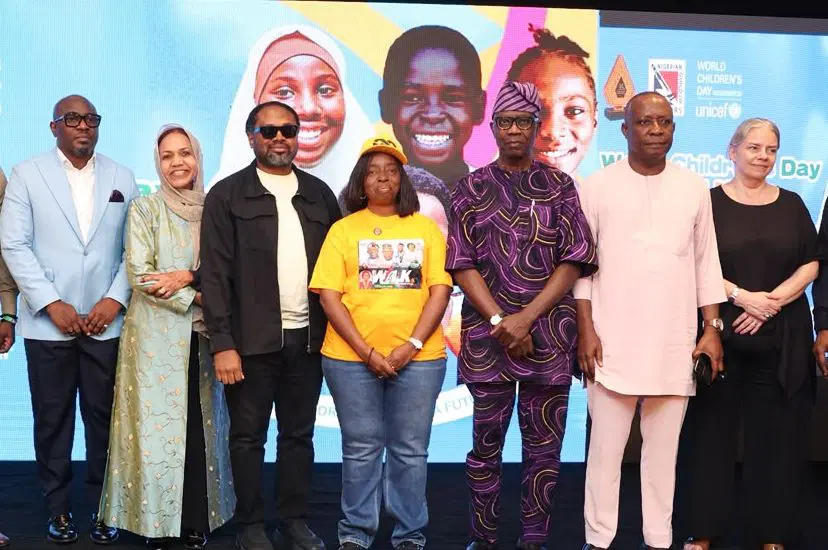
Nigeria’s future is at risk as 18.3 million children remain out of school, while millions more face challenges threatening their survival, development and ability to learn, prompting UNICEF, media leaders and other stakeholders to demand urgent national action.
The warning came at the 2026 World Children’s Day High-Level Media Symposium in Lagos, organised by UNICEF Nigeria in partnership with the Nigerian Guild of Editors (NGE) and the Diamond Awards for Media Excellence (DAME).
Held under the theme “Every Child Alive, Thriving and Learning: A Shared Responsibility”, the symposium brought together government officials, media leaders, development partners, private sector representatives and children to discuss the challenges confronting Nigerian children and the urgent need for sustained investment in their future.
UNICEF Representative in Nigeria, Wafaa Saeed, stressed that investment in children must begin from conception, warning that the critical early years cannot wait for economic recovery.
“You cannot pause a baby’s brain development while waiting for economic recovery. From conception to age two, 80 per cent of human brain growth occurs; investing in the first 1,000 days is critical to a child’s survival, development and future,” Saeed said.
She urged the media to move beyond statistics and consistently highlight the experiences of children and families, as well as solutions addressing their challenges.
“Statistics only matter when they move us to protect the child behind the number. We need the media to humanise the numbers, keep children in the headlines year-round and spotlight the solutions that are working across Nigeria,” she added.
ALSO READ: 2027: I regret criticising Ishaku, he was a saint compared to Kefas – PDP’s Bwacha
In her keynote address, the First Lady of Lagos State, Her Excellency Dr Claudiana Ibijoke Sanwo-Olu, emphasised the importance of supporting mothers and investing early in children to build a healthier and better-educated generation.
She said the Babajide Sanwo-Olu-led administration remained committed to inclusive child development and gender-responsive governance, adding that the ongoing review of the Lagos State Child’s Rights Law 2015 offered an opportunity to strengthen legal and institutional protections for children.
Children also challenged decision-makers to ensure that poverty, insecurity, displacement, gender or disability did not determine their chances of survival, education and protection.
Discussions highlighted the need to strengthen maternal and child healthcare, nutrition, immunisation, breastfeeding support, access to clean water, birth registration and early childhood stimulation.
Participants also called for improved education financing, safer schools, better teacher capacity and flexible learning opportunities for children in underserved and conflict-affected communities.
President of the Nigerian Guild of Editors, Eze Anaba, urged journalists to make children’s rights a sustained editorial priority and hold government and other stakeholders accountable for their commitments.
“The media must go beyond reporting figures and ask what they mean for real children, what government and other stakeholders have committed to do, and whether those commitments are being fulfilled,” Anaba said.
DAME Trustee Lanre Idowu said the partnership between UNICEF, NGE and DAME was strengthening child-rights journalism through training, access to credible evidence, field visits and recognition of excellent reporting.
Adefemi Adeniran, Director of Corporate Communications and CSR at Airtel Nigeria, said a child’s background or economic circumstances should never determine their prospects.
“Keeping them alive is our fundamental obligation. Enabling them to learn is our collective responsibility. Creating conditions for them to thrive must be our shared ambition,” he said.
UNICEF Nigeria Goodwill Ambassador and musician Cobham’s Asuquo highlighted music as an effective tool for communicating the importance of early childhood development. He spoke about his song, “The First 1,000 Days of Life”, and joined schoolchildren in performing “I Am a Nigerian Child”, one of the symposium’s highlights.
The event also coincided with UNICEF’s 80th anniversary of working for and with children globally.
Participants agreed that securing Nigeria’s future requires stronger government leadership and investment, family and community support, private sector engagement, effective development partnerships, sustained media attention and meaningful children’s participation.
They stressed that ensuring every Nigerian child survives, thrives, learns, and is protected is a shared responsibility that requires urgent, sustained action.
WATCH TOP VIDEOS FROM NIGERIAN TRIBUNE TV