

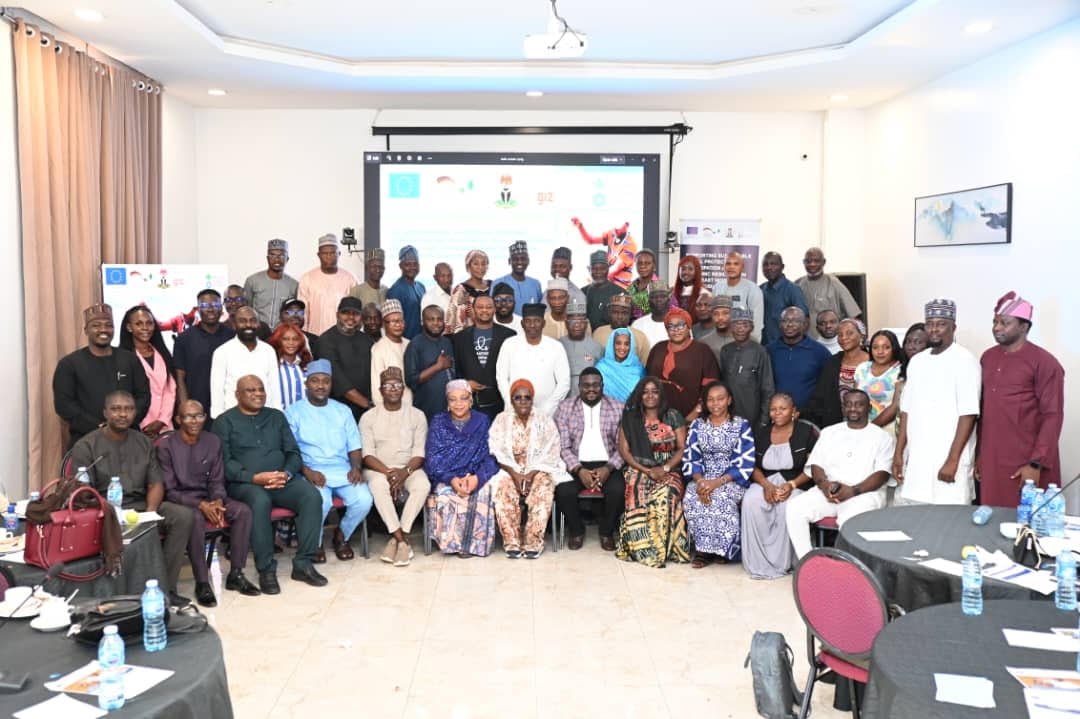
The European Union (EU), Germany and development partners have called for stronger coordination, knowledge sharing and evidence-based implementation of social protection programmes in Nigeria to ensure that poor and vulnerable households benefit from government interventions.
The call was made at the National Social Protection Knowledge and Learning Forum 2026, which opened in Abuja on Monday, with government institutions, development partners, humanitarian organisations, civil society groups, researchers and practitioners participating.
The three-day forum, organised with the support of the EU and the German government through the Deutsche Gesellschaft für Internationale Zusammenarbeit (GIZ) and Action Against Hunger Nigeria, is holding from November 23 to 25 under the theme, “From Strategy to Systems: Institutionalising Knowledge Management and Learning for Stronger Social Protection in Nigeria.”
The SEPIN SUSI Programme is commissioned by the German Federal Ministry for Economic Cooperation and Development (BMZ), co-funded by the European Union and implemented by GIZ and Action Against Hunger Nigeria, with technical support from Internationale Development Stories (IDS).
Speaking at the event, the Head of the National Social Register at the National Social Safety-Net Coordinating Office (NASSCO), Dr Mohammed Dikko Bala, said effective knowledge management was necessary to ensure that experiences, findings and operational procedures developed by institutions were properly documented, shared and utilised.
Bala said several institutions in the social protection sector had developed systems, standard operating procedures and other valuable resources, but much of the information remained within individual organisations without adequate dissemination.
He said, “We have done a lot of work and most of this work sometimes ends up in our laptops. Knowledge management involves sharing key findings, activities and standard operating procedures developed in the social protection sector.
“We need to share all these with the general public and the world. Particularly, with the National Social Register, the product is there. How do we enhance its utilisation? What is its composition, and of what value is it to the country and the social protection sector?”
He commended GIZ, UNICEF and the EU for bringing together stakeholders from different parts of the country to exchange experiences and strengthen knowledge management in the sector.
According to him, the forum will also enable participants to learn how digital platforms can be used to store, access and apply institutional knowledge, including data and operational systems.
Bala expressed optimism that participants would transfer the knowledge acquired to their respective ministries, departments and agencies to strengthen social protection delivery across the country.
Also speaking, the Executive Secretary of the Adamawa State Health Insurance Agency, Dr Ujulu Amos Peter, said the EU and German government’s technical and financial support had helped the state develop a coordinated social protection framework.
Peter, who spoke on behalf of the Adamawa State Government, said social protection interventions in the state were previously implemented by different actors without an effective coordination mechanism.
He said the support had enabled the state to develop its social protection policy, law and implementation framework, bringing together interventions such as social health insurance and conditional cash transfers.
“Before this intervention, several actors in the social protection space were intervening in isolation. But with this support, it has helped the state to coordinate social protection interventions, ranging from social health insurance, conditional cash transfers and other key stakeholders,” he said.
He added that the harmonisation of interventions would ensure that poor and vulnerable residents benefited more effectively from the state’s social protection policy and law.
Peter further said the initiative would benefit communities affected by insurgency in Adamawa and Borno States, particularly internally displaced persons and returnees who had lost their homes and livelihoods.
According to him, the intervention under the SUSI Saving Project would help improve their livelihoods, quality of life and productivity while strengthening government efforts to sustain social protection programmes.
Similarly, the Communications Manager of the National Cash Transfer Office, Shikfu Shiman, described the forum as timely, saying the absence of a central platform for documenting and communicating social protection interventions had contributed to public concerns about the programmes.
He said although different social protection interventions were being implemented across the country, information about their progress, beneficiaries and impact was not adequately available to the public.
“Pocket implementations on social protection are happening across the country, but there is no central location where all these progress reports and stories reside. This is why the Nigerian public is complaining. They have been hearing about numbers, but they are not seeing faces,” he said.
Shiman said a structured knowledge management system would make it easier to document beneficiaries’ experiences, establish who was benefiting from interventions and assess their outcomes over time.
Addressing concerns about the selection of beneficiaries under the Federal Government’s cash transfer programme, he explained that beneficiaries were drawn from the National Social Register, which comprises state social registries of poor and vulnerable households.
He said registration was community-driven, with communities identifying households considered eligible for inclusion in the register.
However, he clarified that being listed in the National Social Register did not automatically qualify an individual for every government intervention, as each programme had specific eligibility requirements.
“For the cash transfer, there is an eligibility criterion, and that criterion is what is used to identify and implement the programme. So, if you don’t fall within that criterion, you cannot benefit even if you are in the social register,” he said.
Shiman explained that the register was integrated with the National Identification Number (NIN), geographical coordinates of beneficiaries’ residences and financial identity details to improve verification and accountability.
On the impact of the cash transfer programme, he said beneficiaries received N75,000 in three instalments of N25,000 each over three months to cushion the effects of economic hardship.
He, however, distinguished between immediate outcomes and long-term impact, noting that the latter required sustained assessment over a longer period.
Giving an example, Shiman said a beneficiary in Adamawa State had used the support to pay the school fees of five children at N3,000 each, demonstrating how the intervention could ease household financial pressures.
He also cited the experience of small business operators, including point-of-sale operators, who could use the funds to improve their liquidity and increase their earnings.
He urged journalists to focus more on the experiences of beneficiaries rather than relying solely on information provided by implementing agencies.
“We really want to promote storytelling from the beneficiaries, not from the programme. At any point or in any state where you want to know, we will provide the contacts of state programme managers who can take you to where these beneficiaries live so you can ask your questions directly,” he said.
The forum is also expected to formally inaugurate the Adamawa and Borno State Social Protection Communities of Practice to strengthen professional exchange and institutional learning.
Participants are equally discussing measures to reactivate the National Social Protection Community of Practice, inaugurated by the Federal Government in September 2023.
The forum will showcase governance instruments, operational frameworks and knowledge products developed under the programme, while examining how digital repositories and evidence-based decision-making can improve social protection delivery.
A proposed Abuja Declaration on Knowledge, Learning and Evidence for Social Protection in Nigeria is also expected to provide a framework for renewed commitments by government institutions and development partners to strengthen collaboration and institutional learning.
WATCH TOP VIDEOS FROM NIGERIAN TRIBUNE TV