

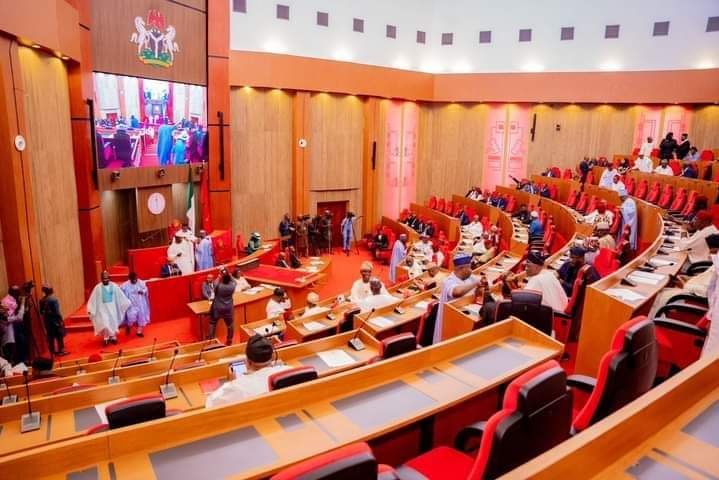
The Senate on Wednesday demanded justice and compensation for 37 young artisanal miners who died in the custody of the Nigeria Security and Civil Defence Corps (NSCDC) in Minna, Niger State, urging President Bola Tinubu to ensure the full implementation of the recommendations of the Federal Government’s investigative committee on the tragedy.
It also called for appropriate sanctions against officers found culpable and comprehensive reforms within the NSCDC to prevent a recurrence. The Senate further resolved to constitute a delegation, to be led by the President of the Senate, Godswill Akpabio, or his nominee, to pay a condolence visit to the bereaved families.
The resolutions followed the adoption of a motion moved by Senator Sani Musa and other senators from the North-Central region.
Recall that the 37 young men died on September 17, 2026, while in the custody of the Niger State Command of the NSCDC following their arrest during operations against suspected illegal mining activities.
Musa told the Senate that the incident raised serious concerns about detention conditions, the protection of fundamental human rights and the responsibility of security agencies to safeguard the lives of persons in their custody.
The Red Chamber recalled that the Federal Government had constituted a 10-member independent investigative committee to establish the circumstances surrounding the deaths, determine responsibility and recommend appropriate disciplinary and administrative measures.
It noted that the committee had submitted its report, identifying serious lapses and recommending sanctions, institutional reforms and financial compensation for the families of the deceased and other affected persons.
The lawmakers expressed concern that any delay in implementing the recommendations, particularly the payment of compensation, could prolong the suffering of the bereaved families and undermine public confidence in the government’s commitment to justice and accountability.
Speaking on the issue, Senator Ned Nwoko (APC, Delta-North) described the incident as a national tragedy, insisting that the circumstances surrounding the arrest of the victims should not diminish the value attached to their lives.
He said, “However, the fact that some of these young men may have been involved in illegal activities should not mean that their lives are not valued.”
Drawing parallels with incidents in oil-producing communities in the South-South, Nwoko said young people involved in illegal activities in those areas had also reportedly lost their lives during security operations, adding, “Life is life, regardless of the circumstances. We should be consistent in how we respond to such incidents.”
For his part, Akpabio commended Musa for bringing the matter before the chamber, noting that the incident had attracted considerable public attention. He also acknowledged Tinubu’s intervention in setting up the investigative committee, stressing that its report must not be ignored.
The Senate consequently directed relevant committees, particularly those on Solid Minerals, Interior, Human Rights, Police Affairs and Judiciary, to exercise oversight over the implementation of the recommendations and report progress to the chamber.
However, the debate took another dimension when Senator Adams Oshiomhole called for an additional resolution condemning illegal mining and urging traditional rulers, state governments and local government authorities to sensitise their communities against the practice.
Oshiomhole argued that while the Senate was concerned about the circumstances surrounding the deaths, it was important to make clear that illegal mining remained an offence punishable under the law.
He noted, “Illegal mining is a crime. It is an attempt to divert the country’s resources into private pockets, and anyone involved must face the consequences of the law.”
The additional prayer, seconded by Senator Solomon Lalong (Plateau South), was subsequently adopted.
However, Akpabio, while clarifying the chamber’s position, stressed that the deceased were entitled to the presumption of innocence under the law, as none had been convicted of any offence.
“The Nigerian law presumes every person innocent until proven guilty. That is the most important point here”, he said, adding, “If they had been prosecuted, they would have had the opportunity to defend themselves. Unfortunately, they died under circumstances that are tragic and questionable.”
WATCH TOP VIDEOS FROM NIGERIAN TRIBUNE TV