

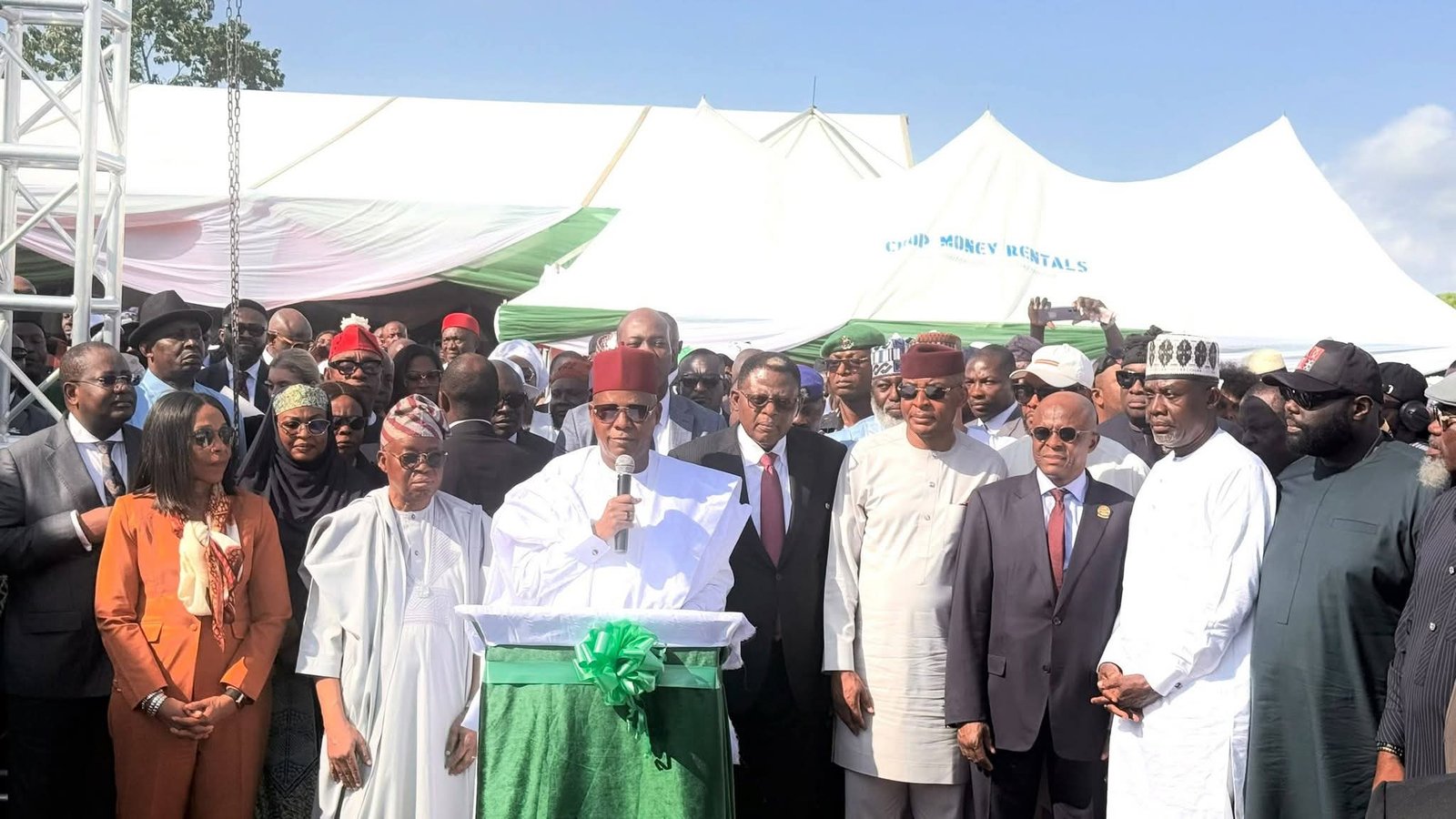
President Bola Ahmed Tinubu has performed the groundbreaking ceremony for the Bakassi Deep Seaport in Ikang, located in Bakassi Local Government Area of Cross River State.
The project aims to enhance Nigeria’s maritime capabilities, promote international trade, draw in foreign direct investment, and encourage industrialisation and economic diversification.
Vice-President Kashim Shettima, who represented President Tinubu at the groundbreaking ceremony in Bakassi, described the proposed $3.5 billion Bakassi Deep Seaport in Cross River State as a strategic national investment capable of expanding Nigeria’s maritime trade, easing pressure on existing ports and positioning the country as a major gateway for regional commerce.
Shettima said the project would help establish an eastern maritime economic corridor, connecting Nigeria’s South-South, South-East, Middle Belt and North-East regions to international markets.
He said the concentration of Nigeria’s maritime trade infrastructure along the western corridor had constrained the country’s capacity to maximise its economic potential, stressing that the new port would promote a more balanced distribution of trade and logistics activities.
According to him, the project is not intended to compete with Lagos but to complement existing maritime infrastructure and reduce congestion in the nation’s ports.
“Lagos is not our enemy. Lagos is our elder brother in trade. No country eats with one hand; no country carries all its loads on one shoulder. That shoulder will break when over 80 per cent of our foreign trade flows through Lagos and Lagos alone,” he said.
The Vice-President added that the concentration of cargo activities had contributed to shipping delays and increased the cost of goods in markets across the country.
He said the Bakassi port, when completed, would create opportunities for employment, industrialisation, investment and lower transportation costs, while opening new trade routes for agricultural produce, solid minerals and manufactured goods.
Shettima identified cocoa from Ekum, rice from Ogoja, timber and other solid mineral resources as some of the products that could benefit from the improved maritime infrastructure.
He further described the project as a potential poverty-reduction initiative, noting that its operations would generate employment for crane operators, truck drivers, welders, engineers, customs officers, hotel workers, traders and other service providers.
The Vice-President said Nigeria’s strategic position in the Gulf of Guinea, coupled with its extensive coastline and economic influence in West Africa, presented enormous opportunities for the country to strengthen its position in global maritime commerce.
He also urged the people of Bakassi and Cross River State to protect the project from political interference and rumours, describing it as an opportunity to reposition the state after years of economic and territorial challenges.
Earlier, Governor Bassey Otu said the project, conceived by a previous administration, had encountered political, administrative, legal and environmental challenges before the Tinubu administration facilitated its final federal approvals.
Otu disclosed that the state government had completed several preparatory processes, including the environmental impact assessment and hydrographic, geotechnical and geophysical surveys, as well as securing the Federal Executive Council’s third approval for the project, with an initial funding commitment of $2.27 billion.
He explained that the project would be executed under a public-private partnership arrangement, adding that the groundbreaking marked a significant step towards positioning Cross River as a competitive maritime and blue economy hub.
The governor said the acquisition of the technical survey reports had provided the baseline for the development of the port and qualified the state to participate in the international Seabed 2030 initiative, which seeks to map the world’s ocean floor.
He also disclosed that the Federal Government had officially retired the 1903 navigational charts previously used to define maritime routes around Cross River State and the Gulf of Guinea, adopting new charts based on modern scientific surveys on October 1, 2026.
According to him, the development has further strengthened the state’s maritime and territorial position.
Otu said some Cross River indigenes were already undergoing specialised training to acquire the technical skills required for the construction and eventual operation of the port, with a view to transferring the knowledge to other residents.
He identified the proposed Lagos-Calabar Coastal Highway, the state’s airport and the deep seaport as three strategic economic gateways that would enhance the state’s competitiveness and facilitate the movement of goods and services.
The governor called on local and international investors, particularly those involved in maritime logistics, shipping, fishing, shipbuilding and other ancillary services, to take advantage of the investment opportunities offered by the project.
In his remarks, the President and Chairman of the Board of Directors of the African Export-Import Bank (Afreximbank), Dr George Elombi, said the $3.5 billion project had the potential to strengthen Nigeria’s eastern maritime corridor and facilitate trade with neighbouring economies in West and Central Africa.
Elombi, who was represented by Mrs Kanayo Awani, said Afreximbank was serving as the mandated lead arranger and financial adviser to the transaction, helping to structure an investable public-private partnership, address early-stage risks and mobilise regional and international institutional capital.
He explained that the port would complement the African Continental Free Trade Area (AfCFTA) by providing the infrastructure needed to connect African producers, processors and businesses to regional and international markets.
The bank’s representative stressed that the success of the project would depend on complementary infrastructure, including the proposed Cross River Superhighway, industrial initiatives, free trade zone facilities, reliable electricity, efficient customs procedures and competitive logistics services.
The representative further called for strict adherence to environmental and social safeguards, particularly the protection of marine ecosystems, coastal communities and the long-term sustainability of the facility.
Meanwhile, the Hydrographer of the Federation, Rear Admiral Olumide Fadahunsi, said hydrographic surveys, navigational charts and other technical assessments were critical to the safe and efficient operation of the proposed port.
He disclosed that the agency had conducted hydrographic, geophysical and geotechnical surveys for the project and developed electronic navigational charts covering the maritime corridor.
He said the agency would continue to provide hydrographic services, charting and navigational support to ensure that the port met international safety and operational standards.
Also speaking, the Managing Director of the Nigerian Ports Authority, Dr Abubakar Dantsoho, said the facility would strengthen Nigeria’s access to international shipping routes and improve its capacity to serve landlocked countries, including Chad, Niger, Mali and Burkina Faso.
He noted that the four West African countries had a combined population of approximately 101 million people, representing a significant potential market for Nigerian maritime trade.
The Bakassi Deep Seaport is expected to serve as a major maritime gateway for Cross River State, Nigeria’s eastern corridor and the wider Gulf of Guinea, with stakeholders expressing optimism that its completion would stimulate trade, investment, industrial development and employment.
WATCH TOP VIDEOS FROM NIGERIAN TRIBUNE TV