

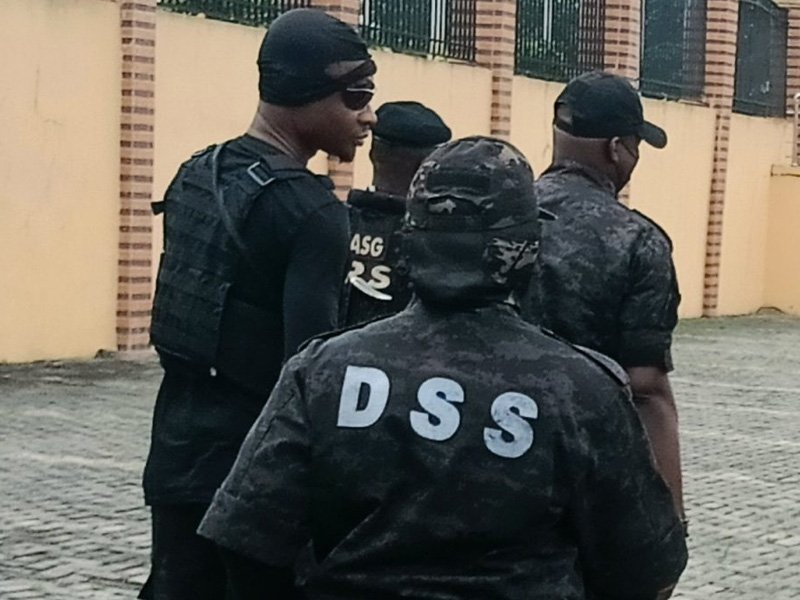
The investigator, who testified as the first prosecution witness, PW1, on Wednesday, told the Federal High Court in Abuja that the defendants allegedly abducted Owoh, took him to an Eastern Security Network, ESN, camp, where he was shot several times and buried in a shallow grave.
The defendants are Michael Okafor, also known as Onyechimeleze; Chinedu Chukwudozie, alias Kante; Chibunna Olisa; and Chigozie Olisa, also known as Ability.
The defendants, however, pleaded not guilty to the charges.
Led in evidence by prosecution counsel, Munirat Oladunjoye, the witness, identified by the codename AAA for security reasons, said he had worked with the DSS for about 17 years.
He told the court that investigations began in February 2022 after Owoh’s wife reported to the DSS Anambra Command that her husband had gone missing while travelling from Port Harcourt to Awka.
According to him, a technical analysis of the operative’s movements showed that he was last seen alive in Osomogu, Ihiala Local Government Area of Anambra State.
He added that Owoh’s Toyota Pontiac vehicle was also traced to the community.
The witness said the DSS subsequently collaborated with the military because the area was allegedly a stronghold of IPOB and ESN.
He disclosed that the operation led to the arrest of one Chinyere Okabue on June 20, 2026, whose arrest provided information that eventually led to the apprehension of the defendants.
According to him, Okafor, described as the principal suspect and an ESN sub-commander, was arrested on September 14, 2026, while the three other defendants were arrested on September 20.
Recounting the circumstances surrounding Owoh’s alleged murder, the witness said the operative had called his wife on February 23, 2022, informing her that he would be returning home to see their newborn baby.
He alleged that Okafor and his co-defendants intercepted Owoh, seized him and took him to their camp.
The witness further claimed that Chibunna Olisa drove Owoh’s vehicle into the camp, where the operative was detained until an ESN sub-commander identified as Double Lion allegedly directed Okafor to kill him.
“He was shot several times and buried in a shallow grave,” the witness told the court.
AAA also alleged that the four defendants had the ESN identification mark, 1414, on their bodies, claiming that the mark was given to them as a form of protection.
Following the allegation, Justice Abdulmalik directed the defendants to approach the court and remove their clothes one after another to enable the witness and their lawyers to inspect the marks.
The witness and defence lawyers, K.C. Ekwe and G.U. Oputa, reportedly confirmed the presence of the marks.
The DSS investigator further alleged that after Owoh was killed, Okafor converted the operative’s Toyota Pontiac vehicle to his personal use and gave his mobile phone to his girlfriend, Chinyere, as a gift.
He said the woman was granted administrative bail after investigators established that she was unaware of the alleged abduction and killing.
The witness also told the court that Okafor travelled to Cote d’Ivoire and later India, where he was allegedly involved in criminal activities before being deported around 2024.
He said that after returning to Nigeria, Okafor went into hiding and worked as a bricklayer in Azia, Ihiala Local Government Area, before his eventual arrest through an intelligence-driven operation.
The PW1 maintained that all four defendants voluntarily made statements to investigators in the presence of a lawyer from the Legal Aid Council.
He said they were informed of their right to remain silent and that anything they said could be used against them in court.
According to him, the statements were obtained in a relaxed, air-conditioned environment and were admitted in evidence after the defence lawyers raised no objections.
Justice Abdulmalik admitted the statements and marked them as Exhibit TWT-5 Series.
The judge adjourned the case until November 16 for the cross-examination of the witness and continuation of the trial-within-trial.
She warned that the defence lawyers risked forfeiting their right to cross-examine the witness if they failed to appear on the next adjourned date.