

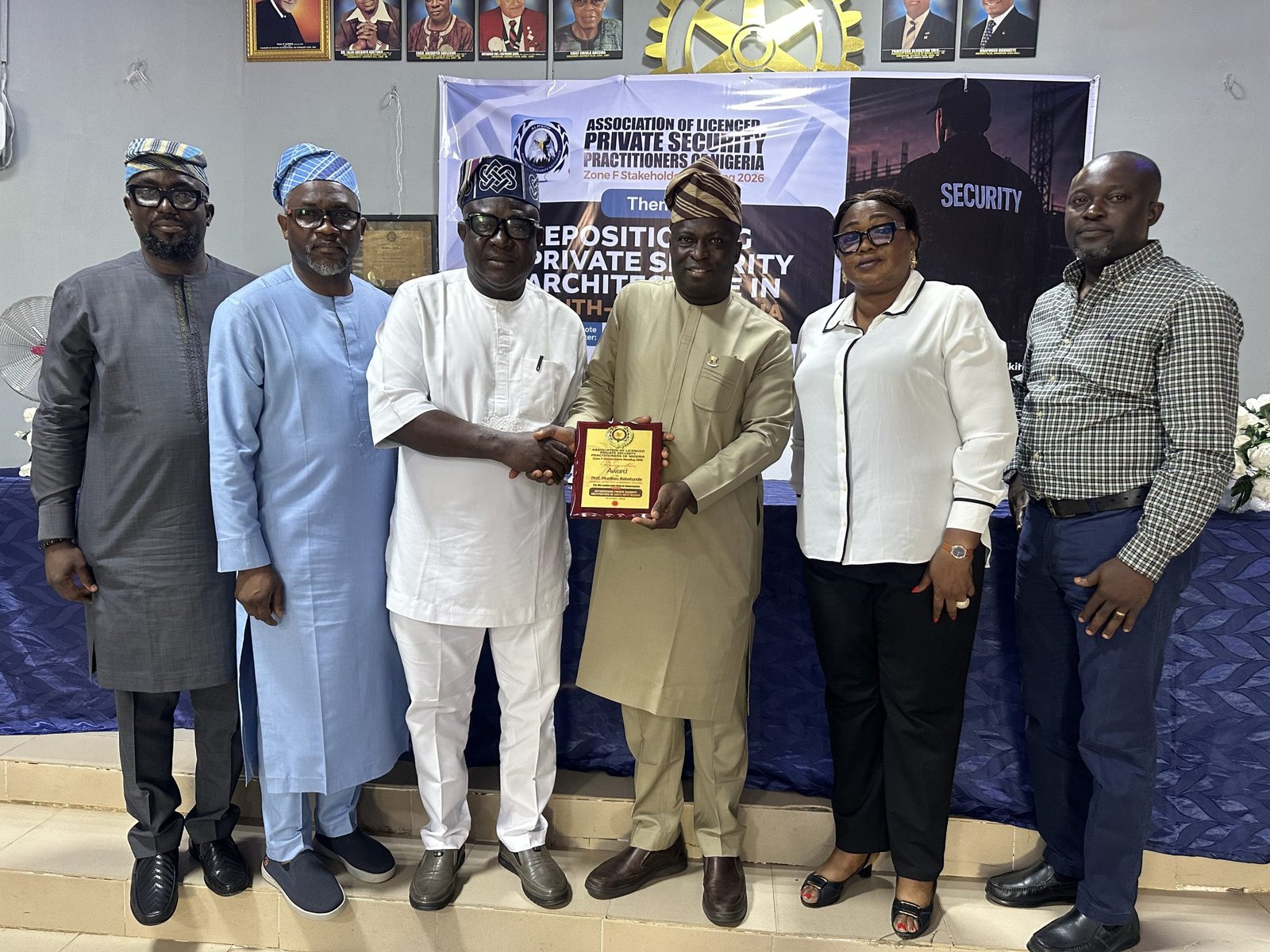
The Oyo State Government has reaffirmed its commitment to supporting private security practitioners through improved regulatory policies and stronger collaboration with conventional security agencies to address the country’s growing security challenges.
The Secretary to the Oyo State Government, Prof. Babatunde Musibau, stated this at the Association of Licensed Private Security Practitioners of Nigeria (ALPSPN), Zone F, stakeholders’ meeting held on Wednesday at Rotary House, Iyaganku, Ibadan.
The meeting, themed “Repositioning Private Security Architecture in South-West Nigeria,” brought together security practitioners, chief executives of private guard companies, and representatives of government security agencies to examine the industry’s contributions and explore ways of strengthening security operations across the region.
Musibau, who was the keynote speaker, said the increasing security challenges in Nigeria had made it imperative for public and private security practitioners to work together in creating a safer environment.
He described the meeting as timely, particularly as the country approaches another election period, when intelligence gathering, information sharing, and collaboration among security stakeholders would become increasingly important.
According to him, private security operators are strategically positioned to provide valuable intelligence that could assist conventional security agencies in identifying and addressing potential threats.
He assured the association of the state government’s readiness to support its aspirations and create a more enabling regulatory environment for private security companies to operate effectively across the South-West.
Earlier, the Zonal Chairman of ALPSPN, Zone F, and Ekiti State Chairman, Major Oluwafemi Awe (rtd.), said security remained a collective responsibility that should not be left exclusively to government and conventional security agencies.
Awe explained that private security companies played important roles in protecting individuals, corporate organisations, government establishments, shopping malls, and residential communities, while also serving as intelligence-gathering partners to major security agencies.
He noted that security operatives deployed across different establishments were strategically positioned to observe activities, identify suspicious movements, and provide useful information that could help prevent crimes and strengthen responses to emerging threats.
According to him, the meeting provided an opportunity for members across Oyo, Ogun, Ondo, Ekiti, and Osun states, which constitute Zone F, to assess their activities, strengthen cooperation, and review their responsibilities as the year draws to a close.
In his remarks, the Chairman of the Oyo State Chapter of ALPSPN, Mr. Seyi Alaba, stressed the need for unity, professionalism, and a stronger working relationship among private security practitioners and relevant government agencies.
Alaba said the meeting provided an important platform for addressing operational challenges confronting private security companies, sharing experiences, and developing practical approaches to improving service delivery across the South-West.
Earlier, the Oyo State Commandant of the Nigeria Security and Civil Defence Corps (NSCDC), CC Padonu Ayodeji, represented by the Head of Private Guard Companies, DCC Akande Akintayo, described private security practitioners as an essential component of Nigeria’s security architecture.
He said private security operatives constituted the first line of defence in homes, banks, schools, industries, worship centres, and residential estates, stressing that their contributions were critical to protecting lives and property.
The Commandant urged practitioners to move beyond numerical strength and prioritise quality, professionalism, and effective service delivery.
He identified training and retraining, personnel welfare, regulatory compliance, discipline, technology, and intelligence sharing as critical areas requiring attention.
According to him, no security operative should be deployed without adequate training in intelligence gathering, customer relations, emergency response, and professional ethics.
He also stressed the importance of improving workers’ welfare, including remuneration and insurance, noting that poorly motivated personnel could become vulnerable to compromise.
In his paper presentation, Mr. Samson Akindele described the media as a critical partner in building public confidence in the private security industry.
He noted that negative perceptions, inadequate public awareness, and the activities of unlicensed operators had continued to affect the image of legitimate practitioners.
Akindele identified six major responsibilities of the media in strengthening the industry: public education and agenda setting, image building, watchdog functions, stakeholder engagement, early warning and crisis communication, as well as advocacy for improved policies and personnel welfare.
The association also honoured Akindele for his contributions to promoting security awareness through his media platform.
WATCH TOP VIDEOS FROM NIGERIAN TRIBUNE TV