

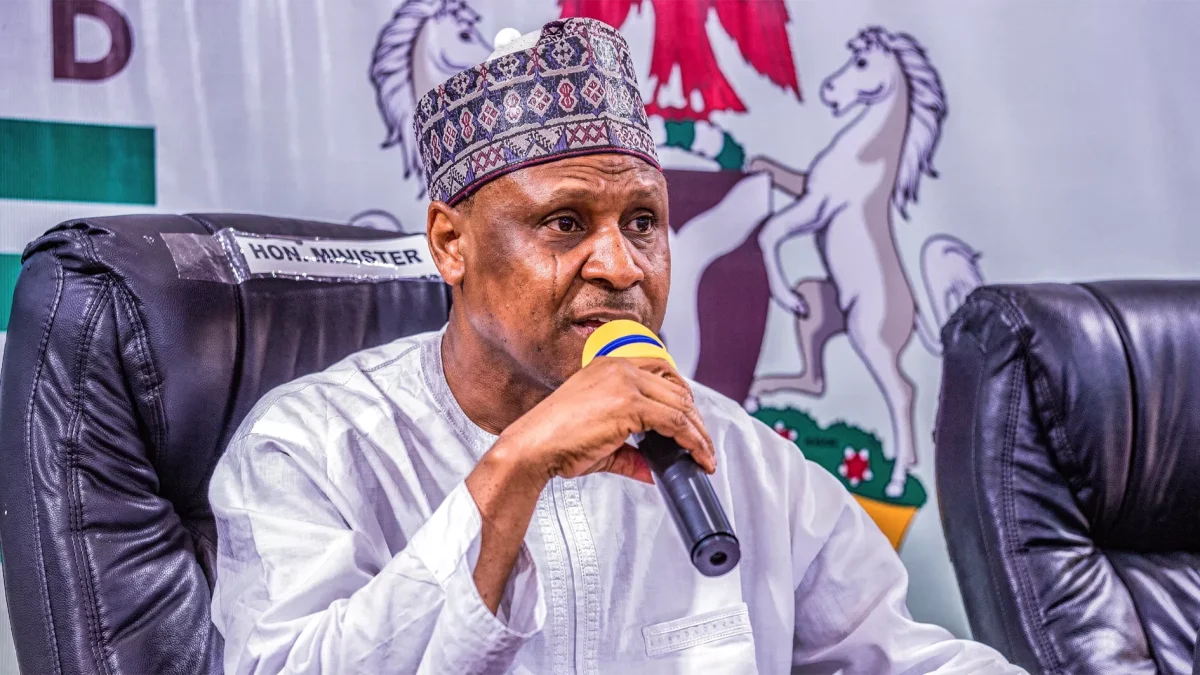
The Minister of Information and National Orientation, Mohammed Idris, has said the economic reforms introduced by President Bola Tinubu’s administration are beginning to benefit Nigerians, citing improvements in security, education, infrastructure and economic performance.
Idris stated this on Tuesday in Abuja during the media presentation of the All Progressives Congress (APC) 2027 Presidential Election Manifesto.
He said the reforms were laying the foundation for national prosperity, adding that the administration’s priority over the next four years would be to ensure that more Nigerians felt their impact.
The minister cited the Federal Government’s student loan scheme, which has supported 1.6 million students through the Nigerian Education Loan Fund (NELFUND), improved security and Nigeria’s removal from the Financial Action Task Force (FATF) grey list as evidence of progress.
He also pointed to improved international credit ratings, declining inflation and economic growth as indications that the economy was responding to the government’s policies.
“People often ask who is benefiting from the reforms. But when roads are built, everyone can use them. When security improves, everyone benefits.
“The 1.6 million Nigerian students supported through NELFUND are ordinary Nigerians, and they do not have to belong to any political party to benefit. These reforms are for all Nigerians,” he said.
Idris urged the media to continue holding the government accountable while giving adequate attention to positive developments, stressing that responsible journalism should reflect both the country’s progress and its challenges.
He maintained that journalists had a responsibility to criticise government policies where necessary but should also acknowledge achievements in the national interest.
Also speaking, the Chief of Staff to the President, Femi Gbajabiamila, described the APC’s 2027 presidential manifesto as a bold and ambitious document reflecting Tinubu’s determination to undertake difficult reforms for the country’s long-term development.
Gbajabiamila, who is also the Deputy Director-General (Administration) of the APC Presidential Campaign Council, said the manifesto represented a commitment between the ruling party and Nigerians.
He suggested that the document should have an additional title, From Reforms to Posterity: The Audacity of Tinubu, arguing that the President had demonstrated leadership by taking difficult decisions rather than prioritising immediate political gains.
According to him, Tinubu chose to address longstanding economic challenges, including petrol subsidy and foreign exchange distortions, despite the immediate consequences for households.
He, however, acknowledged that the reforms had imposed significant hardship on Nigerians, insisting that the government must ensure that the opportunities created by the policies translated into tangible improvements in citizens’ living conditions.
“The President had a choice. He could either govern as a politician or govern as a leader. There is an inherent difference between the two.
“The difference between a politician and a leader is that whereas the politician thinks about the next election, a leader thinks about the next generation. That’s exactly what President Bola Ahmed Tinubu did,” he said.
Gbajabiamila disclosed that the manifesto contained specific targets, including reducing the number of out-of-school children by 50 per cent by 2031, installing seven million additional electricity meters and expanding health insurance coverage.
He said the commitments were anchored on four pillars covering national security; affordable living; energy and infrastructure development; economic growth; and accountable governance.
Using agriculture as an example, he explained that improved security, storage facilities and transportation infrastructure must work together to increase farmers’ productivity, improve their earnings and reduce food prices.
He further described the manifesto as a social contract that would enable Nigerians to assess the party’s performance through measurable targets, identified responsibilities and regular public reporting.
The Chief of Staff urged Nigerians, including those unconvinced by the administration’s policies, to examine the manifesto and hold the government accountable for its promises.
In his remarks, the Minister of Solid Minerals Development, Dele Alake, described the APC as an organised political party with a clear development agenda.
Alake said the Tinubu administration had embarked on comprehensive structural reforms across different sectors, arguing that the scale and depth of the interventions distinguished it from previous civilian administrations.
Similarly, the Minister of Budget and Economic Planning, Atiku Bagudu, said the President’s reform agenda was driven by a long-term vision to transform Nigeria into a $2 trillion economy.
He acknowledged that more needed to be done to ensure that economic growth translated into improved living conditions, particularly for vulnerable citizens and hardworking households.
The Minister of Industry, Trade and Investment, Jumoke Oduwole, who presented an overview of the manifesto, identified its four strategic pillars as a secure and resilient nation; an improved and affordable quality of life; energy, infrastructure and economic growth; and effective and accountable governance.
She highlighted the administration’s targets on food security, reduced living costs, increased domestic production, export expansion and job creation.
Oduwole said the government was targeting the creation of one million export-linked jobs for young Nigerians by 2030, alongside measures to strengthen local industries and expand Nigeria’s participation in international trade.
She added that the administration wanted Nigerians to experience the benefits of structural reforms and economic growth by 2031 through improved security, increased food production and expanded economic opportunities.
The event, attended by civil society representatives, sector experts, journalists and other stakeholders, provided an opportunity for the APC to outline its policy priorities and commitments for the 2027–2031 period.
The party said the manifesto would serve as a framework for assessing its performance and holding the government accountable if returned to power in 2027.
WATCH TOP VIDEOS FROM NIGERIAN TRIBUNE TV