

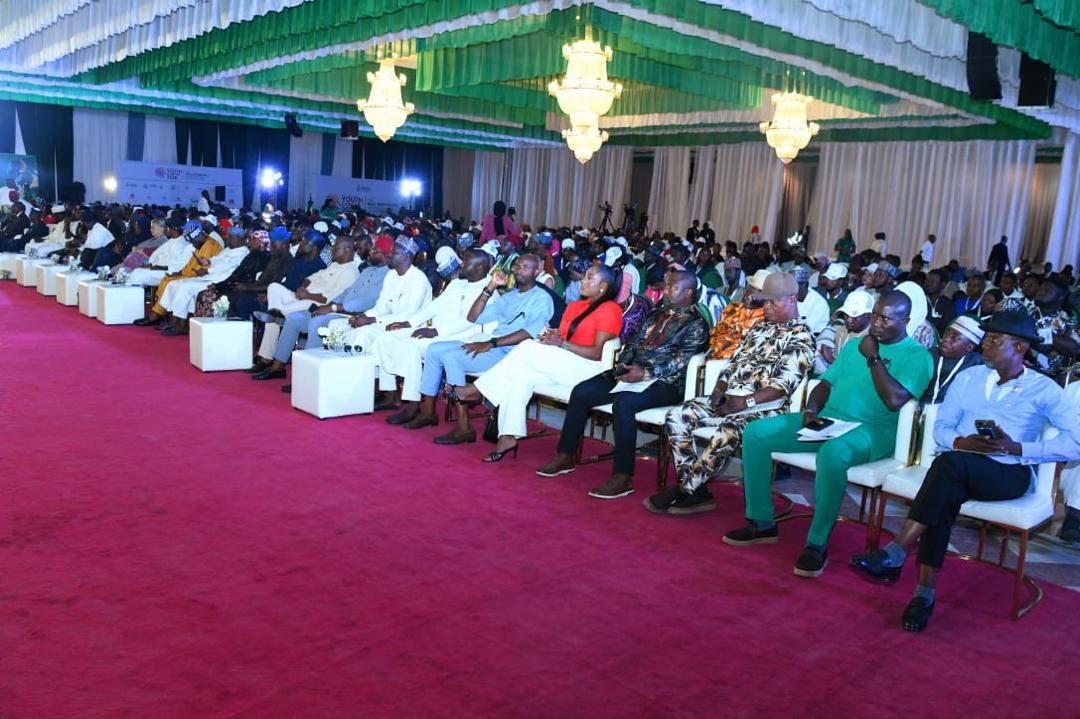
President Bola Ahmed Tinubu has directed the Federal Ministry of Youth Development to immediately commence the implementation of recommendations from the 2026 National Youth Conference, insisting that the resolutions must translate into concrete government actions with clear timelines and measurable results.
The President also demanded the active participation of young Nigerians in implementing and monitoring the recommendations, warning against allowing the outcome of the conference to become another government report without tangible impact.
Tinubu gave the directive on Monday at the closing ceremony of the National Youth Conference, held at the State House Conference Centre, Abuja, where he was represented by the Speaker of the House of Representatives, Rt. Hon. Abbas Tajudeen.
The conference, which brought together more than 291 delegates during its physical phase, alongside participants who took part in nationwide virtual consultations, produced an 18-point action agenda covering six thematic areas: governance, economic transformation, education, technology, climate change and social cohesion.
ALSO READ: 2027: APC achievements in Ebonyi will earn Tinubu votes — Shettima
Among the major recommendations adopted by delegates were the creation of a Ministry for Persons with Disabilities (PWDs), prompt payment of teachers’ salaries and gratuities, improved accessibility of schools for learners with disabilities, industry-recognised skills certification for tertiary students and stronger measures to address insecurity.
The delegates also recommended strengthening existing youth structures, introducing youth-inclusive frameworks across political parties and executive institutions, and establishing a youth-led framework for civic engagement, accountability and digital participation.
Under economic transformation, entrepreneurship and job creation, the conference adopted recommendations on strengthening military equipment, improving anti-terrorism laws and promoting peaceful farmer-herder relations through traditional rulers.
It also called for the establishment of a Ministry for Persons with Disabilities, to be headed by a person with a disability, or alternatively, a PWD-led department within the Ministry of Humanitarian Affairs.
On power supply, delegates recommended greater investment in alternative energy sources, particularly solar and wind energy, to improve electricity access in rural communities.
In the education sector, the conference called for the prompt payment of teachers’ salaries and gratuities, accessible schools and support systems for learners with disabilities, as well as industry-recognised skills certification for students in every tertiary institution.
The technology and digital transformation pillar produced recommendations for establishing platforms that would enable members of different constituencies to engage on technology and youth participation in government.
Other proposals included empowering existing government agencies and parastatals to facilitate technological development and ensuring universal digital literacy through accessible digitalisation.
On climate change and energy transition, delegates advocated affordable and reliable renewable energy for underserved communities, investment in sustainable drainage and flood-control infrastructure, and stronger forest protection through afforestation and reforestation programmes.
Under social cohesion and security, the conference also recommended the effective utilisation of Nigeria’s abundant natural resources to promote job creation and strengthen small and medium-scale enterprises through the development of national and localised manufacturing refineries.
The recommendations were adopted following voting by delegates across the six thematic groups, with reported participation levels ranging from 74.8 per cent to 80.1 per cent in the respective voting sessions.
In his directive, President Tinubu instructed the Minister of Youth Development, Comrade Ayodele Olawande, to work with relevant ministries, departments and agencies, state governments, the private sector and development partners to develop a practical implementation framework.
He said the framework must contain clear priorities, assigned responsibilities, realistic timelines and measurable indicators of progress.
“The real test of this Conference begins after today. I do not want the recommendations of this Conference to become another report gathering dust on government shelves. I want them to become a guide for action,” the President declared.
“You must not be invited to the table only when decisions are being discussed. You must also have a place at the table when those decisions are being implemented,” he stated.
Acknowledging the economic and social challenges confronting Nigerian youths, Tinubu said his administration understood their concerns about unemployment, the cost of living, access to education, business opportunities and insecurity.
He maintained that the government’s investments in education, skills development, innovation and entrepreneurship were designed to expand opportunities for young Nigerians.
Highlighting initiatives such as the Nigerian Education Loan Fund, the Three Million Technical Talent programme, YouthCred and the Nigerian Youth Academy, the President stressed the need to ensure that skills acquisition translated into employment, innovation attracted investment and young entrepreneurs gained improved access to finance.
Earlier, the Minister of Youth Development, Comrade Ayodele Olawande, disclosed that the conference had produced a comprehensive 18-point action agenda covering six priority areas following nationwide virtual consultations and physical deliberations involving youth representatives from across the country and the diaspora.
Olawande described the conference as a major milestone in efforts to strengthen youth participation in national decision-making, assuring delegates that the ministry would work to translate the recommendations into policies, programmes and opportunities.
“For the first time in the history of this country, the youth can feel the government, see the government, and touch the government,” the minister declared.
He explained that the recommendations would be pursued through relevant executive, legislative and judicial channels to ensure they received the necessary institutional attention.
Delivering the keynote address, the Minister of Finance and Coordinating Minister of the Economy, Taiwo Oyedele, challenged young Nigerians to play more active roles in shaping the country’s economic future and strengthening confidence in Nigeria’s investment potential.
He warned that negative perceptions and distorted narratives could discourage investment, undermine economic confidence and ultimately deny young Nigerians employment and business opportunities.
“A factory that is not built means jobs that are not created,” he said, urging delegates to embrace constructive engagement, innovation and practical solutions to national challenges.
Oyedele emphasised the need to translate economic progress into tangible benefits for citizens through increased investment, production, job creation and shared prosperity.
The National Youth Conference was convened by the Tinubu administration to provide a platform for young Nigerians across the country and the diaspora to deliberate on critical national issues and develop recommendations for strengthening youth participation in governance, economic development and nation-building.
WATCH TOP VIDEOS FROM NIGERIAN TRIBUNE TV