

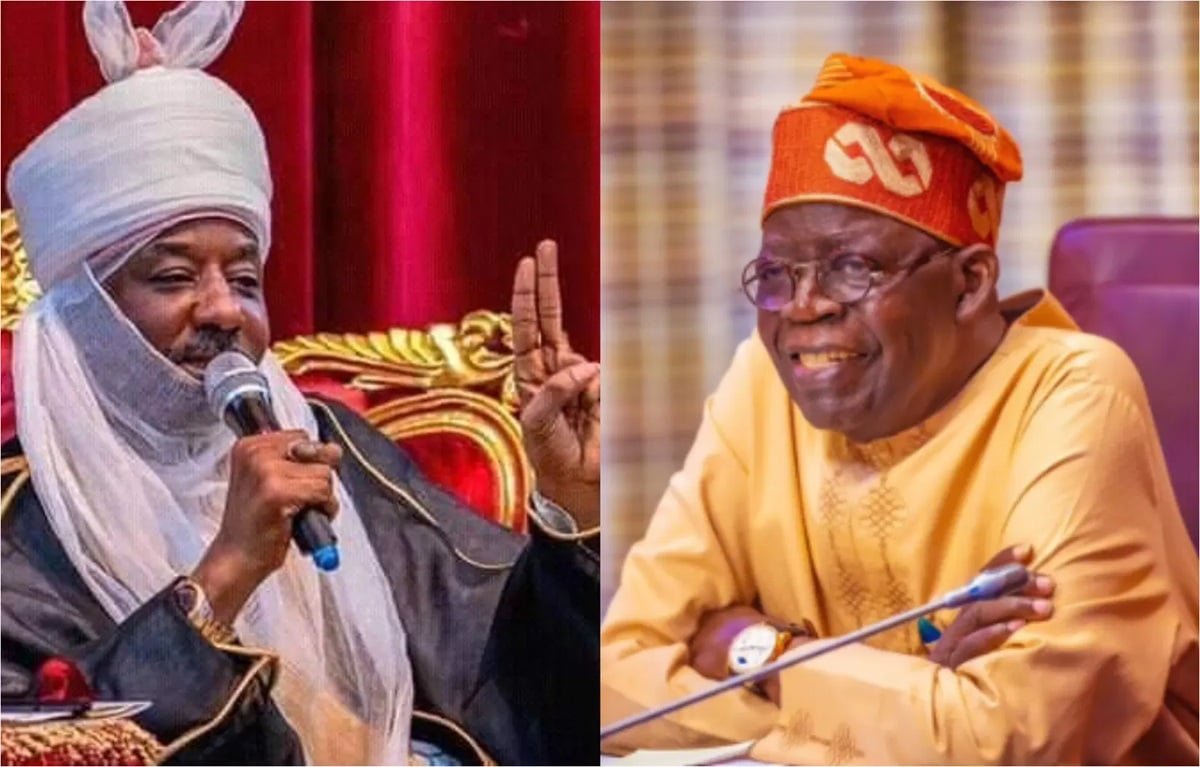
•Don’t consider every criticism an attack
•Reform must go beyond removing fuel subsidies, liberalising exchange rate, he insists
•Says reforms have produced measurable progress
THE Emir of Kano, Muhammadu Sanusi II, on Tuesday in Abuja X-rayed the economic reforms of President Bola Tinubu, urging the government to listen to constructive criticism, rather than treating every comment about poverty or hardship as an attack on the president.
The Emir spoke virtually, on Tuesday, to the audience at the Oxford Global Think Tank Leadership Conference, organised by the Oxford Global Think Tank.
The News Agency of Nigeria (NAN) quoted Sanusi to have raised concerns about the size of government expenditure, saying the country could not pursue fiscal consolidation while continuing to spend without restraint.
He said the World Bank had pointed out that in the first half of this year Nigeria’s debt service consumed 124 percent of federal government revenue.
He warned that the country needed to urgently address the sustainability of its debt and pursue structural reforms that had not yet been made.
Sanusi noted that reform must go beyond removing fuel subsidies and liberalising the exchange rate, describing it as a comprehensive package that needed to address many other areas.
ALSO READ: NYSC disowns certificate linked to ex-Minister Nnanji, cites four defects
He said government needed to make clear spending priorities, choosing between roads, electricity, agriculture and technology based on available resources.
He said every 10 billion dollars spent on roads was 10 billion dollars taken away from electricity and agriculture, stressing the need for deliberate choices.
He acknowledged that President Tinubu’s economic reforms have produced measurable progress, citing improvements in GDP growth, inflation and foreign reserves.
He said GDP growth has risen from an average of 0.9 percent under the previous administration to 4.5 percent, describing the change as progress that deserved recognition.
He added that inflation rate had dropped from over 30 percent to 14.6 percent, with projections of 12.5 percent by next year, and foreign reserves had grown to 55 billion dollars.
“I think moving from an average growth rate of 0.9 per cent to 4.5 percent is progress. Moving from inflation of over 30 percent to 14.5 percent is progress
“Moving from the point where in 2023 the central bank’s reserves were maybe negative to where we are now having reserves of $55 billion is progress,” he said.
The emir said issues such as poverty, hunger, maternal mortality, malnutrition, education and healthcare remained serious concerns that the reforms has not yet addressed.
He said the government should have designed social safety net policies to soften the impact of reforms on vulnerable Nigerians from the beginning.
Sanusi also called for more women to be brought into the centre of governance and decision-making, saying they were largely excluded from government at all levels.
He said issues such as maternal health, malnutrition and early child development were areas women understood and lived with, making their inclusion in policy-making essential.
The emir said Nigeria needed to move away from an `us-versus-them` mentality, urging both the government and citizens to see each other as partners rather than enemies.
He said if the government focused on fixing power supply, increasing agricultural productivity and investing in technology, it could add significant points to economic growth.
On public criticisms of government policies and programmes, Sanusi said: “It’s not every time people talk about poverty or talk about difficulty that they’re just enemies of the government or making an attack on the president
“That is not how to respond to economic distress,” he said.
WATCH TOP VIDEOS FROM NIGERIAN TRIBUNE TV