

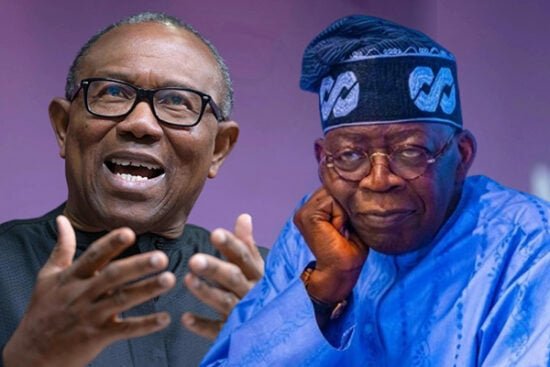
The presidential candidate of the Nigeria Democratic Congress (NDC), Peter Obi, has accused President Bola Tinubu of lacking the competence and commitment to address Nigeria’s economic and security challenges, alleging that his administration has pushed millions of Nigerians into extreme poverty.
Obi, in a statement posted on his Facebook page, also accused the All Progressives Congress (APC)-led Federal Government of presiding over corruption, rising insecurity, unemployment and declining productivity despite the removal of the petrol subsidy and increased government borrowing.
The former Anambra State governor made the allegations after the inauguration of the NDC National Campaign Council in Abuja on Monday, October 26, as the party prepares for the 2027 general elections.
He said more than 140 million Nigerians were multidimensionally poor, representing over 60 per cent of the population, and accused Tinubu of worsening the country’s economic difficulties since assuming office in 2023.
“President Tinubu does not have the competence, the capacity, the character, compassion or the commitment to solve the problems he created. He lacks the energy and the resolve to get Nigeria out of the current worsening crisis,” Obi said.
He further alleged that about 16 million Nigerians had been pushed into extreme poverty in the current year, describing the situation as evidence of the administration’s failure to translate its economic policies into improved living conditions.
Obi’s remarks followed Tinubu’s re-election campaign launch in Kaduna last Saturday. The NDC candidate alleged that the President blamed past administrations and opposition leaders for the hunger and poverty facing Nigerians.
Obi also criticised the government over the country’s electricity supply, saying unreliable power continued to affect businesses, healthcare delivery, education and household welfare.
ALSO READ: Tinubu’s petrol discount political optics, not sound policy – Peter Obi
He promised that an NDC administration would pursue electricity reforms focused on reliability, affordability, investment and accountability. He said the government would work with relevant federal and state institutions, regulators, operators and investors to address challenges in power generation, transmission and distribution.
On corruption, Obi alleged that the practice had become more widespread under the Tinubu administration, claiming that no state institution had been spared since 2023.
He cited the governance philosophy of Singapore’s founding Prime Minister, Lee Kuan Yew, on the need to thoroughly address corruption across the political system and all levels of the bureaucracy.
Obi said he would lead what he described as an unprecedented anti-corruption campaign if elected president in 2027, adding that the effort would require strong leadership, courage and integrity.
He also pledged to tackle insecurity, warning bandits and kidnappers that criminal activities would attract decisive consequences under an NDC-led government.
According to him, an amnesty offer to armed groups would take effect once the party’s victory was announced, while crimes committed after his administration’s inauguration would be met with decisive action.
“Using every lawful means necessary, we will identify the perpetrators and their sponsors, dismantle their criminal networks, and restore order, stability and freedom of movement,” he said.
Obi further promised to resettle internally displaced persons in their communities within the first two years of his administration and support them in rebuilding their livelihoods.
On agriculture, he said his government would prioritise agricultural transformation and industrial growth after restoring security, enabling farmers to return to their farms and supporting states and regions to develop products in which they have comparative advantages.
He said the proposed administration would establish processing facilities close to farming communities, promote smallholder farming and pursue an agrarian revolution to increase value addition, make food more affordable and boost agricultural exports.
Obi also pledged to develop Northern Nigeria into an agro-industrial hub, citing the region’s land resources and agricultural potential.
He said education and healthcare would be central to his administration’s development agenda, with plans to work with state governments to improve primary, secondary and technical education, train more teachers and provide better remuneration and welfare packages.
He added that targeted subsidies would be introduced in key sectors, including education, agriculture and energy, to support Nigerians and stimulate productivity.
The NDC candidate also promised to reduce the cost of living and lift Nigerians out of poverty, arguing that the country’s natural resources must be managed more effectively to improve citizens’ welfare.
Obi urged party members and Nigerians across the country to support the NDC and its presidential ticket with former Kano State governor, Rabiu Musa Kwankwaso.
He said the party envisioned a united and productive Nigeria founded on fairness, justice and equity, with security, good governance and accountability as key priorities.
WATCH TOP VIDEOS FROM NIGERIAN TRIBUNE TV