

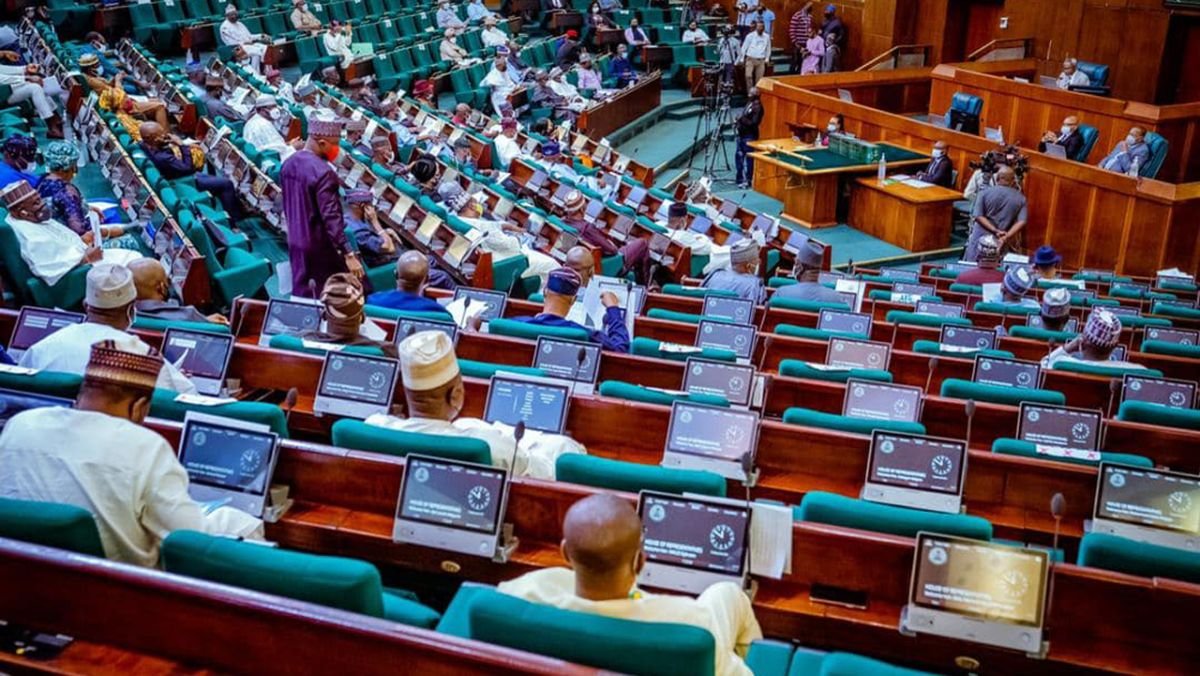
The Deputy Chairman of the House of Representatives Committee on Media and Public Affairs, Hon. Phillip Agbese, on Monday disclosed that the National Assembly was awaiting formal resolutions from state Houses of Assembly after 25 states endorsed the constitutional amendment to establish state police.
Agbese said the National Assembly had commenced the process of receiving and collating the resolutions from the state legislatures.
He told Tribune Online in an exclusive interview that the approval by the required number of state assemblies represented a significant milestone in the constitutional amendment process, adding that the National Assembly would proceed to the next stage once the Clerk to the National Assembly had authenticated the resolutions.
“Now that the required two-thirds of State Houses of Assembly have approved the Constitution (Sixth Alteration) Bill, 2026, the National Assembly is in the process of receiving and collating the formal resolutions from the states,” he said.
He added that the bill would be transmitted to President Bola Ahmed Tinubu for assent once the constitutional requirement had been formally confirmed.
“Once the Clerk to the National Assembly authenticates that the constitutional threshold has been duly met, the Bill will be transmitted to President Bola Ahmed Tinubu for assent in line with Section 9 of the Constitution,” Agbese stated.
The 25 states that have so far endorsed the legislative framework are Adamawa, Ogun, Delta, Plateau, Kwara, Edo, Osun, Oyo, Rivers, Zamfara, Abia, Akwa Ibom, Anambra, Bayelsa, Benue, Cross River, Ekiti, Enugu, Gombe, Imo, Kaduna, Nasarawa, Taraba, Yobe and Kebbi.
Under Section 9(2) of the 1999 Constitution, a constitutional amendment requires the support of at least two-thirds of the members of each chamber of the National Assembly and approval through resolutions of the Houses of Assembly of not fewer than two-thirds of the 36 states, equivalent to 24 states.
Agbese described the development as a major step towards restructuring Nigeria’s policing architecture, which has been dominated by the Nigeria Police Force under the Federal Government.
“This is a critical and irreversible step forward,” he said, stressing that the proposed reform was intended to bring policing closer to communities and improve responses to security threats.
He, however, noted that the constitutional amendment was only one part of the process, as the Presidential Working Group was continuing work on the accompanying National Policing Bill, which would establish the operational framework for the proposed dual policing system.
“Alongside this, the Presidential Working Group continues its work on the accompanying National Policing Bill, which will provide the detailed operational framework, standards and safeguards for the dual policing system,” the deputy spokesman said.
Agbese reaffirmed the commitment of the House leadership to completing the reform process, expressing optimism that the proposed arrangement would strengthen community-based security and make policing more responsive to the needs of Nigerians.
“We remain committed to seeing this reform completed so that Nigerians can begin to enjoy the benefits of more responsive, community-based policing,” he added.
The Constitution of the Federal Republic of Nigeria, 1999 (Sixth Alteration) Bill, 2026, also known as the State Police Establishment Bill, originated as an executive bill sponsored by President Tinubu as part of efforts to address the country’s persistent security challenges and improve the effectiveness of law enforcement.
The National Assembly transmitted the bill to the 36 state Houses of Assembly on Wednesday, 16 September 2026, through the office of the Clerk to the National Assembly, Kamoru Ogunlana, following its passage by both chambers. The transmission was carried out pursuant to Section 9 of the Constitution and on the directive of the National Assembly leadership.
In a statement announcing the transmission, Ogunlana said the State Police Establishment Bill was the only constitutional alteration bill passed by both chambers of the National Assembly in the ongoing exercise at the time.
He explained that the state legislatures had been requested to consider the bill in accordance with their respective legislative procedures and communicate their resolutions to the National Assembly after concluding deliberations.
The Clerk to the National Assembly also indicated that the state assemblies had been given a 30-day administrative window to respond, clarifying that the period was not a constitutional deadline because the Constitution did not prescribe a specific timeframe for submitting their resolutions.
The Senate passed the executive version of the bill on 24 June 2026, a day after receiving it, while the House of Representatives passed its version on 11 June before rescinding that earlier decision and adopting the executive version on 23 July 2026.
WATCH TOP VIDEOS FROM NIGERIAN TRIBUNE TV