

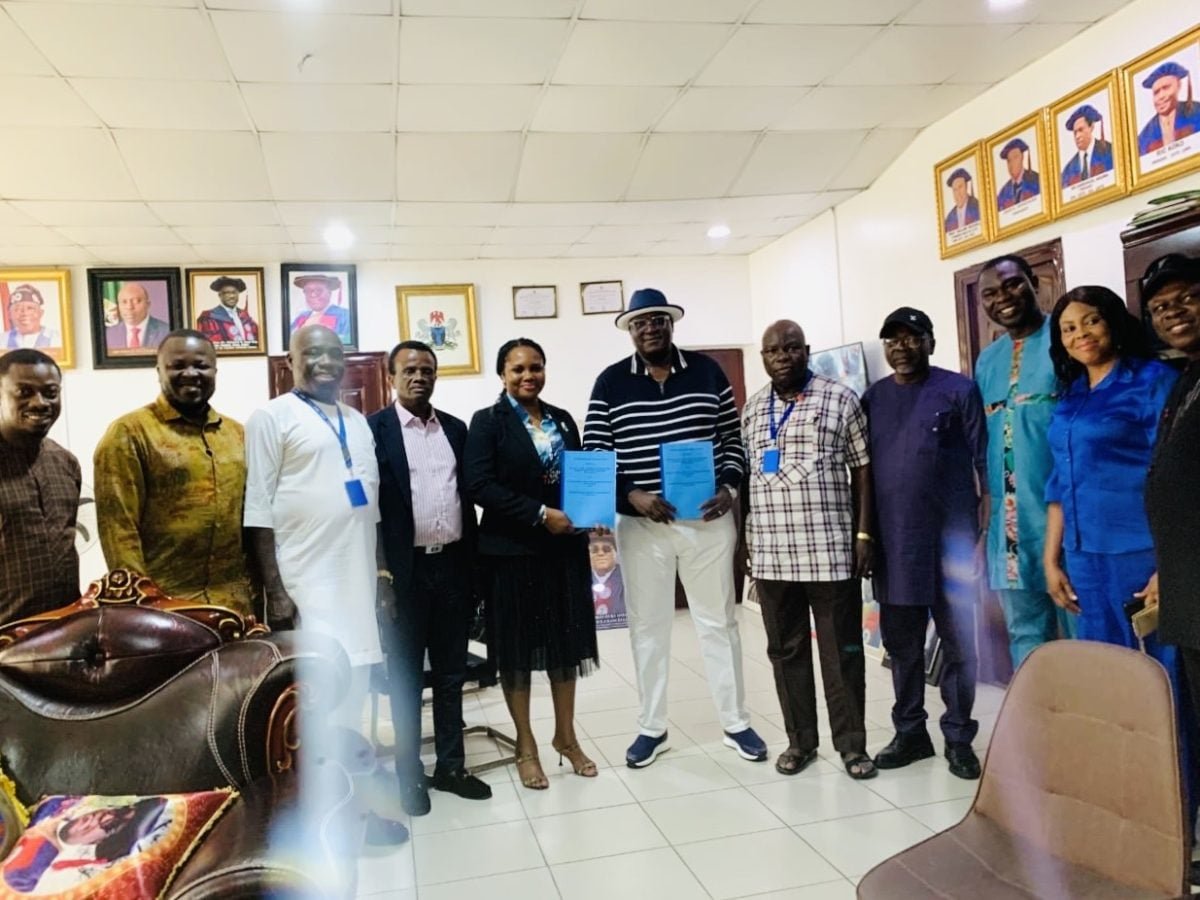
Ignatius Ajuru University of Education, Rivers State, has entered into a partnership with the Agricultural Social Entrepreneurship Foundation International (ASEF Intl) to promote sustainable livestock feed production, agricultural entrepreneurship and employment opportunities through insect farming.
The partnership, formalised through the signing of a Memorandum of Understanding (MoU), will establish a demonstration farm and an agricultural ecosystem at the university, with a focus on the production of high-quality livestock feed using black soldier fly larvae under the foundation’s Project Waste4meal.
The initiative is expected to provide practical training for students, support livestock farmers by reducing feed production costs and demonstrate the commercial potential of agriculture.
Speaking on the partnership, the Vice-Chancellor of Ignatius Ajuru University of Education, Professor Okey Onuchukwu, said the institution was committed to initiatives that would improve agricultural production, create employment and strengthen its internally generated revenue.
Onuchukwu said the collaboration would provide students with opportunities to acquire practical skills in agricultural production and entrepreneurship, enabling them to explore viable business opportunities rather than depend solely on white-collar jobs after graduation.
ALSO READ: Collaboration, storytelling key to transforming Nigeria’s tourism sector — NTDA DG
He noted that agriculture had often been undervalued because of the perception that it was primarily an activity for rural dwellers and low-income earners.
According to him, a commercial approach to agriculture would unlock its potential to address food insecurity, generate employment, increase government revenue and contribute to national economic development.
“If we invest properly in the agricultural sector, it will not only transform agriculture or the economy and put food on the table, it will solve the problem of food insecurity and generate employment and more revenue for the government,” he said.
Also speaking, the Dean of the Faculty of Agriculture, Professor Godfrey Adokiye Kalio, described the partnership as an important milestone for the faculty and the university.
Kalio said the use of black soldier fly larvae to produce high-quality livestock feed represented an alternative approach to animal nutrition that could benefit the agricultural sector.
He expressed optimism that the university would benefit from the project as implementation progressed, adding that the faculty welcomed the collaboration.
In his remarks, the President of ASEF International, Lieutenant Commander Azeez Oluwole, described the MoU as a major milestone in efforts to improve food security, animal health and livestock feed production.
Oluwole explained that the initiative extended beyond black soldier fly farming, encompassing education, research, commercial production, and processing and entrepreneurship development.
He said the project would establish an integrated agricultural ecosystem capable of linking academic learning with research, production and business opportunities.
According to him, the partnership marks the beginning of a new phase in the development of the Project Waste4meal and its contribution to sustainable agriculture.
Similarly, the Coordinator and State Manager of Safe Nest Cooperative, Mr Inene Dan, said the proposed demonstration farm would enable students to gain practical experience and understand how agriculture could operate as a viable business.
He explained that the initiative would bridge the gap between classroom instruction and practical agricultural production, allowing students to see the opportunities available across the agricultural value chain.
Dan expressed confidence that the project would benefit students and positively influence the wider university community in the coming years.
The Chief Executive Officer of ASEF International, Mrs Rosemary Adebayo, said the partnership was designed to demonstrate the opportunities available in agriculture and encourage students to embrace the sector as a source of livelihood and innovation.
Adebayo said the Project Waste4meal was one of the foundation’s interventions aimed at supporting agricultural development, particularly in the livestock sector.
She added that the initiative would help make agricultural work easier and more productive while encouraging students, livestock farmers and aspiring agricultural entrepreneurs to recognize their role in addressing food-related challenges.
The partnership is expected to strengthen agricultural education at the university while promoting alternative feed production, practical skills acquisition and entrepreneurship as pathways to sustainable livelihoods.
WATCH TOP VIDEOS FROM NIGERIAN TRIBUNE TV