

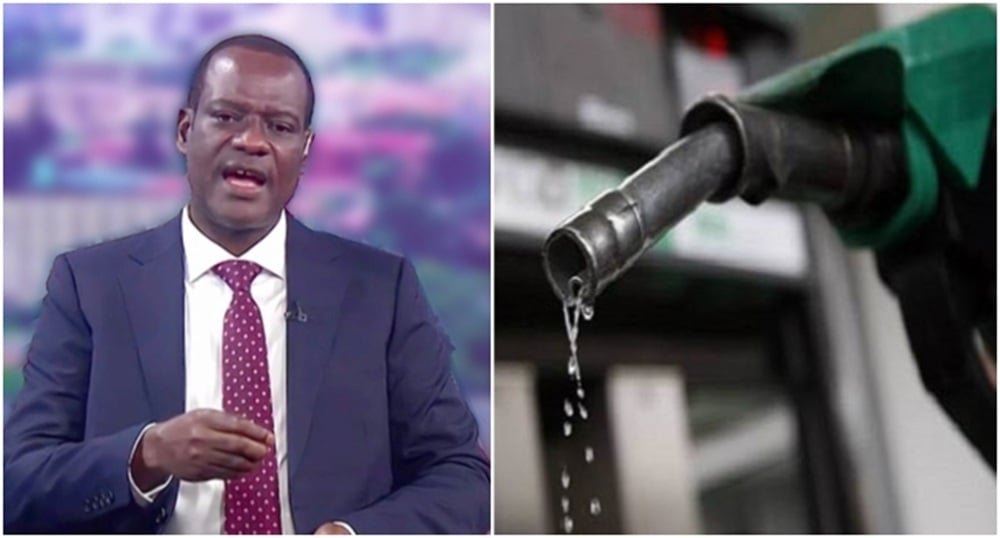
The Federal Government has said what it is doing to address the rising cost of petrol is price modulation and not a return to fuel subsidy.
The Minister of Finance and Coordinating Minister of the Economy, Mr. Taiwo Oyedele, stated this on Friday while speaking on Channels Television’s Politics Today and at a press briefing in Abuja.
Oyedele said the government is negotiating a ceiling to stabilise petrol prices amid the current global crude oil shock.
According to him, the government is working out a framework that will protect Nigerians from sharp price fluctuations at the pump.
He disclosed that the proposed arrangement will set a ceiling on the ex-gantry and landing cost of petrol.
“We are introducing price modulation. The government is negotiating a ceiling of N1,350 per litre on the ex-gantry or landing cost of petrol to keep the price stable,” Oyedele said.
He explained how the mechanism will work when market prices rise above the agreed threshold.
“When costs rise above the ceiling, refineries and importers will carry the shortfall and recover it later,” he said.
The Minister stressed that the intervention should not be misconstrued as subsidy or government fixing of pump prices.
“This is neither a subsidy nor a price control,” he said.
He said the objective is to smoothen prices over time rather than allow them to swing with every change in global oil prices and exchange rate.
“It is designed to smooth prices over time rather than suppressing them,” Oyedele said.
He added that price stability is more beneficial to households and businesses than volatile drops.
“N1,400 a litre today and N1,400 tomorrow is better than N1,500 today and N1,300 tomorrow, because volatility itself adds to uncertainty and cost,” he said.
Oyedele explained that pump prices should not follow every movement in the international market.
“Pump prices should not have to follow every swing in global crude or the exchange rate,” he said.
ALSO READ: ‘You owe me apology,’ Atiku slams Tinubu’s 30-day petrol discount
He said the ceiling will be subject to regular review for transparency and sustainability.
“The ceiling will be reviewed every month, reset where costs require, and the figures published for transparency,” he said.
The minister also announced plans for forward sale of crude oil to domestic refineries to give them more certainty.
“As production rises and previously committed crude is freed up, these will shield pump prices from volatility in the global markets,” he said.
“So the idea we have is sustainable. You can sell your crude forward. We say to the refiners, for the next six months, we are selling you crude at $80 per barrel, for example. That preserves your budgets, provides certainty to the refiners and price stability to the consumer,” he added.
He was emphatic that none of the new measures amount to bringing back subsidy.
“To be perfectly clear, none of these measures restore a blanket subsidy. To do so would amount to creating longer-term harm for a short-term cure,” Oyedele said.
“The cost of fuel is real, and we do not dismiss it. But Nigeria has already lived through that cycle: scarcity, smuggling, collapsing currency and fiscal crisis. Our task is not to reverse a necessary reform but to make its gains reach more Nigerians, more quickly under President Bola Ahmed Tinubu,” he said.
WATCH TOP VIDEOS FROM NIGERIAN TRIBUNE TV