

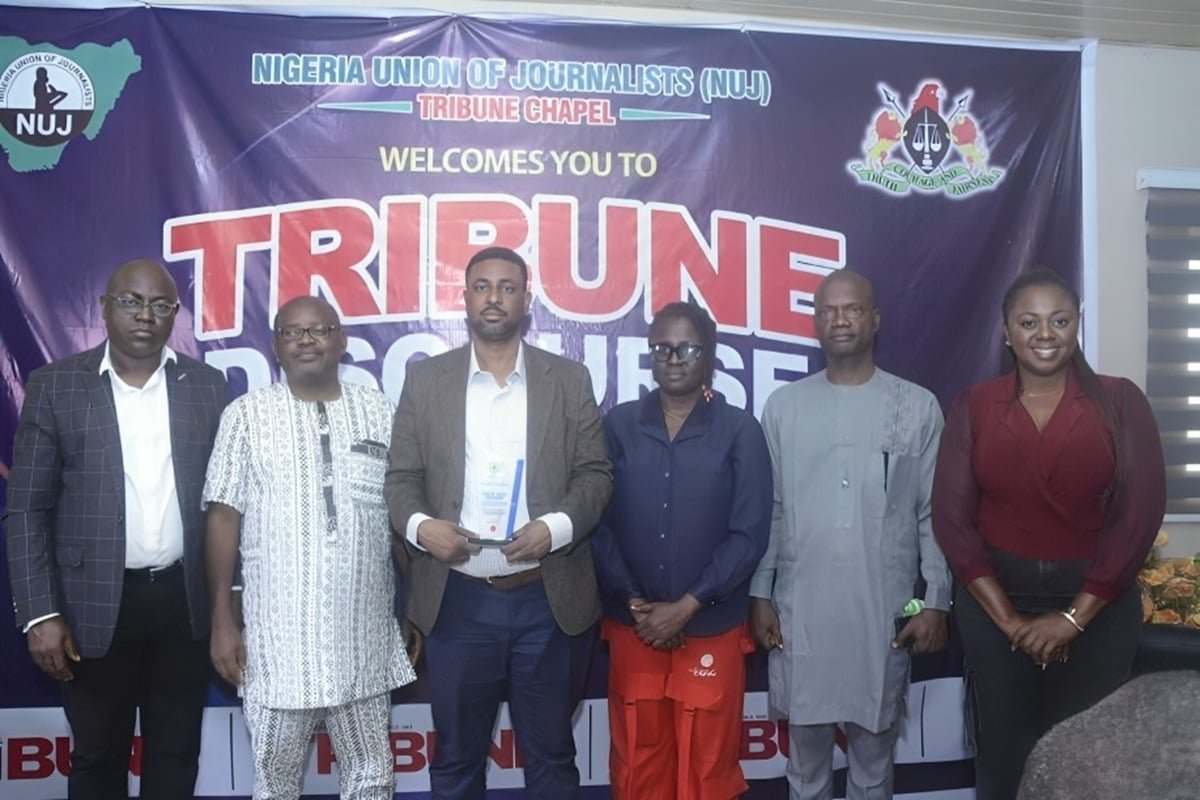
The Chancellor of the American Open University, Global Campus, Professor Seyi Akanbi, has called for a fundamental redesign of Nigeria’s education system to meet the realities of the digital age.
Akanbi said the challenges of electricity supply and internet connectivity should not be allowed to hinder the development of effective online education in Nigeria.
He made the call on Thursday in Ibadan while speaking at the Tribune Discourse organised by the Nigerian Union of Journalists (NUJ), Tribune Chapel, themed ‘Bridging Nigeria’s Education Gap: How Technology and Online Learning Are Transforming Higher Education’.
Akanbi said Nigeria should not simply transfer the traditional classroom model to an online platform, but should develop learning systems specifically designed for the country’s environment.
He explained that American Open University had adopted a flexible and hybrid approach that allows students to access learning materials even when internet connectivity is unavailable.
ALSO READ: Nigeria emerging as one of Africa’s AI hubs —World Bank
Akanbi argued that no country has perfect infrastructure, but that education providers must develop solutions that work within their particular environment.
He also called for a shift from conventional digital literacy to what he described as “productivity literacy”, saying Nigerians already have significant exposure to digital platforms.
According to him, the objective of digital education should not merely be to teach people how to use computers or access the internet, but to equip them with the ability to use technology to create solutions and become productive.
Speaking on accessibility for students with disabilities, Akanbi advocated the adoption of Universal Design for Learning, which provides educational materials in different formats.
He dismissed the perception that graduates of online universities are inferior to those from conventional universities, arguing that quality should be measured by competence rather than mode of education.
He said: “We have a problem of design. We bring the same design of traditional education, wrap it around and package it as online learning. You cannot just package something that has failed and call it online learning. You have to redesign it from the ground up.
“Our system is designed in such a way that if you are a student, you have access to the course materials. If you go outside where there is internet, you have access to the course materials, and even if there is no internet, you can access them offline.
“Everybody here is on Facebook, Twitter, Instagram and other platforms. We use digital banking and other digital services. What we are lacking is a productivity system.
“At our school, there is no physical classroom where you come and sit down. From the beginning, it is hands-on. Your assignments are done on the computer, submitted on the computer and communication is also digital.
“Accessibility should not be about putting one group of people at a disadvantage while trying to help another. It is about giving people the opportunity to choose the option that works best for them.”
Earlier, in her opening address, the chairman of NUJ Tribune Chapel, Mrs Bunmi Ishola, said the discourse was aimed at confronting issues critical to Nigeria’s future.
She said: “The reality before us is clear. While the demand for higher education continues to grow, access remains a major challenge. Many young Nigerians are still unable to secure places in conventional institutions, while distance, cost, inadequate infrastructure and other barriers keep education beyond the reach of many.
“Technology offers us a new possibility. With online learning and digital education, the classroom is no longer necessarily confined by four walls. A student in a rural community can potentially access a lecturer, course or institution hundreds of kilometres away. But we must ask: Are we truly prepared to make this opportunity accessible to every Nigerian?”


WATCH TOP VIDEOS FROM NIGERIAN TRIBUNE TV