

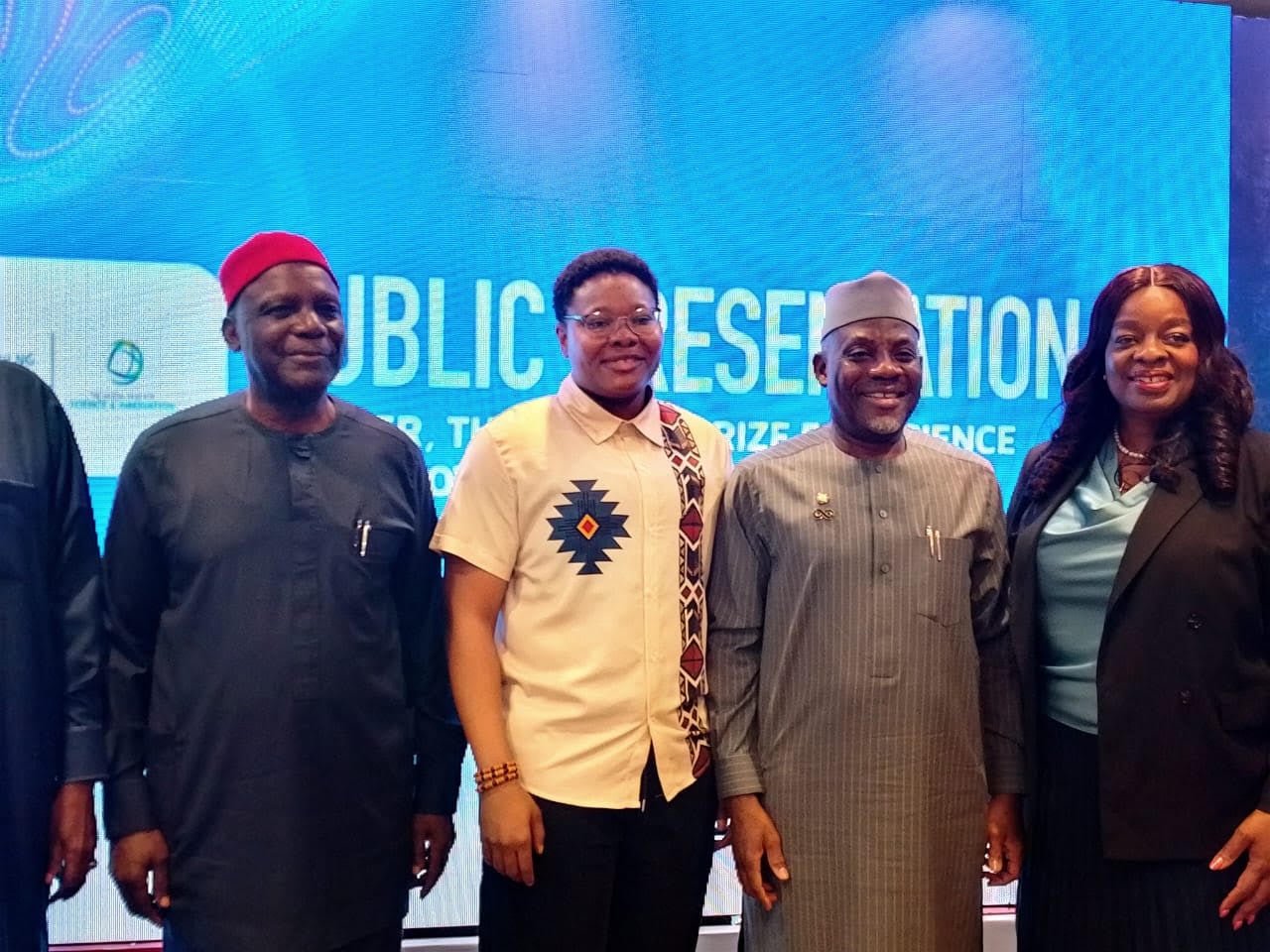
The Federal Government has said Nigeria cannot compete globally without sustained investment in science, research and innovation, urging the country to create an environment where locally developed technologies can move from laboratories into practical solutions for society.
The Minister of Education, Dr Tunji Alausa, stated this on Monday in Abuja at the public presentation of the 2026 winner of the Nigeria Prize for Science and Innovation (NPSI), Dr Mary-Brenda Akoda, whose GenScan AI technology is designed to reduce magnetic resonance imaging (MRI) scan time by up to 90 per cent.
Reflecting on last year’s edition of the prize, Alausa said the absence of a winner should prompt Nigeria to reassess its approach to science and innovation.
“Last year, at the grant award dinner, in my keynote address, it was difficult to celebrate. There was no prize for science and innovation. At that time, I said we needed to pause and reflect. Without innovation, Nigeria could not hope to compete in a digital future,” the Minister of Education said.
He, however, said the 2026 competition produced a different outcome, with Akoda’s GenScan AI emerging from 237 entries as the winning innovation.
“But today, I stand before you with a different story. The prize has produced an outstanding work of global relevance and national importance,” Alausa said.
The Minister of Education commended NLNG for sustaining the prize, describing the winning innovation as an example of what could be achieved when advanced technology was directed at addressing real human needs.
“This is the kind of science we must encourage: science that moves from laboratory into society, and shows young Nigerians that they can create solutions to Nigerian problems,” Alausa said.
He described Akoda’s achievement as further evidence that Nigeria’s education system could produce innovators capable of competing internationally.
The minister also urged Akoda to explore applications of the technology beyond MRI, including CT scans, chest X-rays and angiography.
“You don’t limit this to MRI alone. You can use the same thing for CT scan, for chest X-ray, and for angiography. You don’t have a limit. The entire world is your breadth,” Alausa said.
He urged Akoda to urgently protect the intellectual property associated with the technology, given its commercial potential, and directed relevant officials to facilitate access to teaching hospitals and federal medical centres for clinical trials.
Earlier, Dr Sophia Horsfall, General Manager, External Relations and Sustainable Development, NLNG, said effective treatment depended on accurate diagnosis, noting that diagnostic imaging enabled medical professionals to identify conditions that might not be detected through physical examination.
Horsfall said MRI scan quality could be affected by acquisition time and patients’ inability to remain still because of pain, anxiety, age or illness.
According to the NLNG General Manager, these challenges provided the context for the 2026 NPSI, which focused on artificial intelligence, ICT and digital technologies for development.
She said the judges found that GenScan AI could considerably reduce MRI acquisition time, improve image quality and accommodate patient movement without requiring new hardware.
Horsfall said the public presentation was designed to allow medical and scientific professionals to hear directly from the inventor and examine the technology from the perspective of clinical practice.
Speaking on the significance of the prize, Professor Barth Nnaji, Chairman, NPSI Advisory Board, said the award was not simply for research but recognition of innovations capable of solving significant problems and producing practical impact.
“This prize is not awarded for research. It’s simply given to you because you have done something that is so important out there in the world, something that is solving a world problem but has impact in Nigeria,” Nnaji said.
He explained that the previous year’s competition produced no winner because none of the entries met the rigorous standards set by the advisory board and expert evaluators.
Nnaji said the decision to retain artificial intelligence, digital technology and ICT as the focus of the competition reflected the growing importance of those technologies.
He described Akoda’s innovation as particularly significant because of the limited availability of MRI services and the length of time required for patients to undergo scans.
“It looks like Dr Mary Akoda has done it for the world, not just for Nigeria, but for the world,” the NPSI Advisory Board Chairman said.
Presenting her innovation, Mary-Brenda Akoda, founder of GenScan AI and an AI research scientist, said her personal experience with a relative who suffered a stroke helped shape her understanding of the consequences of delays in medical imaging.
She said MRI scans could take between 15 minutes and one hour or longer, with patients sometimes required to remain completely still in an enclosed space.
According to Akoda, movement during scanning could produce blurred images and require repeated scans, while children, elderly patients and other vulnerable groups might require sedation.
She said GenMRI, the AI technology behind GenScan AI, was developed to address the problem by reconstructing diagnostic-quality images from a fraction of the data normally required for MRI scans.
“GenMRI is a first-of-its-kind AI imaging software that makes MRI scans up to 90 per cent faster,” Akoda said.
She explained that the technology could reduce a 20-minute scan to about two minutes and an hour-long scan to approximately six minutes without requiring hospitals to purchase new MRI machines.
Akoda said the technology achieved up to 99.7 per cent similarity to conventional MRI scans despite the reduction in acquisition time.
She added that consultant radiologists who participated in a blinded assessment rated the GenMRI images as diagnostically equivalent to conventional scans in all the cases evaluated.
The researcher said the technology originated from her work at Imperial College London and had produced two peer-reviewed publications at leading conferences.
She said GenScan AI had also received support from Innovate UK, UK Research and Innovation and the NHS Clinical Entrepreneur Programme, while clinical partners had been secured in the United Kingdom, United States, Kenya and Nigeria.
In Nigeria, Akoda said Asokoro Diagnostic and Medical Centre had agreed to support a clinical pilot of the technology.
She said the next steps were regulatory submission and clinical pilots, with the aim of obtaining approval and deploying the technology commercially by the second half of 2027.
Representing the Minister of Innovation, Science and Technology, the Director-General/Chief Executive Officer of the National Board for Technology Incubation, Dr Kazeem Kolawole Raji, pledged government support for the commercialisation and protection of the innovation.
Raji said the National Office for Technology Acquisition and Promotion had a mandate to protect intellectual property and facilitate the commercialisation of research outcomes.
He also offered Akoda an opportunity to participate in an international innovation programme in London, where Nigerian innovators would have access to prospective investors.
The Director-General stressed the importance of protecting the intellectual property of GenScan AI before seeking investment.
“We need their money, but you cannot come and steal our intellectual property,” Raji said.
He said the government would continue to support Nigerian innovators and create platforms through which research could be transformed into commercially viable products capable of generating jobs, revenue and solutions to national challenges.
WATCH TOP VIDEOS FROM NIGERIAN TRIBUNE TV