

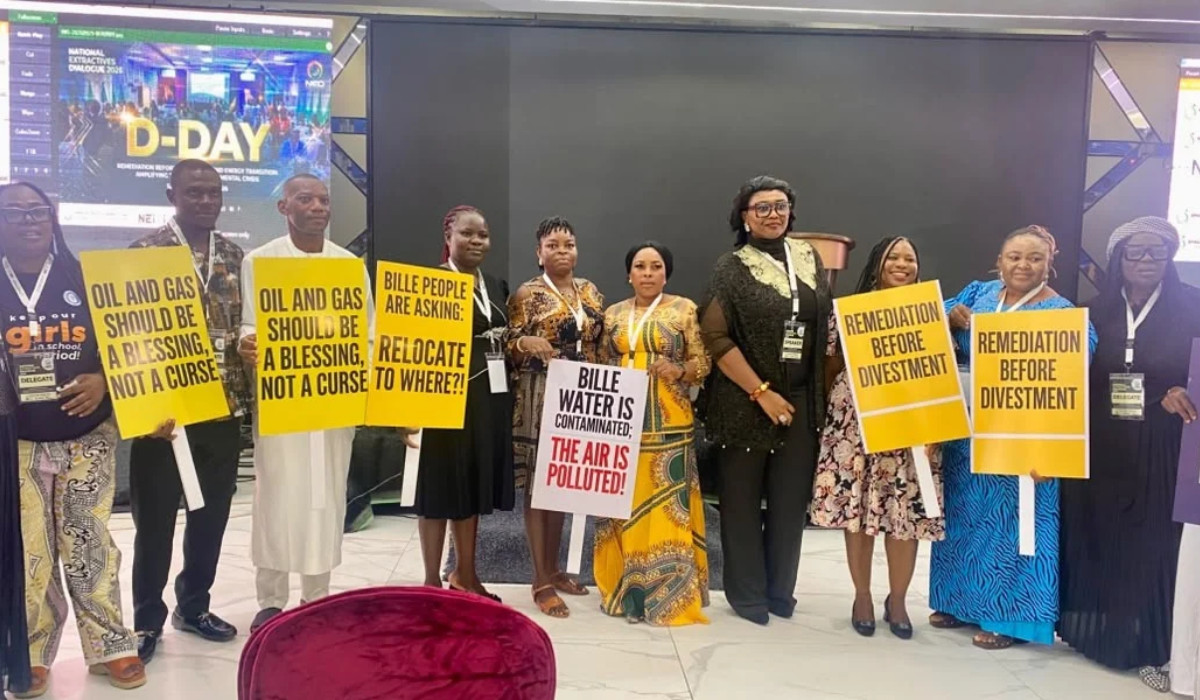
The member representing Khana/Gokana Federal Constituency in the House of Representatives, Dumnamene Dekor, has called on the Federal and Rivers State governments to declare Bille Kingdom in Degema Local Government Area of Rivers State a disaster zone over persistent gas leaks and environmental degradation.
Dekor, who made the call at the 2026 National Extractives Dialogue (NED) in Port Harcourt on Tuesday, urged the National Emergency Management Agency (NEMA) and the Ministry of Humanitarian Affairs to establish immediate medical camps, distribute relief materials and develop evacuation plans for residents in high-risk areas of the community.
The dialogue, organised by Spaces for Change (S4C), had the theme, “Remediation Before Divestment and Energy Transition: Amplifying the Bille Environmental Crisis.”
The lawmaker said the scale of environmental degradation in Bille required urgent government intervention, stressing that residents would have been evacuated if the crisis were occurring in countries with stronger emergency response mechanisms.
He also called on community leaders, civil society organisations, regulatory agencies and industry stakeholders to set aside political differences and work together to save Bille Kingdom from further environmental devastation.
“We must put politics aside to save Bille Kingdom. We will not stand by and watch Bille Kingdom sink into an environmental abyss.
“The people of Bille deserve clean air, safe water, and a secure future, and we will not rest until this gets done,” he said.
Dekor further urged the Rivers State Government to intensify its intervention, saying the state had a greater responsibility to protect citizens affected by the crisis.
“As Chairman of the House Committee on those communities, I wish to affirm that my committee stands fully ready to act as that bridge, facilitating open dialogue, supporting necessary policy frameworks, and ensuring that our agreements here are translated into lasting relief on the ground,” he said.
Meanwhile, the National Oil Spill Detection and Response Agency (NOSDRA) and the Nigeria Extractive Industries Transparency Initiative (NEITI) have called for the identification, disclosure and remediation of environmental liabilities before oil and gas assets are divested or transferred to new operators.
Representing the Director-General of NOSDRA, Engr. Chukwuemeka Woke, the agency’s Director of ICT/GIS, Dr Yusuf Rigasa, said NOSDRA had conducted several technical investigations into the Bille crisis in collaboration with relevant government agencies.
Rigasa assured the community that the agency remained committed to transparently sharing the findings of its investigations and ensuring that appropriate remediation measures were undertaken.
He said environmental responsibilities should not disappear merely because ownership of an oil asset had changed.
According to him, NOSDRA’s mandate covers oil spill preparedness, detection, response coordination, environmental monitoring, technical investigation, remediation and restoration oversight.
He stressed that the agency’s responsibilities remained relevant during divestment, adding that changes in ownership and the energy transition should not become avenues for escaping environmental accountability.
Also speaking, the Executive Secretary of NEITI, Hon. Musa Sarkin Adar, represented by the Director, Energy and Mining, Sa’ad Balarabe, said the dialogue was taking place at a time when the ownership structure of Nigeria’s onshore and shallow-water petroleum assets had undergone significant changes.
Adar said while investors had the right to enter or exit markets, environmental liabilities attached to the assets must be addressed before ownership changed.
He warned that environmental liabilities could be transferred from well-capitalised international operators to successor companies with different financial and technical capacities, leaving host communities and the Nigerian government to bear the consequences.
“Those environmental liabilities must be fully identified, valued and disclosed before a divestment is approved, and not reconstructed afterwards through litigation,” he said.
He stressed that remediation should be a condition precedent to exit rather than an issue left for courts to resolve years after an asset had changed hands.
ALSO READ: Nigeria demands total elimination of atomic weapons
Adar also highlighted the importance of emissions disclosure in Nigeria’s energy transition, noting that NEITI had incorporated greenhouse gas and methane emissions disclosure requirements into its 2022 and 2023 oil, gas and mining audit processes.
He said credible data on environmental performance, remediation spending, community payments and the social and economic impacts of the energy transition would be critical to effective planning and accountability.
He added that NEITI would work with the Nigerian Upstream Petroleum Regulatory Commission (NUPRC), NOSDRA and the Federal Ministry of Environment to improve public disclosure of environmental payments, decommissioning contributions and remediation fund flows.
Adar recommended a comprehensive and independently verified audit of environmental liabilities, abandoned wells and ageing infrastructure across divested and divesting assets.
Earlier, the Executive Director of Spaces for Change, Victoria Ibezim-Ohaeri, said the Bille crisis raised broader questions about how Nigeria manages environmental liabilities when oil and gas assets change hands.
She said residents had, for months, reported persistent gas emissions, contamination and threats to water sources and livelihoods, stressing that the situation was beyond a technical issue as it directly affected the safety, health and economic wellbeing of the people.
Ibezim-Ohaeri said regulators had acknowledged the seriousness of the situation and commenced empirical, scientific, environmental and technical investigations to establish the causes of the gas leaks and bubbling water sources reported in the community.
She said the Bille experience provided an opportunity to examine how environmental liabilities could be identified, documented and enforced before ownership or operatorship changed.
She added that the forum would examine investigations and technical assessments relating to Bille, emissions data and operators’ compliance, pre-divestment liabilities, corporate accountability, and the health, economic and social burdens of legacy pollution.
The dialogue also considered the impact of environmental degradation on women and children, as well as challenges relating to remediation, compensation and accountability across the Niger Delta.
WATCH TOP VIDEOS FROM NIGERIAN TRIBUNE TV