

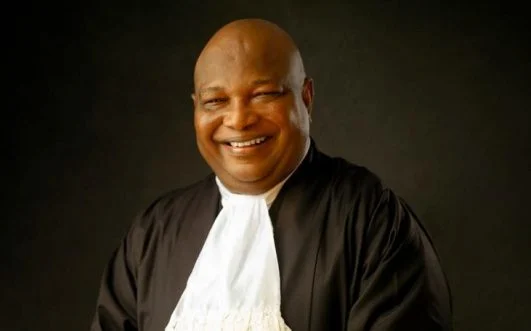
Senior Advocate of Nigeria, Wahab Shittu, has lamented that Nigeria’s progress is partly hindered by “unexplained wealth”.
He noted that while Nigeria is blessed with human and natural resources, the majority of the nation’s wealth is carted away through “unexplained” means.
He added, however, that if Nigeria had a working mechanism in place to check this anomaly, the country would progress.
Shittu stated this on Monday while addressing journalists at the public presentation of his three-volume book, titled “Unexplained Wealth: A Trilogy of Nigerian Financial Law” at Oriental Hotel, Lagos State.
“The summary of it is that no country can progress if that country is faced with unexplained wealth. This country is very rich in terms of human and natural resources, but the bulk of our wealth is being siphoned away through unexplained means.
“So, if the country has a mechanism for recovering such unexplained wealth, this country will progress.”
He lamented the prosecution of innocent persons in the nation’s legal system, saying, “No country can also progress when you label the innocent with the smear of corruption when, in fact, they have worked very hard to acquire their wealth.”
The author noted that while acquiring wealth is not a crime, the “illicit acquisition of wealth” is “indefensible”.
Speaking on the relevance of the book, the Senior Advocate said it is important to anti-corruption agencies such as the Economic and Financial Crimes Commission (EFCC), the Independent Corrupt Practices and Other Related Offences Commission (ICPC), as well as members of the public.
Shittu added, “Wealth acquisition in itself is not a crime. Being rich is not necessarily a crime. But what is a crime and indefensible is illicit acquisition of wealth, or that which defies logical explanation.
“This book is written for both the anti-graft agencies in order to guide them in prosecuting all who are obsessed with the theory of illegal or illicit acquisition of wealth, and those who are being called upon to justify their acquisition of wealth.”
Shittu, a lecturer at the Faculty of Law, University of Lagos, said he drew inspiration from two instances in the course of his work in the legal profession.
He disclosed that after conducting some research, he discovered that Nigeria had no legislative framework on unexplained wealth, as seen in advanced nations like the United Kingdom.
“A few years ago, I prosecuted a case successfully to the Supreme Court against a former local government chairman in Kogi State, who was unable to justify assets acquired in excess of his legitimate income, and the court used that case to establish a principle that where you acquire assets or income in excess of your legitimate income, you owe the state a duty of explanation. That is the first inspiration.
“The second was when the National Judicial Institute, in collaboration with the EFCC, invited me to discuss the subject of unexplained wealth. I did a fanfare of about a thousand copies which I circulated to the judges. It was well received; same with the ICPC.
“I then found out in the course of my research that Nigeria does not have a legislative framework on unexplained wealth, unlike the UK and some other advanced countries,” he narrated.
Shittu added that “this is the first text on unexplained wealth in Africa,” adding that it is also the first time the doctrine of unexplained wealth is explained worldwide.
He advised that if investigators, judges and prosecutors follow the prescribed rules in the book, it would be possible for the state to “deliver quality and successful prosecution, and also possible for the innocent and wrongfully accused to escape unjust punishment.”
“I think what we need to do is not to label people anyhow or fight anti-corruption in the pages of newspapers. It is to enthrone a regime of credibility throughout the prosecution process and ensure that our country is sanitised, our commonwealth is not siphoned away by thieves and that those who are innocent are not unjustly labelled,” Shittu concluded.
Among the dignitaries present at the event were former President Olusegun Obasanjo, who was the Chairman of the occasion; a former Vice-Chancellor of Lagos State University, Prof Olanrewaju Fagbohun, SAN; President of the Nigerian Bar Association, Oyinkansola Badejo-Okusanya; Emir of Kano, Muhammadu Sanusi II, among others.