

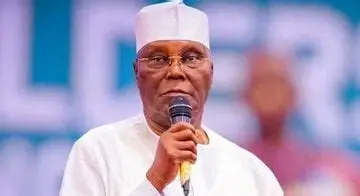
Former Vice-President Atiku Abubakar has demanded a full reconciliation of Nigeria’s public debt, including new borrowings, Treasury Bills and controversial charges contained in the latest external debt-service records, as the country’s debt stock climbed to N166.79tn.
Atiku also demanded an apology from the President Bola Tinubu administration over the hardship Nigerians have experienced since the removal of the petrol subsidy and other economic reforms introduced in 2023.
The demands were contained in a statement on Saturday by Phrank Shaibu, Director of Strategic Communications of the African Democratic Congress Presidential Campaign Council.
The intervention followed the latest data from the Debt Management Office, which put Nigeria’s total public debt at N166.79tn as of June 30, 2026. The DMO published the latest debt figures on September 25.
The figure comprises N91.59tn in domestic debt and N75.20tn in external debt, with the latter converted at an official exchange rate of N1,379.18 to the dollar.
Atiku contrasted the latest figure with the N49.85tn public debt recorded in March 2023, before the Tinubu administration assumed office.
He, however, called for a breakdown showing how much of the current debt represented inherited obligations, the naira impact of exchange-rate movements on foreign debt and genuinely new borrowing since May 2023.
According to the former Vice-President, the government should also account for the N22.71tn Ways and Means advances that were securitised and incorporated into the debt stock from June 2023.
“A government that says more money is coming in must explain why it keeps borrowing and why the people paying for its policies cannot see the promised gains,” Atiku said.
He urged the government to “identify the old debt newly recorded, the foreign debt whose naira value rose with the exchange rate, and every new loan contracted since he assumed office.”
Atiku also questioned the cost of servicing the country’s debt, arguing that rising obligations were limiting resources available for public services and development.
The DMO’s latest domestic debt data put Federal Government Treasury Bills outstanding at N19.48tn as of June 30, 2026.
He demanded a reconciliation showing which Treasury Bills had matured, which were redeemed, which were rolled over, and which represented new borrowing.
“A June snapshot cannot answer a September question,” he said, demanding that the government publish a transparent reconciliation of the transactions behind the Treasury Bills figure.
Atiku also questioned $39.25m listed as “other charges” in the DMO’s second-quarter 2026 external debt-service report.
According to the report, the amount included $22.5m for a First Abu Dhabi Bank Total Return Swap and $8.97m for Deutsche Bank AG.
The report recorded no principal or interest payment against the First Abu Dhabi Bank Total Return Swap during the quarter, with the $22.5m listed under other charges.
Atiku demanded an explanation of the transaction.
“What exactly was the $22.5m charge for? Which agreement authorised it? What was the original facility? How much was drawn? What obligations remain outstanding?” he asked.
The development comes amid a wide fiscal gap in the 2026 budget, which provides for expenditure of about N68.32tn against projected revenue of N36.87tn, leaving a deficit of roughly N31.45tn, with borrowing expected to finance a substantial part of the gap.
President Tinubu has also highlighted the pressure created by debt servicing.
Speaking at the Africa Forward Summit in Nairobi in May, he said Nigeria expected to spend about $11.6bn on debt service in 2026, describing the amount as nearly half of projected revenue.
Atiku, however, argued that the government could not point to increased revenues and improved macroeconomic indicators while continuing to accumulate debt and asking Nigerians to endure higher living costs.
“The true test of economic policy is whether Nigerians can afford food, transportation, housing, education, healthcare and electricity,” he said.
His criticism also comes amid concerns over poverty and food insecurity. In its June 2026 Article IV assessment, the International Monetary Fund said Nigeria’s macroeconomic outcomes had improved following reforms but noted that conditions remained difficult for many Nigerians.
The IMF estimated poverty at 63 per cent under the national poverty line and said 27 million Nigerians were estimated to have faced food insecurity in the latter part of 2025. It also warned that higher fuel and food prices could aggravate poverty and food insecurity.
Atiku described the situation as a contradiction between improving government revenues and the economic experience of households.
“The Tinubu economy is producing two Nigerias: one in which ordinary citizens are suffocating under rising food, fuel, transport, electricity, education and housing costs, and another in which those with wealth, access and privilege are far better positioned to protect and multiply their fortunes,” he said.
He also called on Tinubu and the All Progressives Congress to apologise to Nigerians over the hardship associated with the administration’s economic policies.
“Nigerians were asked to sacrifice. Fuel subsidy was removed. The naira was allowed to depreciate sharply. Electricity and transportation costs rose. Government revenues increased, yet borrowing continued.
“After all of this, the Nigerian people are entitled to ask one simple question: what exactly did our sacrifice buy?” he asked.
Atiku urged the Federal Government to reconcile the borrowing figures, explain the debt-service charges and disclose how borrowed funds had been deployed.
“Reconcile the borrowing. Explain the charges. Show Nigerians what their sacrifice bought. Apologise for the hardship,” he demanded.