

By: BODE OPESEITAN
In Kano, there is a tavern-table argument that resurfaces every now and then, usually after a fresh wave of national conversation about Lagos. Why, some ask, could Aliko Dangote not have built his refinery at home, in the north, and simply laid pipelines: one stretching nearly 2,000 kilometres south to the Niger Delta to draw in crude, and another running the same distance back down to a southern seaport to ship out petrol and diesel? On paper, it sounds like civic pride dressed as engineering. In practice, it is a fantasy that would have bankrupted the idea before the first pipe was welded. A 700,000-barrel-a-day refinery needs ocean-going tankers calling regularly at its coastal terminal to unload crude and load finished fuel just as fast. Route that through two overland pipeline corridors of well over 1,000 kilometres each, across terrain scarred by decades of vandalism and theft, and you have not built a refinery. You have built a hostage to sabotage, with landlocked Kano paying premium freight both ways while Lagos, sitting on the coast, would have paid none.
That thought experiment matters because it exposes, cleanly and without malice towards anyone, a truth that Nigerians keep forgetting under the pressure of grievance: geography is not an insult, it is an input cost. Coastal access, water depth and proximity to crude are not favours a government hands out to its favourite tribe. They are physical facts that determine whether billions of dollars in private capital ever arrive at all. Understanding this is the only honest starting point for the argument now raging over Ogun State’s new port deal, because the same logic that kept Dangote’s refinery on the Lagos coast is the logic that just delivered a $7 billion investment to Ogun Waterside.
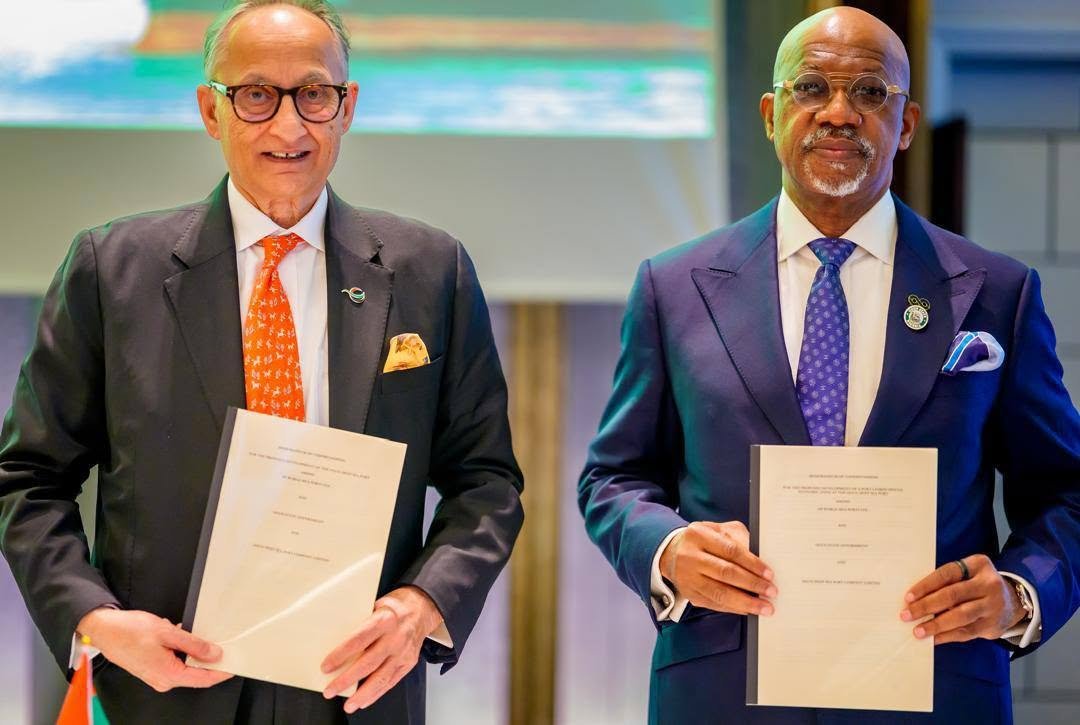
On 24 September 2026, in Paris, the Ogun State Government and DP World signed Memoranda of Understanding to build the Gateway Deep Sea Port and the Ogun State Blue Marine Special Economic Zone, witnessed by President Bola Tinubu. The numbers are substantial: an initial investment exceeding $7 billion, a four-kilometre berth with an 18-metre natural draft deep enough for Post-Panamax vessels, and a Special Economic Zone spanning 10,000 hectares. Within hours, a segment of online commentary, spearheaded by vocal elite commentators from the South East, had recast a commercial agreement as fresh proof that President Tinubu is “Yorubanising” Nigeria’s maritime infrastructure. It is a serious charge dressed in urgent language, and it deserves a serious answer, not a shrug.
The answer begins with what a Memorandum of Understanding actually is. This was not a federal loan, and no state debt was created. It is a Public-Private Partnership in which DP World and its financial partners will deploy their own equity and raise private capital to construct and operate the port, while Ogun State’s contribution is land, right-of-way facilitation and the regulatory framework for the Special Economic Zone. The Federal Government’s role, by its own account, is confined to regulatory clarity and matching infrastructure such as road and rail links, not to underwriting anyone’s risk. Put simply, DP World is not extracting from Nigeria; DP World is the one bringing the money, because Ogun Waterside offers what its money needs: an 18-metre draft that avoids the crushing dredging bills already draining Lagos, a direct link via the 28-kilometre Ogun stretch of the Lagos-Calabar Coastal Highway, and proximity to a manufacturing base that can turn imported raw materials into exports without ever leaving the same economic corridor. Decisions built on depth soundings and dredging costs are not ethnic decisions. They are the same arithmetic that guided Dangote away from Kano.
The national gains are not abstract. Officials project more than 50,000 direct jobs once the port and the Special Economic Zone are fully developed, alongside indirect employment across logistics, warehousing and manufacturing. The port is designed to decongest the chronically overwhelmed Apapa and Tin Can Island terminals, cutting the delays and demurrage costs that currently punish importers and exporters nationwide, of whatever region they call home. It positions Nigeria to serve the African Continental Free Trade Area, a market of roughly 1.4 billion people, and to generate non-oil export earnings that the whole federation, not one region, will need as oil revenue continues its long decline. None of these outcomes respects ethnicity. A container moving faster through Ogun Waterside lowers the landed cost of goods in Onitsha, Enugu and Aba just as surely as it does in Lagos.
Nor does a port sited in the South West translate into South East exclusion, a claim that collapses on contact with the record at Lekki Deep Sea Port, the closest working model Nigeria has. Senior operational leadership there includes professionals from the South East: Daniel Odibe, an 18-year veteran of the maritime industry, serves as Deputy Chief Operating Officer, while public-facing corporate communications for the port has for years been led by Ada Igboanugo, whose byline appears on Lekki Port’s own official press releases covering everything from executive appointments to new shipping line launches. This is not tokenism. Lekki Port and its terminal operator function as private corporate entities, not federal civil service departments bound by geopolitical quota rules. Recruitment runs through competitive corporate channels, and given how heavily South East professionals are represented among Nigeria’s maritime, logistics and supply chain talent, they are naturally well placed to win these roles on merit, not on federal character arithmetic. A seaport’s location decides where the concrete sits. It does not decide who runs it, ships through it, or profits from it.
It is also inaccurate to describe this as a government fixated on one corner of the map. The Federal Government, through the Ministry of Marine and Blue Economy and the Nigerian Ports Authority, is running its most extensive port rehabilitation programme in over fifty years, and its ambitions plainly extend east and south. Procurement for full structural rebuilds of Onne Port, the Rivers Port in Port Harcourt, Calabar Port and Warri Port has commenced, targeted for completion within a 48-month window. The Federal Executive Council has approved dredging and breakwater rehabilitation for the long-neglected Delta channels, including the Escravos breakwaters and Terminals A and C, precisely the kind of engineering that has kept Eastern ports underused for decades. Separately, President Tinubu has approved certification and compliance processes clearing the legal path for five further deep seaports: Ibom in Akwa Ibom, Bakassi in Cross River, Bonny in Rivers State, Badagry in Lagos and Olokola in Ondo. Three of those, Ibom, Bakassi and Bonny, sit squarely in the South South. A government genuinely intent on cementing one region’s dominance would not simultaneously be clearing runway space for ports in other regions.
What is happening, then, is not ethnic cleansing by infrastructure. It is a country, finally, trying to fix a maritime sector so lopsided that Nigeria has for years surrendered the majority of its own cargo traffic to ports in neighbouring countries, simply because domestic capacity could not cope. Framing every commercial decision through an ethnic lens does not protect any region; it merely persuades global investors that Nigeria negotiates infrastructure by tribal quota rather than by feasibility studies, and that is a reputational cost the whole federation pays.
Through all of this, proponents of the project and mainstream commentators have, notably, declined the invitation to quarrel. There has been no organised retaliation, no matching wave of ethnic insult, only a quiet confidence that the wider South East, beyond a vocal commentating class, understands the difference between a business decision and a conspiracy. That restraint is not weakness. It reflects an understanding, shared by most reasonable Nigerians regardless of region, that a $7 billion port and a hypothetical pipeline through the Sahel rest on the same unglamorous truth: capital follows depth, distance and viability, not ancestry.
Nigeria’s greatest infrastructure failures over 60 years have rarely come from choosing the wrong coastline. They have come from politicians and commentators who convinced entire regions that someone else’s investment was proof of their own exclusion, when the honest answer, as any port engineer or refinery planner will confirm, was always written in the depth of the water.