

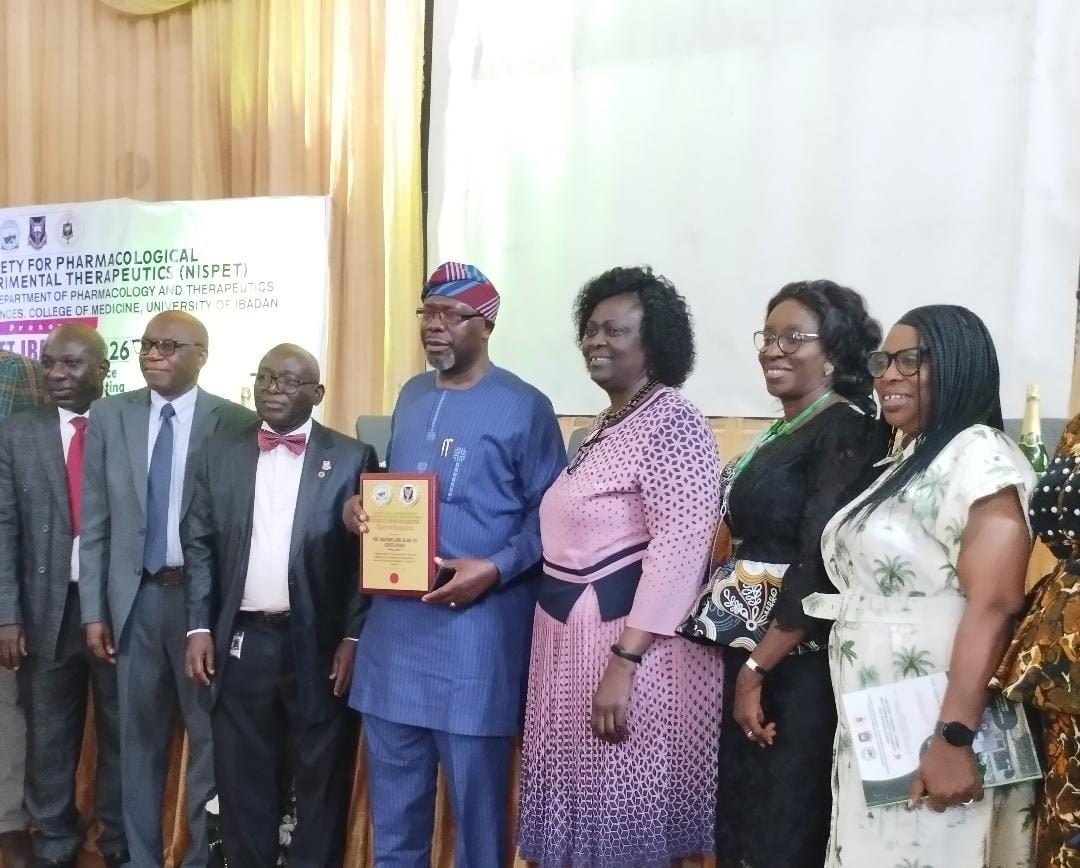
Nigeria must move beyond consuming scientific knowledge produced elsewhere and take its place as an equal partner in the global research enterprise, the Vice-Chancellor of the University of Ibadan, Prof. Kayode Oyebode Adebowale, has said.
Adebowale, represented by the Deputy Vice-Chancellor (Academic), Prof. Juwon Arotiba, spoke at the 4th Nigerian Society for Pharmacological Sciences and Experimental Therapeutics (NISPET) Scientific Conference and Annual General Meeting at the University of Ibadan.
Speaking on the theme “Pharmacology Beyond Boundaries: Innovation and Translational Science for Sustainable Health,” he urged Nigerian pharmacologists to participate more actively in global research consortia, contribute to international scientific databases and strengthen partnerships with researchers across Africa and beyond.
“No single institution, no single nation, and no single discipline can hope to address these challenges in isolation,” he said.
Adebowale said emerging infectious diseases, antimicrobial resistance, non-communicable diseases, and challenges of drug affordability and access required closer collaboration among researchers, universities, industry, regulators and healthcare institutions.
He identified the gap between laboratory discoveries and clinical application as a major obstacle to drug development, urging researchers to strengthen expertise in regulatory science, health economics and implementation science.
The Vice-Chancellor said the University of Ibadan was investing in research infrastructure, interdisciplinary collaboration and postgraduate training while strengthening partnerships with industry and regulatory agencies to translate research findings into health products and policies.
He stressed that sustainable healthcare required more than discovering new therapies, noting that medicines must also be accessible, affordable, safe and appropriately used.
Adebowale charged young researchers to build networks and pursue collaborations capable of producing solutions to Nigeria’s health challenges.
Also speaking, the President of NISPET, Prof. Omoniyi Yemitan, called for urgent strengthening of Africa’s capacity in drug discovery, development and regulation to close the continent’s drug-development gap.
Yemitan said Africa bears a disproportionate disease burden but remains underrepresented in global drug-development pipelines, stressing the need to bridge the gap between laboratory research, clinical application and community impact.
He said research must ultimately translate into better patient care, affordable medicines and sustainable health systems. He identified antimicrobial resistance, emerging infectious diseases, non-communicable diseases and health inequalities as challenges requiring stronger scientific capacity.
Yemitan urged African researchers to deepen global collaborations while investing in local research, training and regulatory capacity.
The Provost of the College of Medicine, University of Ibadan, Prof. Temidayo Ogundiran, called for stronger collaboration among researchers, clinicians, industry and policymakers to translate pharmacological research into practical healthcare solutions.
He stressed that pharmacology links basic science, clinical medicine, drug discovery and public health, urging participants to forge collaborations and develop innovative approaches to improving healthcare in Nigeria and beyond.
The Chief Medical Director of the University College Hospital (UCH), Ibadan, Prof. Jesse Abiodun Otegbayo, represented by the Chairman, Medical Advisory Committee, Prof. Bukola Adesina, also called for greater focus on safe, effective and affordable therapies.
Otegbayo identified rising healthcare costs and limited access to innovative medicines as challenges requiring increased research investment and collaboration. He urged participants to keep patients at the centre of innovation and build partnerships that bridge scientific discovery and improved health outcomes.
The Dean, Faculty of Basic Medical Sciences, University of Ibadan, Prof. Oluwatosin Adaramoye, said the conference was designed to equip participants with practical tools, fresh perspectives and actionable knowledge for addressing emerging challenges in their fields.
He urged participants to engage actively in discussions, challenge conventional approaches and apply lessons from the conference to improve research and professional practice.
WATCH TOP VIDEOS FROM NIGERIAN TRIBUNE TV