

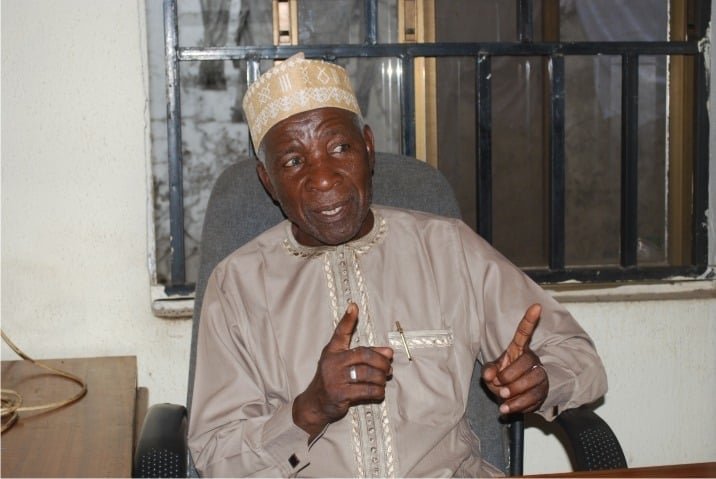
A chieftain of the Nigeria Democratic Congress (NDC), Buba Galadima, has said there is a lot of misunderstanding between the party and support groups backing its presidential candidate, Peter Obi, and running mate Rabiu Kwankwaso.
Galadima spoke on Channels Television’s Politics Today programme on Thursday while commenting on the disagreement between the NDC and the Obi-Kwankwaso (OK) Movement over the role and structure of support groups ahead of the 2027 general elections.
The NDC had earlier dissociated itself from a 59-member presidential campaign council unveiled by the OK Movement, saying the structure was not authorised by the party and should be disregarded.
The party maintained that support groups could not establish parallel structures without its approval.
The development triggered a disagreement, with the OK Movement insisting that it was an independently organised political movement and would not surrender its structures or merge them with the NDC.
However, Galadima said the disagreement stemmed largely from a misunderstanding of the relationship between political parties and support groups.
“I think there is a lot of misunderstanding, both from the support groups and the party.
“You know what a lot of people don’t understand. Having been a manager of a political party and political process for the last 48 years, I think I can qualify to be a consultant on this issue.
“Support groups are not even likely to be members of the party; are not supposed to be.
“They can carry their activities independently if they want, but if they subordinate themselves to the party and sign up with the party as a support group of the presidential candidate or governorship or Senate or House of Reps or House of Assembly candidate, then they have to toe the lines of the party. That is what it is,” he said.
His comments come a day after NDC National Leader Seriake Dickson criticised the OK Movement’s decision to establish a separate campaign council, arguing that support groups should provide grassroots mobilisation rather than operate as parallel structures to the party.