

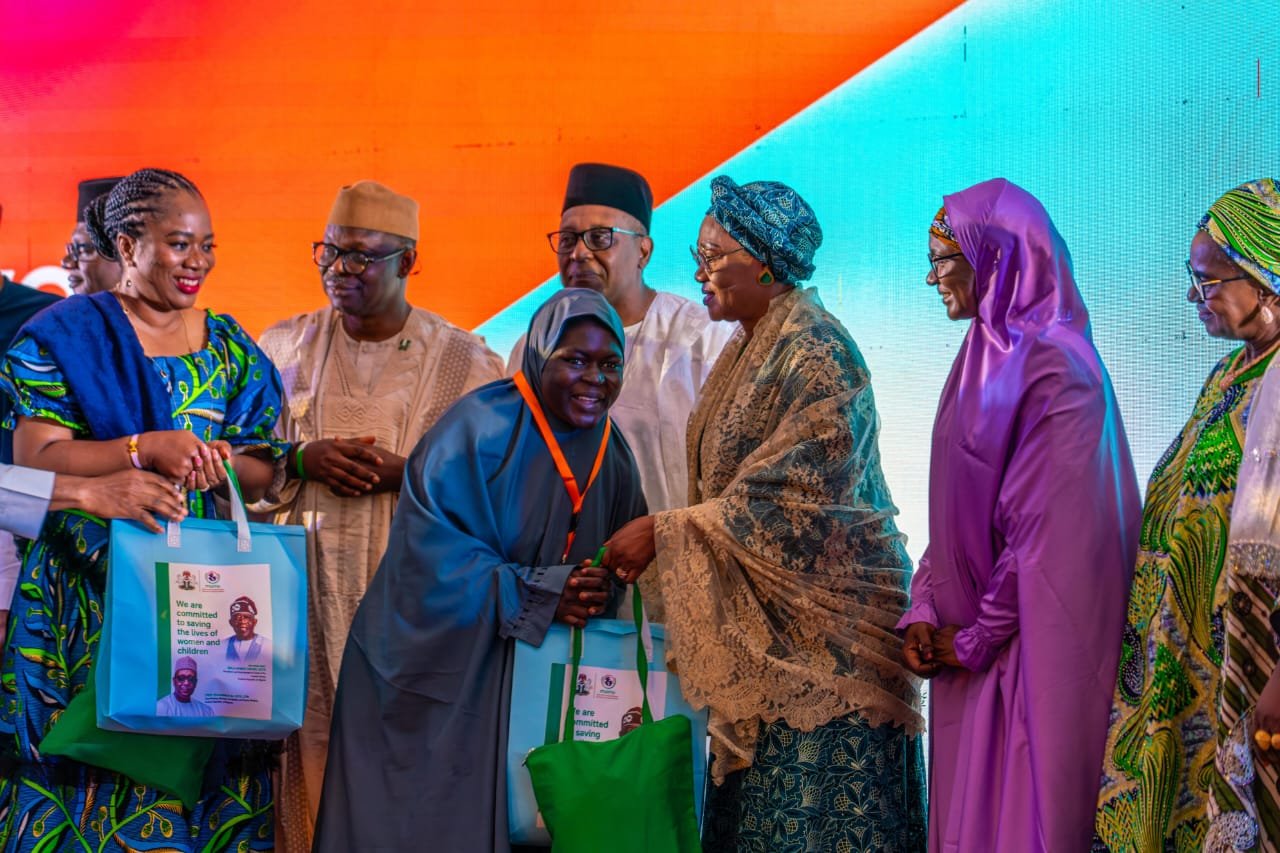
The Federal Government has unveiled a fresh package of incentives under its Maternal and Neonatal Mortality Reduction Initiative (MAMII), targeting 2.9 million pregnant women with free, timely and comprehensive maternal and newborn healthcare services in 172 local government areas across the country.
First Lady, Senator Oluremi Tinubu, on Monday flagged off the distribution of the incentives in Abuja, saying the intervention was aimed at encouraging more women, particularly those in vulnerable communities, to access antenatal care, skilled delivery and postnatal services.
The package includes 215,000 Mama Kits and bags, representing the second batch following the distribution of 110,000 kits in 2025, as well as 40,000 maternal food support packs and 40,000 sets of essential newborn clothing.
Speaking at the national flag-off ceremony, Mrs Tinubu said the initiative represented another step towards ensuring that every Nigerian child had a healthy start in life and that no woman lost her life while giving birth.
She said the intervention was in line with the Renewed Hope Agenda of President Bola Tinubu’s administration, which recognised health as an essential pillar of national development.
“MAMII is a bold national intervention that unites key stakeholders to reduce preventable maternal and newborn deaths by strengthening awareness, emergency care, referral systems, making safe childbirth and newborn survival the standard of every Nigerian family,” she said.
The First Lady said the incentives were particularly important because social, economic, cultural and logistical barriers continued to prevent some women from accessing essential maternal healthcare.
She said the maternal food support recognised the importance of the mother’s health and nutrition to a healthy pregnancy, safe delivery and healthy newborn, while the newborn clothing demonstrated the government’s commitment to welcoming every Nigerian child with dignity, warmth and care.
According to her, the Federal Ministry of Health and Social Welfare also plans to extend the distribution of the food support packs and newborn clothing to additional local government areas with low uptake of MAMII incentives.
“Such practical support will encourage less privileged pregnant women to attend antenatal clinics, prepare adequately for delivery, and continue receiving essential care after birth,” she said.
Mrs Tinubu urged state and local governments, traditional and religious leaders, development partners, philanthropists and other stakeholders to ensure that the incentives reached vulnerable and underserved communities.
She also commended the Coordinating Minister of Health and Social Welfare, Professor Muhammad Ali Pate, and his team for their efforts in improving maternal and newborn health outcomes.
Responding, Pate said the Federal Government was seeking to intensify and accelerate the gains recorded since MAMII was launched.
He said maternal mortality remained a major public health challenge, noting that the initiative was designed to address both the supply and demand sides of healthcare delivery.
According to him, more than 60,000 women have benefited from free emergency obstetric services, including Caesarean sections, through the National Health Insurance Authority in the last two years.
He added that more than 120,000 frontline health workers had been retrained, while over 3,000 primary healthcare facilities had been revitalised.
Pate also disclosed that more than 6,000 women with obstetric fistula had received corrective treatment under the government’s intervention.
“And so the results are there. Now we need to intensify, accelerate, and communicate those results more,” he said.
The minister said the new incentives would encourage pregnant women to participate in antenatal care and skilled birth attendance, while nutrition would remain a core component of the strategy.
He urged state governments to complement federal interventions by committing resources to maternal and newborn health in their respective jurisdictions.
“The states will need to expand on these efforts. They are closer to the localities, and their resources from the proceeds of the macro-fiscal reforms of the President can be channelled towards the issues that affect our people directly,” Pate said.
Earlier, the Minister of State for Health and Social Welfare, Dr Iziaq Adekunle Salako, said MAMII was established against the backdrop of Nigeria’s persistently high maternal mortality burden.
Salako, who cited the 2023–2024 Nigeria Demographic and Health Survey, said a Nigerian woman faced roughly a one-in-19 lifetime risk of dying from pregnancy-related causes, compared with about one in 4,000 in the most developed countries.
He said Nigeria accounted for close to 29 per cent of global maternal deaths.
According to him, MAMII, launched by President Tinubu in November 2024, targets 172 LGAs across the 36 states, representing about 22 per cent of Nigeria’s LGAs but accounting for approximately 55 per cent of maternal deaths.
He said the initiative had a target of reducing maternal mortality by 30 per cent and neonatal mortality by 20 per cent in the selected LGAs by 2028.
Salako said more than 250 health facilities were already implementing the programme, with over 32,000 women and 1,700 newborns benefiting directly from emergency obstetric and neonatal care.
He added that NEMSAS had transported nearly 79,000 beneficiaries to healthcare facilities, about 60 per cent of whom were pregnant women.
“In MAMII-implementing local governments, fourth-visit antenatal care attendance rose by 20 per cent in a single quarter,” he said.
The minister said the latest incentives were intended to reinforce behaviours that save lives, including early antenatal registration, facility delivery and postnatal follow-up.
Representing the President of the Christian Association of Nigeria, Archbishop Daniel Okoh, CAN Vice President, Reverend Dr Stephen Panya Baba, said the Church regarded every mother and newborn as precious and would support efforts to protect life.
He said the incentives would help address barriers such as cost, distance and lack of information that often prevented women from accessing care.
“We are so glad that these incentives by the Federal Government are a practical expression of the stewardship that will encourage more mothers to seek antenatal, delivery, and postnatal services, and give newborns the best chance to survive,” he said.
Representing the Sultan of Sokoto and President-General of the Nigerian Supreme Council for Islamic Affairs, Dr Nasir Sani Gwarzo, said the Sultan viewed the intervention as an empowerment programme for vulnerable women rather than merely an incentive.
He said the Sultanate would deploy its network of religious and traditional leaders to support the initiative at community level.
Gwarzo said the programme was aligned with Islamic principles on the welfare and dignity of women and urged stakeholders to help scale it up.
Representing the National President of the Association of Local Governments of Nigeria, Dr Ben Nkechika said the 774 local government councils remained committed to supporting MAMII and strengthening primary healthcare delivery.
He said the initiative would encourage early maternal care, skilled birth attendance and timely postnatal care, particularly at community level.
The World Health Organisation Representative in Nigeria and representative of the UN Country Team, Dr Pavel Ursu, commended the Federal Government, First Lady, state governments, health workers and communities for the initiative.
He said the Mama Kits, bags, Hope Meal and newborn clothing were practical incentives capable of encouraging families to use essential health services.
However, Ursu stressed that increased attendance must be matched with quality care.
“Women must find quality care when they arrive. Services must be safe, respectful, and timely, in facilities with trained and supported health workers, essential medicines and supplies, and referral systems that work when every minute counts,” he said.
He called for stronger primary healthcare, referral systems and investment in health workers, particularly to ensure that rural communities, adolescents, poor women and other underserved groups were not left behind.
Representing the Gates Foundation Country Director, Uche Amaonwu, Dr Yemi Suleiman said the foundation supported the initiative because of its potential to increase early antenatal care, skilled birth attendance and access to essential maternal and newborn services.
He said the ultimate measure of the programme’s success would be a reduction in preventable deaths among mothers and children.
Also speaking, the Chairman of the Senate Committee on Health, Senator Ipalibo Harry Banigo, described MAMII as an evidence-driven intervention capable of strengthening community mobilisation and demand for maternal and newborn healthcare.
Banigo commended the First Lady for providing high-level visibility and advocacy for the programme.
She said the National Assembly had taken steps to strengthen health financing through the Vulnerable Group Fund under the National Health Insurance Act, which targets children under five, pregnant women, internally displaced persons, persons with disabilities and retirees.
She said the Senate remained committed to supporting policies and legislation that would provide sustainable domestic financing for healthcare and improve access to essential services.
WATCH TOP VIDEOS FROM NIGERIAN TRIBUNE TV