

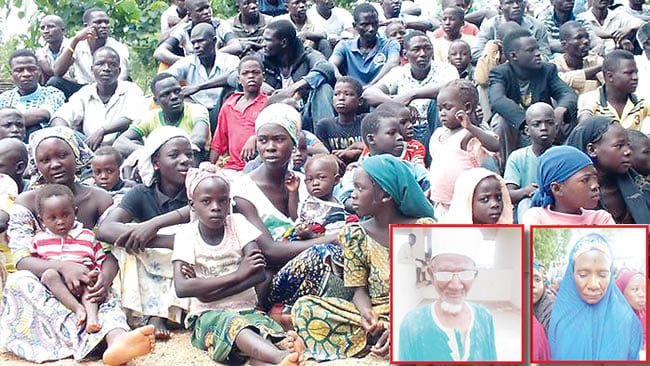
THE security challenges posed by banditry and terrorism have continued to escalate in the northern part of the country, as the number of internal displaced persons and camps has continued to swell, putting a significant financial burden on the state governments.
The Nigerian Tribune’s findings revealed that states such as Benue, Borno, Niger, Zamfara, and Katsina have the highest number of displaced persons, primarily women and children who fled their ancestral communities as a result of attacks and killings, with the unfortunate situation exacerbated by flooding in some communities.
Benue
Checks in Benue pointed out that there are no fewer than 21 camps for the IDPs across the state, while records obtained from the Benue State Emergency Management Agency (BSEMA) depicted that 219,477 persons were displaced from their communities, with the majority of them at the IDP camps.
The breakdown of the number of people displaced as obtained by BSEMA include that Male: 0-four years 9,708, five-17 years, 53,449, 18-59 years, 28,488 and 60+ 4,002, and Female: 0-four years, 9,212, five-17 years, 50,168, 18-59 years, 56,432 and 60+ 8,018.
Kaduna
A recent survey by some civil organisations indicated that more than 1.1 million out-of-camp internally displaced persons are currently squatting in Kaduna, placing growing pressure on housing, services, and livelihoods.
This was disclosed during a one-day capacity-building workshop on youth migration governance for staff of the Kaduna State Ministry of Youth Development.
Zamfara
Similarly, Zamfara harbours 290,000 IDPs, and the state government spends N7.3b for their upkeep. The state government, through the Ministry of Humanitarian and Relief Matters, disclosed that it spent over N7.3 billion to support these camps, saying Zamfara State harbours over 290,000 Internally Displaced Persons (IDPs) in the state.
The commissioner, Honourable Salisu Tsafe who disclosed this during the Commemoration of 2026 World Humanitarian Day, highlighted that banditry activities have forced quite a lot of people out of their communities and villages to seek refuge in the IDP camps
Katsina
An assessment carried out by the International Organisation for Migration (IOM) in Katsina State recently revealed that more than 138,000 people were displaced by insecurity and natural disasters in Katsina State between January 2025 and January 2026.
The organisation’s Chief Mission Officer, Sharon Dimanche, disclosed at a press conference in Katsina that 72,000 people were displaced in the state following floods, heavy rainfall, and windstorms, while 60,000 others were forced out from their communities by armed banditry and kidnapping within the period under review.
Niger
Niger is also one of the states in the North battling insurgency at different fronts, as records obtained from the Niger State Directorate of Internally Displaced Persons (IDPs) showed that eight IDP camps are currently operating across six local government areas with a total of 21,258 displaced persons.
Shiroro Local Government Area has the highest number of camps, with three facilities, while Munya, Mashegu, Rafi, Rijau and Mariga local government areas have one camp each.
The Gwada IDP camp in Shiroro is hosting 2,222 displaced persons, while Kuta camp has 2,615, and Gijiwa camp has 321.
In Munya Local Government Area, the camp is accommodating 6,183 IDPs, representing the highest population among the existing camps.
Similarly, the Mashegu camp has 3,541 displaced persons, while the Rafi camp has 2,278 persons. The Rijau camp also has 2,278 displaced persons, while the Mariga camp is accommodating 1,820.
Plateau
Findings in Plateau showed that all the IDP camps had closed, despite ongoing attacks on communities and villages in parts of the state, making it difficult to obtain precise data on the number of people displaced from their ancestral homes.
Recall that the state government closed all the camps three years ago with the aim of relocating those displaced to their respective villages.
Speaking with the Nigerian Tribune, National President, Berom Youth Moulder Association (BYMA), Mr Dalyop Solomon, stated that the people of the state, despite repeated attacks, did not fully embrace the practice of IDP camps, highlighting that victims of attacks often preferred to relocate to their neighborhoods or cities within the state to stay with their relatives.
“They do not stay in government-designated camps. You will see their relatives from Jos and other cities in the state arriving to take them away,” he stated.
Kwara
It is the same pathetic story in Kwara, which has only one Internally Displaced Persons camp, located at Patigi, in the Patigi local government area of the state.
The North Central Zonal Director of the National Commission for Refugees, Migrants, and Internally Displaced Persons (NCFRMI), Hajia Ahmed Afusat Jumai, who gave the data of the affected persons said men; 2,231; women; 3,642 and children; 6,124.
Kogi
In Kogi, it is a combination of banditry and flood, which have made the number of internally displaced persons increase, but those displaced seldom stay in camp, thereby making it difficult to aggregate their numbers.
Borno
Another state facing the problem is Borno. The governor’s spokesman, Mallam Dauda Iliya, said some years back most of the IDP camps were closed, adding that the state government prioritised voluntarily returning of displaced persons to their communities of choice as security conditions improved.
He mentioned that so far, about two million people, including men and female-headed households, youths, and children, have been resettled across Borno State.
However, he said only one IDP camp remains operational in Maiduguri, while other camps were in liberated communities, including Monguno, Damboa, Gwoza, Dikwa, Konduga, Mafa and Ngala.
Sokoto
In Sokoto, thousands of residents forced to flee their homes as a result of persistent attacks by bandits and other security threats, is causing a growing humanitarian crisis across several communities in the state.
Investigations revealed that displaced population is scattered between formal and informal camps, as well as host communities, making it difficult to establish a single, up-to-date figure for the number of internally displaced persons (IDPs) in Sokoto.
The Nigerian Tribune further learnt that Sabon Birni Local Government Area alone has more than 25,000 displaced persons, making it one of the major displacement hotspots in the state.
WATCH TOP VIDEOS FROM NIGERIAN TRIBUNE TV