

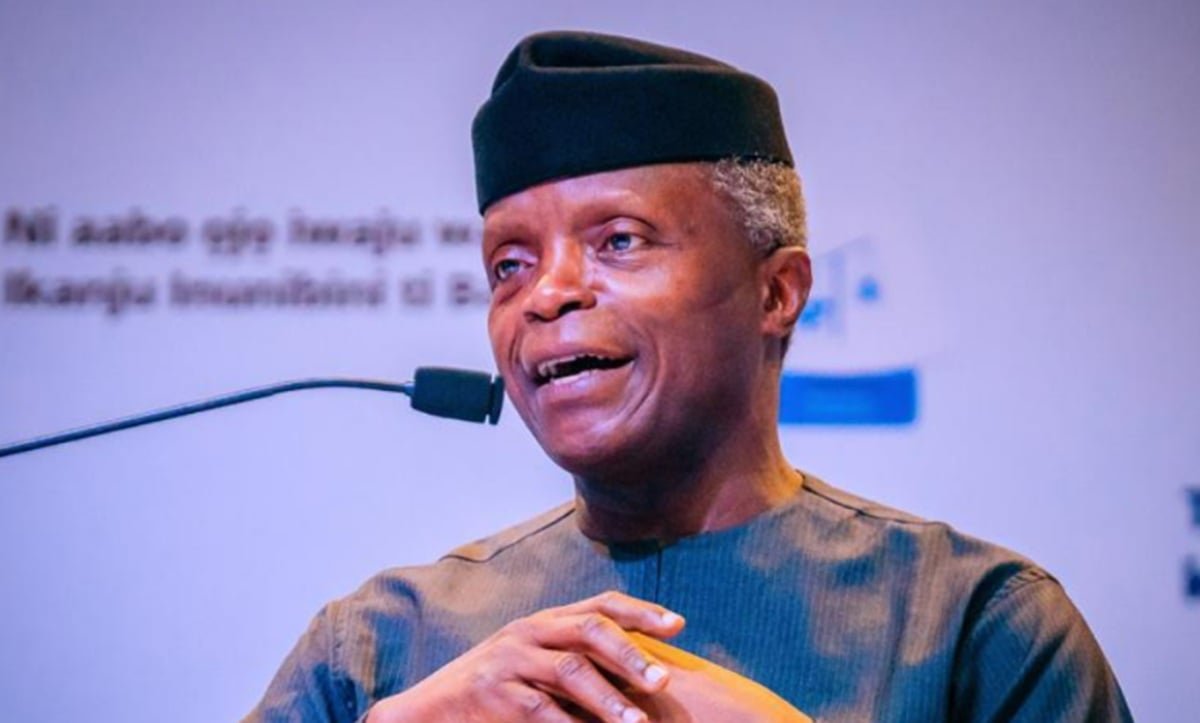
Former Vice President, Professor Yemi Osinbajo, SAN, has advocated a people-centred approach to justice reform, urging stakeholders to reposition the justice system around the actual needs and daily experiences of citizens.
Osinbajo spoke on Tuesday in Port Harcourt, Rivers State, during a panel session at the ongoing 66th Annual General Conference of the Nigerian Bar Association (NBA).
Represented by former Attorney-General and Commissioner for Justice of Lagos State, Mr Ade Ipaye, the former Vice President asserted that a citizen-focused justice system remains critical to strengthening governance and guaranteeing maximum protection for everyday Nigerians.
Highlighting the need for data-driven strategies, local ownership, and strategic prioritisation, Osinbajo stated that reform efforts must start with rigorous data collection on justice needs and case outcomes.
“What is measured is what gets funded and fixed,” Osinbajo declared.
He pressed the legal community to prioritise high-impact sectors, particularly pre-trial detention, small claims courts, first-response mechanisms, and legal assistance, adding that early successes in these areas would build support for more difficult reforms.
According to him, justice reform would be far more effective when domesticated and adopted by state governments, noting that it must be “embedded in institutions, rather than treated as a government-only initiative.”
Addressing members of the Bar, the law professor called on the NBA to take the lead in driving policy, professional development, and structural reforms that expand access to justice while maintaining quality and ethical standards. He urged the association to champion continuous education in mediation, legal tech, legal aid, and community justice, while pushing for improved funding across the broader justice sector.
The former Vice President particularly singled out pro bono work as a game-changer, noting that a legal profession of the size of Nigeria’s, if it took its pro bono obligations seriously, “could provide a significant national legal aid mechanism for citizens who could not afford legal representation.”
He argued that the central issue is no longer whether Nigeria needs justice reform, but whether legal custodians are prepared to redesign the system from the standpoint of those who need it most.
ALSO READ: Nigeria, others dominate world’s 60 poorest countries by GDP-PPP per capita
“The people-centred approach asks us to move from abstraction to reality, from system convenience to citizen need, from exclusive pathways to inclusive ones,” he stated.
Osinbajo further emphasised that justice should be viewed not merely as an institutional function, but as “a living public good.”
Recalling the historical role lawyers played in Nigeria’s struggle for independence and the fight against military rule, the former Vice President charged the current generation of legal practitioners to uphold that legacy.
“It falls to our generation today to prove that law can give service to the people, all of the people,” he said.
Maintaining that a people-centred justice system would strengthen government, make the legal profession more transparent, and protect citizens, Osinbajo concluded: “That surely is in everyone’s interest.”
WATCH TOP VIDEOS FROM NIGERIAN TRIBUNE TV