

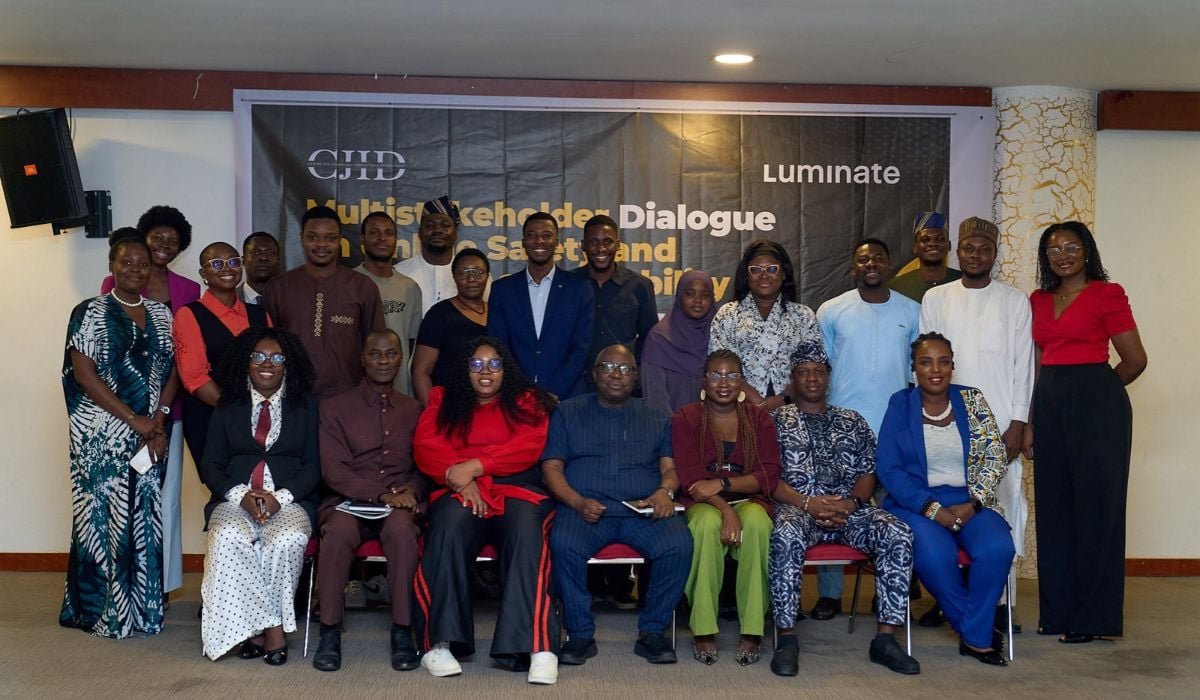
Investigations into TikTok prison streams, deepfake scams, and INEC impersonation presented as evidence of Nigeria’s growing digital accountability gap
Participants at a multistakeholder dialogue on online safety and platform accountability held in Abuja on Wednesday have called for stronger scrutiny of technology platforms operating in Nigeria, warning that the growing influence of digital companies over what Nigerians see, share and believe has created an accountability gap that neither platforms nor regulators are adequately addressing.
The dialogue, convened by the Centre for Journalism Innovation and Development (CJID) at Bon Hotel Octagon, Abuja, brought together newsroom leaders, investigative journalists, regulators, civil society actors and other stakeholders to examine Nigeria’s response to emerging digital harms while safeguarding freedom of expression.
Setting the tone for the dialogue, Dapo Olorunyomi, Chief Executive Officer of CJID, said the concentration of consequential power has increasingly shifted beyond governments to private technology companies whose platforms now influence communication, commerce, politics and access to information across Nigeria and globally.
He said these platforms determine what becomes visible, what disappears and what spreads widely, while making important decisions through algorithms that are often difficult for citizens and regulators to scrutinise.
“They write rules for participation, enforce those rules, adjudicate our nations, and increasingly make consequential decisions through algorithms that most citizens cannot see,” Mr Olorunyomi said.
He warned that the growing influence of technology companies requires a rethink of the traditional understanding of accountability, which has largely focused on governments and public institutions, and that a digital environment without meaningful accountability could expose citizens to fraud, exploitation, manipulation and privacy violations.
However, he cautioned that the push for stronger platform accountability must be balanced against the risk of regulations being weaponised to enable surveillance, censorship and restrictions on civic freedoms.
“Our task cannot simply be between one or the other. The more difficult question is how societies create institutions capable of constraining power without unnecessarily restraining freedom,” Mr Olorunyomi said.
The Executive Director of CJID, Akintunde Babatunde, said the growing influence of technology platforms had created a new form of digital citizenship, with Nigerians increasingly subject to decisions made by companies they have no role in electing or governing.
“People have effectively become citizens of a digital world governed by platforms whose owners they never elected,” Mr Babatunde said.
Investigations put evidence behind accountability concerns
To ground the dialogue in documented evidence, four investigative journalists supported under CJID’s Platform Accountability Fellowship presented findings from investigations that illustrated how digital platforms can create or amplify real-world harm.
This reporter presented findings from an investigation published jointly by the Saturday Tribune and Premium Times, exposing how Elijah Oyebode, a convicted murderer serving a death-by-hanging sentence at Ibara Custodial Centre, Abeokuta, operated TikTok Live sessions from inside his condemned cell, received monetary gifts from thousands of viewers, and described a facility where over 2,000 smartphones circulate among approximately 1,000 inmates.
The investigation triggered a formal response from the Nigerian Correctional Service within five days of publication, resulting in the removal of the Officer-in-Charge of the facility, the suspension of two principal officers, the seizure of the contraband device, and the transfer of the inmate to another facility under enhanced security.
Abubakar Abdulrasheed of Premium Times presented findings on how fraudsters exploit TikTok’s advertising system using deepfakes and artificial intelligence-generated content to defraud Nigerians at scale.
Toheeb Babalola exposed a fraudulent United States-based website that impersonated the Independent National Electoral Commission to harvest personal data from Africans without consent. Simbiat Bakare’s investigation examined how Telegram’s regulatory failures and the spread of misinformation are fuelling prostitution networks in Nigeria.
Taken together, the four investigations illustrated the dialogue’s central concern: that online harms are not merely virtual problems but produce documented, measurable consequences for individuals, communities and institutions.
Platforms ignore journalists — Managing Editor
During a panel session moderated by Tracy Keshi, Project Manager for CJID’s Tech Justice and Digital Governance programme, Premium Times Managing Editor Idris Akinbajo said journalists investigating technology companies routinely encounter difficulties obtaining information from both platforms and regulators, even when approaching them with documented evidence.
“Access to information, both by the platforms themselves and also by Nigerian regulators, and improving the knowledge of journalists who report on tech issues and AI issues, are the key issues that need to be attended to,” Mr Akinbajo said.
He urged journalists to think beyond publication when investigating digital harms and to sustain engagement with regulators, civil society and relevant institutions until identified problems are addressed. “Until the issue is resolved, the story cycle around that issue must not stop,” he said.
Miriam Kadiri, representing the National Human Rights Commission, stated that online violations should increasingly be treated as human rights issues requiring prompt and proactive institutional response. She noted that the commission’s legal services and enforcement department maintains a unit that monitors digital rights violations and can take up cases even without a formal complaint, often working in collaboration with civil society organisations and other regulatory bodies.
However, she acknowledged that digital rights remain an evolving area in which regulators, lawyers and citizens are still developing deeper understanding.
Jessica Eni, representing Techsocietal, argued that platforms should be held accountable not only for the content users post but for the systems through which harmful content is created, distributed, amplified and reported. She said platforms should conduct proper risk assessments before introducing new features and provide meaningful remedies when users report violations.
She raised particular concern about the inability of automated moderation systems to understand Nigerian languages, slang and cultural contexts, warning that harmful content easily recognisable to Nigerian users may escape platform moderation entirely.
“AI moderators are not trained to understand our language. They are not trained to understand our context,” Ms Eni said.
Filani Funso, a data protection officer at the Nigeria Data Protection Commission, said Nigerians have enforceable rights over their personal information and can lodge complaints with the commission when those rights are violated. However, he acknowledged that public awareness of those rights remains inadequate despite sustained outreach efforts.
“One of the major challenges is that the awareness is still not enough,” Mr Funso said.
Prince Godwin, an IT specialist with the Federal Competition and Consumer Protection Commission, said enforcement in the digital economy is further complicated when companies operate through complex cross-border structures that span multiple countries, limiting the reach of Nigerian regulatory authority.
WATCH TOP VIDEOS FROM NIGERIAN TRIBUNE TV