

Speaking after an infrastructure inspection, Governor Ademola Adeleke openly backed President Bola Tinubu’s 2027 re-election bid. He warmly referred to him as “our own son, father and leader.” He went further to declare: “I am the governor of the ancestral birthplace of Mr President. How can I have my own in the saddle and think twice before embracing him?” Yet, even as those words echoed, in the election that held yesterday in Osun, Governor Adeleke’s fate and that of the state were being systematically framed, for better or worse.
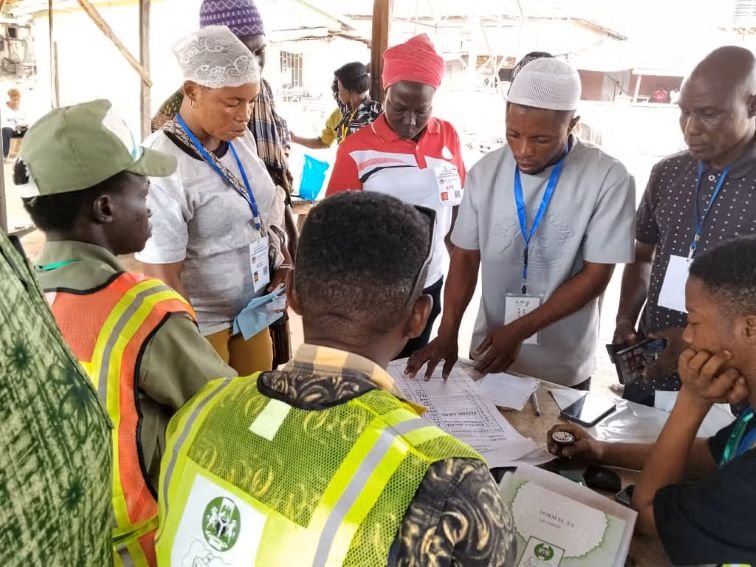
As we speak, spanning from Friday through the entire weekend, at least 25 states of the federation were left without a commissioner of police. They were all deployed to Osun state to do the president’s bidding. Reports confirmed that 32 commissioners, 36 deputy commissioners, and 51 assistant commissioners descended upon a state with a mere 1,906,390 eligible voters. This was supplemented by an intimidating machinery of political heavyweights — the Senate President, ministers, governors, and presidential aides — acting as the semiotics of a Villa muscle-flexing designed to dismantle the state-level opposition.
Much like Okonkwo, who struggled with a desperate fear of being deemed weak or cowardly, Tinubu seemed gripped by an anxiety to prove his political virility in his ancestral home state of Osun — where his umbilical cord lies buried. He was apparently unwilling to confront failure in the battle to be a bearer of his cousin, Gboyega Oyetola’s political battle coffin. Ezeudu’s warning carried profound moral and spiritual weight: participating in the murder of someone who calls you “father” violates fundamental humanity, regardless of political expediency or clan custom. Yet, Okonkwo disregarded the elder’s counsel. He joined the execution party, and when a blow struck Ikemefuna and the terrified boy ran toward him crying, “My father, they have killed me!”, Okonkwo dealt the fatal final stroke. Replace Okonkwo with Tinubu and Ikemefuna with Adeleke. You will then discover that what Tinubu did yesterday to an Adeleke who called him the father of Osun state was filicide.
A far greater tragedy awaited Okonkwo at Ezeudu’s funeral. As guns and cannons boomed, sending billowing fire into the sky and machetes clattered in a frenzy, Okonkwo’s gun unexpectedly exploded. A piece of shrapnel flew out, penetrating the heart of Ezeudu’s sixteen-year-old son and killing him instantly. Total chaos erupted. Okonkwo stood pensive, looking down as if counting his toes, fully aware of the grave consequences of killing the young boy. Tragedy wears a single, unforgiving colour. Killing a clansman, even accidentally, was an unpardonable offence against Ala, the earth goddess. Okonkwo knew the implications of murder in Umuofia: He had to go into a seven-year exile in Mbanta, his mother’s clan.
With what we saw in Osun, elections in Nigeria have increasingly transformed into the heavy beat of the Gbedu drum. It is characterised by a mournful, ululating cadence. When it is sounded as it was in Osun, a downcast populace asks in desperation: what song can be sung to this strange drumming? The Gbedu is no ordinary instrument; it is a sacred, massive drum symbolising royal authority, sovereign power, and deep ancestral communion. Historically, it remains taboo for non-initiates to strike the Gbedu, as its resonant vibrations communicate directly with deities during coronations. Thus, when non-initiates commandeer this sacred beat, appalled Yoruba ask: “Orin wo laa ko si gbedu yi?”— What song do we sing to such a strange, ominous rhythm?
The Osun Gbedu comes with an air of foreboding of evil. William Shakespeare’s Brutus smelled the evil early enough. In his famous metaphor, wherein he said, “It is the bright day that brings forth the adder, and that craves wary walking,” Brutus saw hidden danger and tyranny. Just like the clairvoyant could see ahead of yesterday’s Osun election. Whatever is its outcome, the election will be a harvest of the wild oats we sowed in the last couple of months. This comprises the president’s frightening “all is fair in politics” Freudian slip; the 29 people killed in 73 political violence incidents in Osun; the brutally injured victims of the political war; the acerbic rhetoric and the do-or-die politics that have all become the hallmark of Nigeria’s electoral life.
Osun and Nigeria find themselves jointly marking an anniversary of political anarchy, falling victim to George Santayana’s famous warning that “those who fail to learn from history are condemned to repeat it.” Exactly 43 years ago, the very anarchy that characterised this election defined old Oyo State (of which Osun was part) in August 1983. Just as the electoral horror of the Western Region signposted the collapse of the First Republic, the 1983 electoral violence in Osun ultimately buried the Second Republic.
I was in Osogbo, the state capital, as part of a Town Hall meeting organised by Arise TV and the Nigerian Tribune for the governorship candidates. Seated inside the hall were the key political gladiators: Ademola Adeleke, Bola Oyebamiji, Najeem Salam, and others. Their supporters wore multi-coloured outfits reminiscent of Dolly Parton’s 1971 classic “Coat of Many Colours.” Where spectators saw colourful gaiety, I observed two distinct things: an elephant and the tragedy of political propaganda textile material called Aso Ebi. I saw a massive elephant about to hit the canvas, surrounded by gluttons wielding glittering knives to carve out its humongous pieces of meat. This immediately brought to mind the Yoruba aphorism: “Orísiríṣi ọbẹ làá rí ní’jọ ikú erin”— On the day the elephant falls, knives of all shapes jostle for a share. Beyond the outer beauty of the Aso Ebi, a tragic drama was unfolding.
Turning Osun into a war theatre was vicariously the president’s doing. It exposed a totalizing view of electoral politics that makes opposition dangerous in Nigeria. It explains why Francis Fadahunsi, a senator close to the president, could brazenly call for the elimination of opposition elements and instruct enforcement agents to deal with non-APC voters on Saturday. While Fadahunsi’s flippancy highlights his own villainy, it raises a wider question: how many others like him have grown emboldened inside a system where political brigandage is normalised?
Even as the presidency issued meek, statesmanlike press releases to distance itself from the heavy-handedness in Osun, the underground perception remains clear: the executive gave implicit approval to the ruthless villainy that unfolded.
In 1983, that same geography, which is now Osun State, became a victim of electoral rampage. This writer, living in Ilesa at the time, witnessed the anarchy firsthand. Angry voters who suspected electoral fraud battled policemen to a standstill in Ilesa. They set homes of political opponents ablaze in a violence that shook Ijesaland and Nigeria to their foundation. At least 49 people were recorded killed in a week of the announcement of results by Ovie Whiskey’s FEDECO. President Shehu Shagari’s NPN was accused of mass ballot-rigging. While there were pockets of arson and killings, Nigeria’s worst hit states were the old Oyo and Ondo States, with unofficial casualty figures put at 25 dead in Oyo state and 24 in Ondo.
That historic electoral tragedy in Osun and the earlier ones in the First and Second Republics mirror both Okonkwo’s tragic downfall and Christopher Marlowe’s Elizabethan masterpiece, Doctor Faustus. Marlowe tells the story of Dr. Faustus, a celebrated scholar who grows dissatisfied with traditional knowledge — law, religion, logic, and medicine- and turns instead to black magic taught by Valdes and Cornelius. Faustus summons Mephastophilis, who explicitly warns him of the horrors of hell. Undeterred, Faustus surrenders his soul to Lucifer in exchange for twenty-four years of magical power. Yet, having traded his eternal soul, the scholar squanders his time on petty tricks until midnight strikes, and he is dragged down into eternal damnation.
As the Osun election unfolded, the process was not only stained with blood, but stood as a perfect replica of Marlowe’s tragedy. It evokes the poignant lines of Negritude poet David Diop in The Vultures: “their talons stained in blood / From where the wild current floods / A heavy weight upon the crest / No song of peace / No gentle nest.”
This brings me back to the Aso Ebi seen across Osun and its signification of political tragedy. In Nigeria, textiles and politics are deeply intertwined instruments of propaganda. They appear as ankara fabric distributed in yardages, T-shirts, caps, and banners. Southwestern Nigeria has a long history of weaponising textiles in politics. The legendary Ibadan politician, Adegoke Adelabu, pioneered this strategy ahead of the 1954 and 1956 elections. He commissioned propaganda cloths bearing his name and face. However, following his party’s defeat, the unsold fabrics left his Lebanese-Syrian business partner, Albert Younan, burdened with massive bank debts. It was on their return journey from Lagos after seeking a financial solution on March 25, 1958, that Adelabu’s car crashed near Ode-Remo, prematurely extinguishing the life of the 43-year-old political powerhouse. Ever since, Aso Ebi has remained an indispensable tool of Nigerian electioneering.
Beyond Okonkwo, the Gbedu drum, Brutus, and the semiotics of Aso Ebi, the Osun election serves as a metric for 2027. Even if the attempt of men of power to flex their muscles fails, it will be a measurement for January and February next year. It will then bring to mind the words of Muhammadu Odolaye Aremu, the legendary Dadakuada bard from Ilorin. In his music extolling the height and majestic power of Ilorin’s Sobi Hills, Aremu reminded us that all human power is fleeting and every empire eventually falls.