

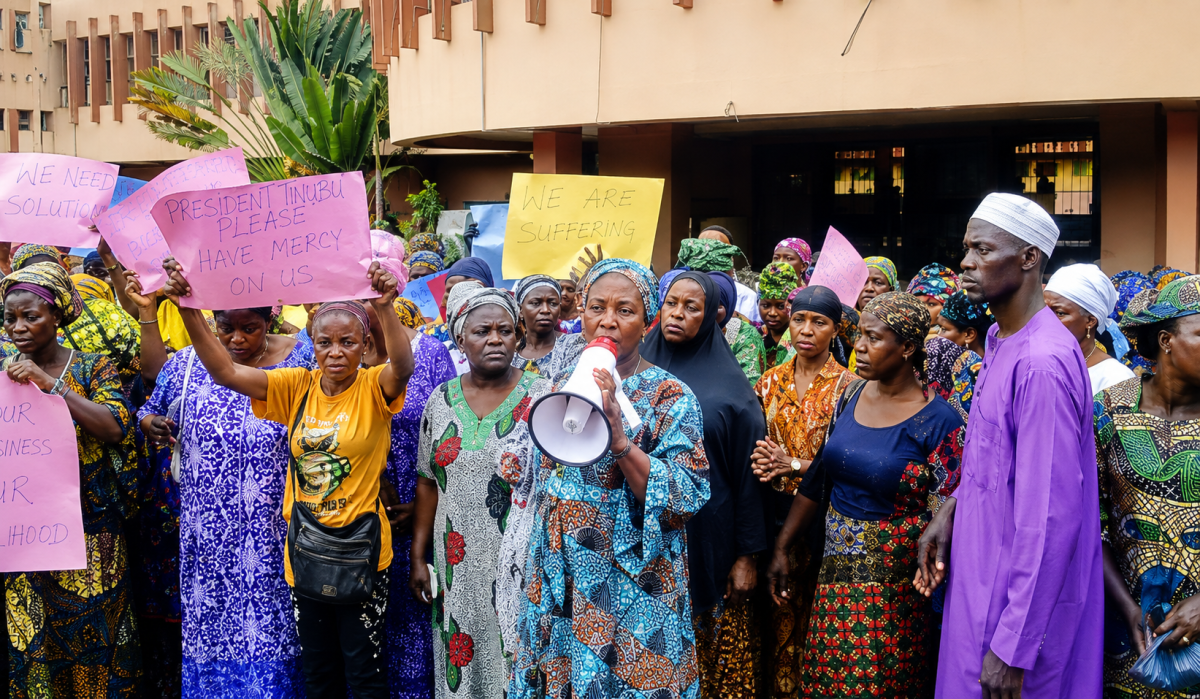
Sachet alcohol sellers in Ibadan, Oyo, on Thursday took their grievances to the Federal Secretariat, Ikolaba, urging the Federal Government to reconsider its ban on alcoholic drinks sold in sachets and containers below 200 millilitres.
The Ibadan sachet alcohol sellers, who marched to the secretariat carrying placards, appealed to the Federal Government to provide a solution that would protect public health without leaving thousands of small-scale traders without their livelihoods.
The protesters called for wider consultations involving government agencies, manufacturers, distributors and traders, saying such engagement could produce measures that address concerns over alcohol consumption while allowing legitimate businesses to survive.
ALSO READ:VIDEO: ‘We don’t want to turn to prostitution, stealing’ — Sachet alcohol sellers urge FG to lift ban
Speaking during the protest, the Iyalode of sachet alcohol traders in Ibadan, Iyabo Balogun, said many of the women involved in the trade depended on it to support their families.
Balogun appealed to President Bola Tinubu to consider the economic consequences of the ban on traders, particularly widows and other low-income women.
“Most of us selling sachet alcohol are widows, and this is our source of livelihood. We are calling on the federal government to lift the ban.
“It is from this business we train our kids in school and also feed. Please have mercy on us. We want President Tinubu to consider our appeal,” she said.
Receiving the protesters, the Oyo State Coordinator of the National Agency for Food and Drug Administration and Control (NAFDAC), Dr Isaac Kolawole, acknowledged their peaceful conduct but maintained that public health concerns largely drove the government’s position.
Kolawole said the government had provided opportunities for affected businesses to adjust to the policy, noting that some traders had already moved into other lines of business.
“Since February 2024, we have been starting, mopping, and stopping to give your complaints a chance for you to adjust. Nobody is adjusting, but some people are adjusting; you are not aware. Some people among you have accepted their fate and have adjusted,” he said.
He urged the traders to consider alternatives to sachet alcohol sales, particularly in view of health complications associated with excessive alcohol consumption.
According to him, the health consequences being recorded among some alcohol consumers should not be overlooked in the consideration of the policy.
“So, go and adjust, because the children that are dying in the hospital from liver and kidney problems and other psychological problems are more than the ones that you know,” Kolawole said.
The NAFDAC coordinator, however, advised the traders to engage government on possible support for alternative businesses rather than relying solely on a reversal of the ban.
“It is difficult where we are now, but I want to plead with you to approach the government by asking what the government can do for you to replace your business and make you better than before,” he said.
The Federal Government’s restriction covers alcoholic drinks packaged in sachets as well as alcoholic products sold in PET or glass containers below 200ml.
The implementation followed the expiration of a multi-year adjustment period granted by NAFDAC, with the ban becoming effective at the end of December 2025.
WATCH TOP VIDEOS FROM NIGERIAN TRIBUNE TV