

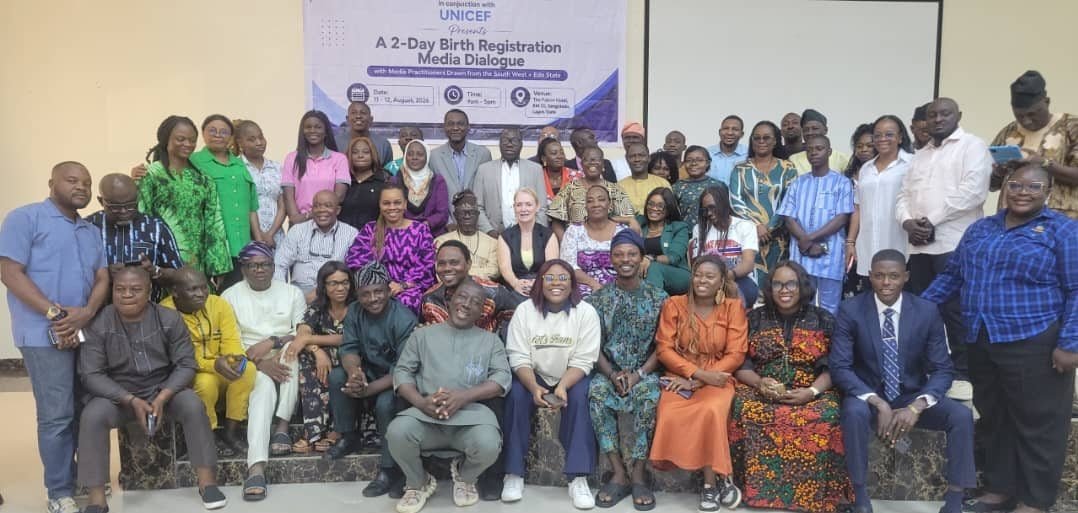
The United Nations Children’s Fund (UNICEF) has called on the media to intensify advocacy and public enlightenment on the importance of birth registration, particularly for children under one year, describing legal identity as a fundamental right and an essential tool for protecting children and improving development planning.
The call was made during a two-day media dialogue on “Support Advocacy on Birth Registration of Children Under One Year,” organised by the Lagos State Office of the National Population Commission (NPoPC), in collaboration with UNICEF.
The dialogue brought together media practitioners from Lagos, Ogun, Osun, Ondo, Ekiti and Edo states, with stakeholders stressing the need for stronger collaboration among government institutions, development partners, the media and communities to ensure that every child is registered at birth.
ALSO READ: UNICEF: Millions of Nigerian children risk losing basic rights without birth certificates
Speaking during the engagement, the Chief of the UNICEF Lagos Field Office, Celine Lafoucriere, emphasised the critical importance of ensuring that children are registered early, noting that birth registration provides the official recognition of a child’s existence and establishes the foundation for access to a range of rights and essential services.
Lafoucriere urged stakeholders, particularly the media, to sustain public awareness campaigns that would help parents and caregivers understand the long-term implications of failing to register children at birth.
She said birth registration should not be regarded merely as an administrative exercise, but as a crucial component of child protection and development, stressing that every child deserves to have a recognised legal identity from birth.
According to her, strengthening birth registration requires sustained advocacy and public engagement, particularly in communities where cultural practices, inadequate awareness, geographical barriers and other challenges may prevent parents from registering their children promptly.
“Right now, across your various states, some babies born even this morning will end this day with no name on any government record. This translates to 3.5 million children with no birth certificate, no legal identity, and no proof on any record that they were ever born across Lagos, Ogun, Oyo, Osun, Ondo, Ekiti, and Edo states.
” Here is the number I want you to remember for the next two days: 3.5 million. That is how many children across the six south-west states and Edo that have no birth certificate, no name on paper, no proof they exist, children whom the system cannot see. Some are in cities. Some are in villages. Some were born in hospitals and still never got registered. The gap is everywhere.
“A birth certificate is not a piece of paper. It is a child’s ticket into school. It is what allows a doctor to put a name on a patient file. It is how a family proves their child is theirs. Without it, a child cannot vote when they grow up, cannot get a passport, or cannot inherit land. They go through life, having to prove they exist over and over again,” the UNICEF chief said.
She encouraged the media to use their platforms to bring the issue to the forefront of public discourse, educate families on registration procedures and draw attention to gaps that could undermine the country’s efforts to achieve universal birth registration.
Also speaking, the State Director of the National Population Commission in Lagos, Abiola Kekere-Ekun, said the media had a significant role to play in the drive to achieve digital and legal identity for every child, particularly those under one year.
Kekere-Ekun said the media could contribute substantially through advocacy, sensitisation and public enlightenment, while also holding relevant stakeholders accountable for ensuring that the birth registration system functions effectively.
He noted that the success of the exercise would require the media to go beyond reporting statistics and government activities by taking the message of birth registration to parents and caregivers in communities.
He urged journalists to consistently highlight the benefits of timely birth registration and expose challenges preventing children from obtaining legal identity, thereby helping to strengthen public demand for efficient services.
He further stressed the importance of collaboration among government agencies and other stakeholders, saying that accurate registration of births would strengthen the availability of reliable demographic information needed for effective governance and development.
In his presentation, UNICEF Child Protection Specialist, Denis Onoise, described birth registration as an important component of a child’s rights, noting that it provides children with a legal identity and officially establishes their existence before the law.
Onoise said birth registration also generates verified demographic data that could be utilised by government agencies and private-sector organisations for effective planning and the delivery of essential services.
He explained that reliable birth registration data could assist authorities in determining the population of children within different age groups and locations, thereby enabling more accurate planning in sectors such as education, healthcare, social protection and child welfare.
According to him, children who lack birth certificates or other recognised documentation may face difficulties accessing certain services and proving their age or identity later in life, making early registration particularly important.
He therefore called for greater awareness among parents, communities and other stakeholders, stressing that birth registration should be treated as a priority from the earliest stage of a child’s life.
Speaking, the UNICEF communication officer, Blessing Ejiofor, while giving the objectives said the media dialogue was designed to strengthen the capacity of journalists to report more effectively on birth registration and support advocacy efforts aimed at increasing the number of children registered within their first year of life.
She emphasized the importance of coordinated media advocacy in addressing the challenges of birth registration across different communities.
According to her, achieving universal birth registration would require sustained public enlightenment, stronger institutional coordination, improved accessibility of registration services and continuous accountability from relevant authorities.
WATCH TOP VIDEOS FROM NIGERIAN TRIBUNE TV