

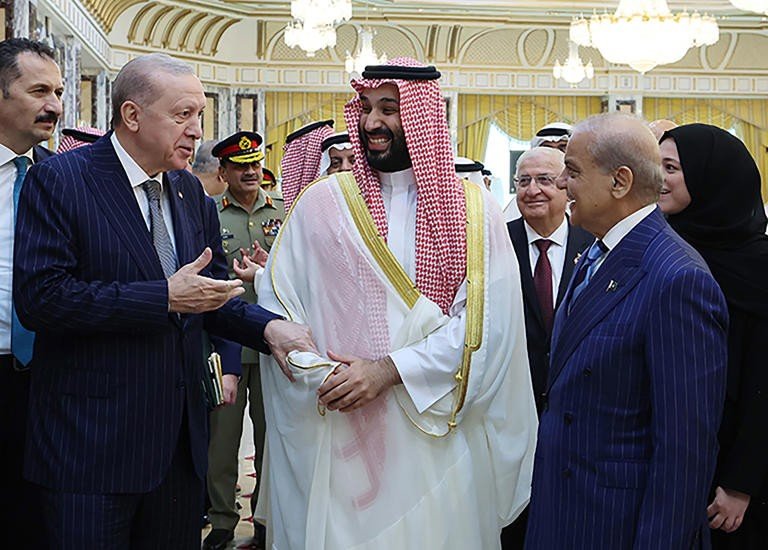
Saudi Arabia, the United States’ largest military partner in the Middle East, Turkey—a NATO member, and Pakistan, an unofficial nuclear-armed state alongside India, Israel, and North Korea, have formed a trilateral defense pact. Saudi Crown Prince Mohammed bin Salman, Turkish President Recep Tayyip Erdogan, and Pakistani Prime Minister Shehbaz Sharif met on the 7th in Mecca, Islam’s holiest city, and signed the ‘Mecca Joint Defense Agreement.’
In a joint statement, the leaders described the agreement as “a pact pursuing a prosperous future based on the brotherhood and Islamic solidarity that bind the three nations.” The signing date was first noted in the Islamic calendar (February 24, 1448), emphasizing its Islamic character.
Analysts assess that the emergence of an ‘Islamic NATO’—combining Saudi oil wealth, Turkish defense technology, and Pakistan’s nuclear arsenal, with a combined population of 380 million people—has become a reality. Al Jazeera called it “the start of a new security system uniting the world’s three largest Islamic nations.”
Saudi Arabia and Pakistan previously signed a NATO-style Strategic Mutual Defense Agreement (SMDA) in September last year. They discussed upgrading it to a collective defense pact, finalizing a draft in January. As the U.S.-Iran war escalated in February following U.S. airstrikes on Iran, Turkey joined, accelerating the trilateral pact.
The three nations hold firm positions within the Islamic world. Saudi Arabia, custodian of Mecca and Medina, leverages its religious authority, oil wealth, and the ‘bromance’ between Mohammed bin Salman and U.S. President Donald Trump to claim regional leadership. Turkey, a NATO member, has cooperated with authoritarian blocs like Russia and mediated the 2023 Israel-Hamas war. Pakistan, a nuclear state born from an arms race with India, played a mediating role in U.S.-Iran ceasefire talks.
Pakistan aims to secure stable Saudi oil funds and gain leverage in its rivalry with India. It has historically relied on Saudi economic support during currency crises, including receiving 50,000 barrels of free oil daily during 1998 nuclear sanctions.
Turkey seeks to solidify its status as a ‘global military power’ by linking the pact to its geopolitical position between Europe and the Middle East, while countering Israel. In 2023, Turkey exported over $10 billion in weapons, including to Ukraine, and expanded influence in Syria and Libya.
Egypt, another Sunni military power, may join the Mecca pact. It formed a four-nation diplomatic-security group (R4) with Saudi Arabia, Turkey, and Pakistan earlier this year. R4 foreign ministers met in Amman on the 5th, urging swift progress in U.S.-Iran ceasefire talks. Given Egypt’s historical role as a regional mediator, its participation is highly anticipated. Additional Gulf Cooperation Council states, which suffered Iranian retaliation, might also join.
If the Mecca pact expands into a ‘Sunni Islamic military alliance,’ Israel could respond with countermeasures. India, engaged in a nuclear arms race with Pakistan, might further destabilize global security. Experts widely predict that U.S. influence in the Middle East will inevitably decline. Andreas Krieg, associate professor at King’s College London, stated, “Gulf states were shocked to see the U.S. prioritize protecting Israel over them, despite investing trillions in the U.S. The era of American hegemony in the Middle East is ending.”