

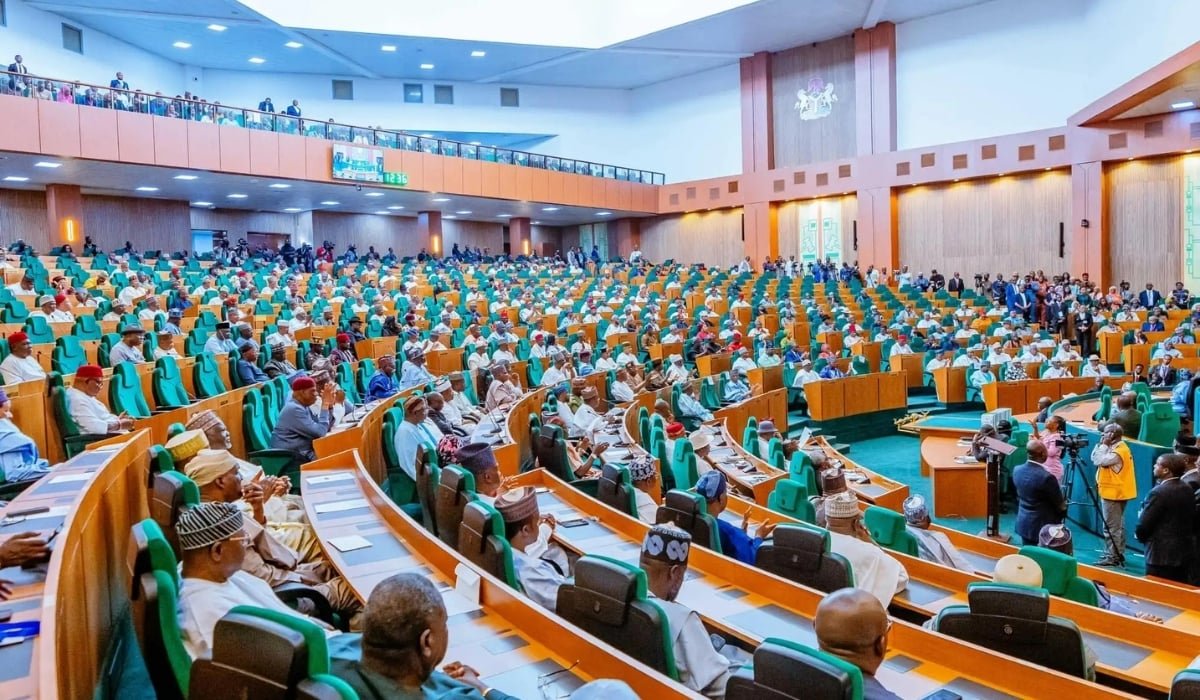
The House of Representatives has passed through Third Reading a bill seeking to establish the State Security Service Research and Development Bureau that will conduct and coordinate robust research and development for the Department of State Services and for related matters.
While giving the synopsis of the report, Chairman, House Committee on National Security and Intelligence, Hon. Ahmed Satome, who spoke before the clause-by-clause consideration of the report on Thursday, explained that the legislative framework seeks to: “address the gap in terms of development looking at the global trajectory of security and value.
“The DSS is one agency that kept this country moving and in their quest to strengthen their combat operation, there is a requirement that they should have this particular institution within the Department of State Services, for the sake of development so that contemporary knowledge in tandem with global practice will be involved for this institution to enable us to develop our security and intelligence institution particularly the Department of State Services,” he said.
According to the explanatory memorandum of the bill the proposed Bureau is expected to develop and implement a pragmatic intelligence policy for conducting basic and applied research on intelligence-related items and equipment, initiate, coordinate, and oversee scientific, technological, and environmental research activities within the State Security Service.
The Bureau is also expected to provide strategic direction and guidance for achievement of self-reliance in meeting intelligence and security needs, assessing and evaluating the requirements for intelligence-related items and equipment, and collaborating with private and public research institutions to address these needs.
As stipulated in Clause 2 of the bill, the objectives of the Bureau are to – “conduct and coordinate robust research and development in the Department of State Services; coordinate the research and development efforts of the Department of State Services; crystallize the results of scientific and technical research on intelligence items and equipment for public and private institutions; provide scientific and technical information to the Department of State Services and allies; initiate new scientific, technological and environmental research on intelligence matters; disseminate results of scientific research which are likely to advance intelligence; organise and coordinate training, research in natural and technological sciences relating to intelligence matters; collaborate with universities in scientific and technological research.”
The Bureau is also expected to collaborate with other national and international institutions in the promotion and transfer of science and technology relating to intelligence, provided that in all international liaison, foreign institutional cooperation, intelligence related eternal
As stipulated in Clause 3 of the bill, the functions of the Bureau are to enter into agreements, liaisons, memoranda of understanding, cooperation and partnership with institutions, agencies and corporations as may be necessary or desirable, subject to the approval of the Council; collaborate with other national and international institutions in the promotion and transfer of science and technology relating to intelligence, provided that in all international liaison, foreign institutional cooperation, intelligence related eternal engagements, and transnational research partnerships undertaken by the Bureau, shall be coordinated in consultation with the National Intelligence Agency.
The Bureau is also empowered to promote science culture in the State Security Service; and undertake all such activities or things as are necessary or expedient for carrying out the objectives of the Bureau and promotion of research and development into the State Security Service science and technology, as well as social sciences and environmental related challenges affecting the Service.
Clause 4 further provides that the Research Centres shall include: Cyber intelligence and emerging technology; Economic intelligence and critical infrastructure protection; Zonal crimes compartmentalization; Geo-spatial, environmental, and human security; Contemporary threats; and any other research Centre as may be approved by the Council.
Clause 4(2) provides that the Training Institutions shall include: State Services Academy (SSA) Lagos; Staff Development Centre (SDS) Kaduna; Senior Staff Development (SSDC) Bauchi; Counter Terrorism Centre (CTC) Bauchi; Research and Development Centre (RDC) Bauchi; Digital and Engineering Academy (DEA) Calabar; State Services Incubation Centre (SSIC) Enugu.
WATCH TOP VIDEOS FROM NIGERIAN TRIBUNE TV