

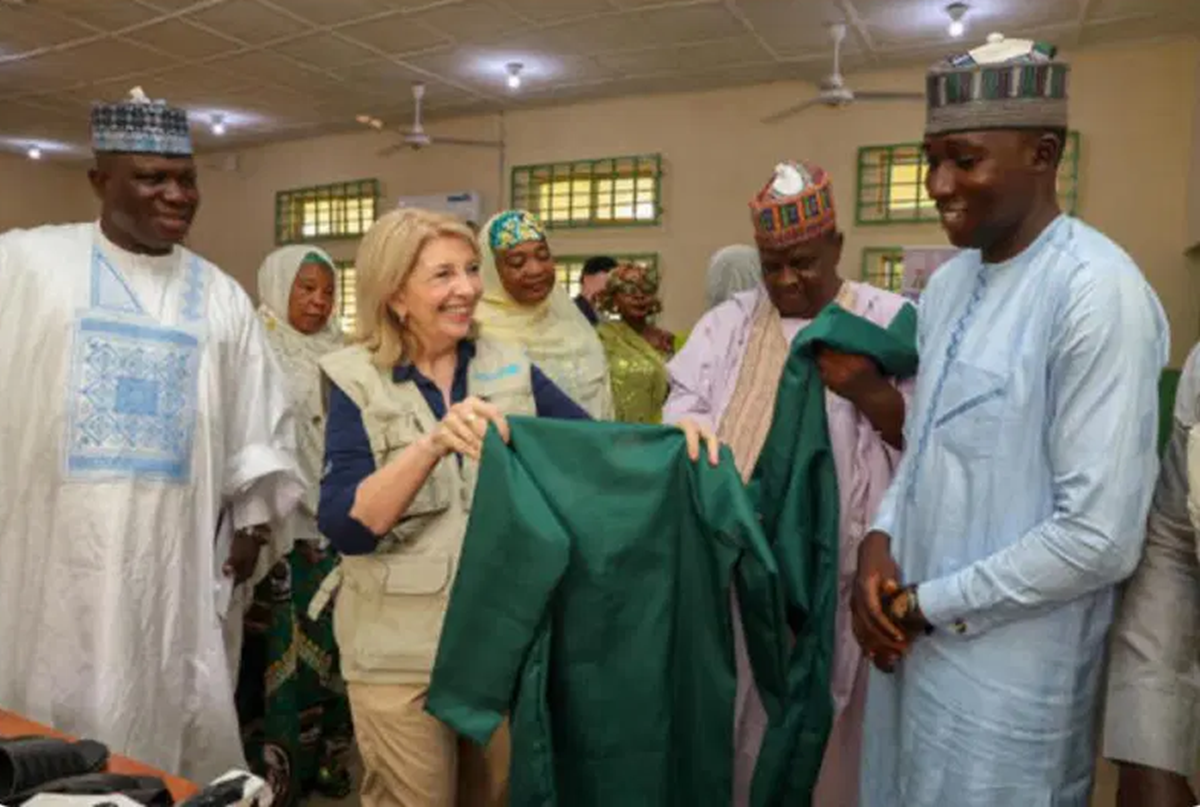
The Executive Director of UNICEF, Catherine Russell, has commended the Sokoto State Government for prioritising investments in healthcare, education, and child protection, describing the initiatives as vital to securing Nigeria’s future.
Russell gave the commendation on Friday during a courtesy visit to the Government House in Sokoto as part of her official visit to Nigeria, where she also called for deeper collaboration to improve the lives of children across the state.
She was received by the Deputy Governor, Engr. Idris Mohammed Gobir, who represented Governor Ahmed Aliyu and reaffirmed the administration’s commitment to strengthening its long-standing partnership with UNICEF and other development partners.
Welcoming the delegation, Gobir expressed appreciation to UNICEF for selecting Sokoto as one of the states on Russell’s itinerary, noting that the agency’s interventions had significantly improved maternal and child health, education, and child welfare.
He said the Ahmed Aliyu administration had placed healthcare at the centre of its development agenda through massive investments in infrastructure and manpower.
According to him, the government has renovated health facilities across the state, recruited more than 1,500 nurses and midwives, and employed 2,440 Community Health Extension Workers (CHEWs) to boost primary healthcare services, particularly in rural communities.
The deputy governor added that the state was also expanding access to potable water through the rehabilitation of water schemes and the drilling of boreholes in underserved communities.
Gobir further highlighted achievements recorded through the state’s collaboration with UNICEF in the education sector, including the establishment of 10 integrated Qur’anic schools, child-friendly learning centres, ICT training facilities for Almajiri children, and vocational skills programmes for out-of-school children.
“We remain grateful to UNICEF for its continuous support and technical guidance in improving the lives of children and women in Sokoto State,” he said.
He, however, warned that insecurity continued to undermine development efforts, with several schools and health facilities destroyed by armed attacks.
“Sokoto is among the states facing serious security challenges affecting schools and health facilities. Several facilities have been destroyed during attacks, making it more difficult for vulnerable children and mothers to access essential services,” Gobir said.
He appealed to UNICEF and other development partners to support the reconstruction of damaged schools and healthcare facilities to restore access to essential services in affected communities.
Responding, Russell described her visit to Sokoto as both encouraging and inspiring, saying it showcased what could be achieved when governments, communities, and development partners work together.
“My visit to Sokoto has been truly inspiring. At both the Rumbukawa Primary Health Centre and the Digital Village, I have seen what is possible when leadership, partnership, and community commitment come together,” she said.
Russell praised the dedication of health workers, teachers, local officials, and mothers, saying their commitment reflected a shared determination to secure a brighter future for children.
“I met with dedicated health workers, teachers, local officials, and mothers determined to give their children the best possible start in life. I also met children and young people whose curiosity, creativity, and ambition remind us why investing in them is the wisest investment in the future,” she said.
The UNICEF chief said that despite the challenges confronting Nigerian children, the country’s future remained promising because of the resilience, innovation, and talent of its young population.
“The challenges facing children do not define Nigeria’s future. What defines that future is the extraordinary talent, resilience, and innovation of its people,” Russell said.
She stressed that decisions taken today on child welfare would shape the nation’s future for generations.
“Every child who is healthy, learning, and protected strengthens not only their own future but also the future of their community, their state, and the nation,” she added.
Russell reaffirmed UNICEF’s commitment to working closely with the Federal Government, the Sokoto State Government, communities, and other partners to ensure every Nigerian child survives, learns, thrives, and reaches their full potential.
“UNICEF remains proud to be a trusted partner, and we will continue working alongside governments, communities, development partners, and young people to build a better future for every child,” she said.
WATCH TOP VIDEOS FROM NIGERIAN TRIBUNE TV