

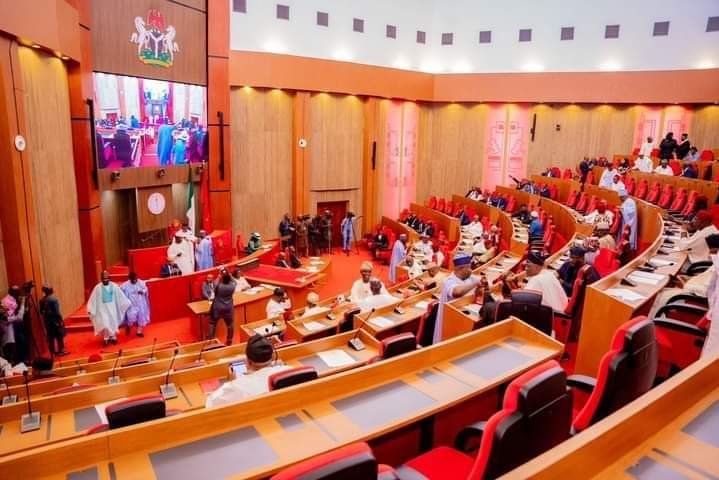
The Senate is alarmed that Import Duty Exemption Certificates (IDEC) issued by the Federal Government have cost the country a staggering ₦34 trillion in revenue over five years.
The figure, which covered 2020 to 2025, was recorded from government intervention measures and reforms to address crippling challenges affecting the lives of the citizenry.
The Senate Committee on Finance has begun looking into the losses as it investigates the operations of revenue-generating agencies with a view to plugging leakages.
The committee, chaired by Senator Sani Musa, opened a hearing into funds remitted by the agencies into the Consolidated Revenue Fund (CRF) between 2023 and 2025 on Monday in Abuja.
The Comptroller-General of the Nigeria Customs Service (NCS), Bashir Adewale Adeniyi, made disclosures on the government’s import duty policy and its impact on revenue returns, but defended the policy on the grounds that it had good objectives.
He said the waivers were implemented to achieve broader economic, security and social objectives amid the challenging times the country had passed through.
Speaking particularly about the impact on security, the CG told the committee that about 60% of the waivers went on duty-free military hardware used by the armed forces in responding to insurgency, banditry, kidnapping and other forms of violent crime.
Adeniyi added that the balance went on government-approved imports of Compressed Natural Gas (CNG) vehicles, electric and hybrid vehicles, medical equipment, pharmaceutical supplies, industrial machinery, manufacturing inputs and food commodities.
The CG defended the measures, saying, “Fiscal policy is not only about collecting revenue. Government also uses tax incentives and duty exemptions to stimulate investment, improve healthcare, support manufacturing, strengthen national security and reduce the cost of living.”
However, he agreed that the beneficiaries of the waivers must be rigidly monitored to ensure they were used for the purposes approved by the government.
On Customs’ own revenue performance, the CG said it generated ₦3.2trn in 2023 against a target of ₦3.67trn, recording a shortfall of about eight per cent.
Adeniyi stated that revenue collection rose sharply in 2024, when Customs realised ₦6.1trn compared with a target of ₦5.079trn, representing an increase of over 20 per cent.
ALSO READ: Tinubu orders ICPC to investigate PFIPC within 30 days
Quoting 2025 performance, the CG said the service collected ₦7.2trn, exceeding the target of ₦6.584trn, while revenue generated between January and June this year stood at approximately ₦4.5trn against an annual target of ₦11trn.
He attributed the fluctuations in revenue to disruptions in international trade caused by the Russia-Ukraine conflict and the crisis in the Middle East. However, he expressed optimism that cargo traffic was recovering, saying July import volumes showed encouraging signs of improvement.
Senators also seized the opportunity to focus on the government’s decision to reduce import duties on vehicles to as low as 5% for fairly-used ones.
Senator Adams Oshiomhole, for example, questioned the policy, arguing that lowering tariffs on imported vehicles, particularly fairly used ones, could undermine Nigeria’s local automobile assembly industry. While admitting that Customs merely implements government policy, Oshiomhole maintained that the country must strike a balance between providing short-term relief for consumers and protecting local manufacturers.
But Adeniyi again reacted that fiscal policies were not made by the service, adding that the agency’s role was restricted to implementation.
He explained, “We implement government policy. Naturally, lower import duties affect Customs revenue, but the policy was introduced to make vehicles more affordable for Nigerians facing severe economic hardship.”
The committee also heard that the Corporate Affairs Commission (CAC) has over N13.9billion in unremitted revenue against the agency from its operations covering 2023 to 2025.
Registrar-General of CAC, Hussaini Ishaq Magaji, who appeared before the committee, confirmed the outstanding liability but assured the committee that the money was being paid gradually.
The outstanding liability was disclosed by the Fiscal Responsibility Commission (FRC) after the committee chairman, Musa, asked the representative of the FRC to verify the remittances of CAC.
Although senators commended the CAC for its “impressive” revenue performance, they also queried the N13.9bn liability, which they considered to be on the high side.
Following the submission by Magaji that CAC was offsetting the liability gradually, Musa directed that CAC, the FRC and the committee should hold a meeting to reconcile the details in order to ascertain the exact outstanding balances.
Meanwhile, the committee expressed displeasure over the absence of 14 of the agencies at the hearing on Monday, warning that sanctions would be meted out to their heads if they failed to honour invitations.
Among the absentee agencies were the Office of the Accountant-General of the Federation (OAGF), Industrial Training Fund (ITF), Nigerian Communications Commission (NCC), Nigerian Maritime Administration and Safety Agency (NIMASA), Federal Airports Authority of Nigeria (FAAN), Nigerian Railway Corporation (NRC), National Environmental Standards and Regulations Enforcement Agency (NESREA), Nigerian Civil Aviation Authority (NCAA), and Small and Medium Enterprises Development Agency of Nigeria (SMEDAN).
WATCH TOP VIDEOS FROM NIGERIAN TRIBUNE TV