

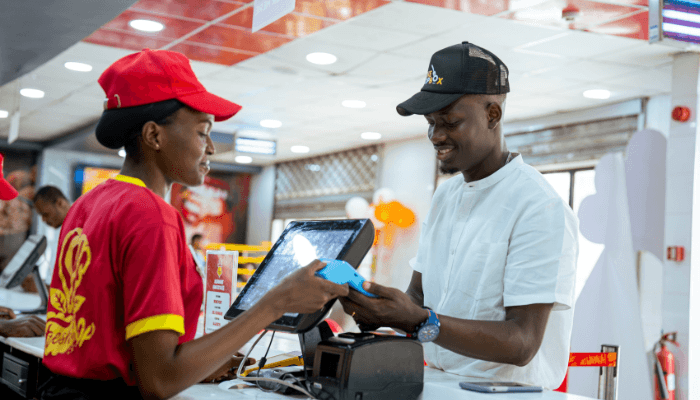
Nigeria’s foodservice industry is undergoing its biggest transformation since the emergence of modern fast-food chains four decades ago, with digital payments, embedded finance, and business management platforms replacing cash-driven operations and changing how restaurants, food vendors, and quick-service chains operate.
What began as a sector dependent on physical cash, handwritten records, and manual bank reconciliations has evolved into an $11.09 billion market in 2025, powered by instant payments, cloud kitchens, food delivery platforms, and integrated financial technology, according to a new case study by Moniepoint.
The report titled What it takes to feed Nigeria every day: The payment story behind its foodservice industry projects the market will expand to $19.31 billion by 2030, representing an annual growth rate of 11.73 percent.
The findings highlight a broader shift taking place across Nigeria’s economy, where fintech firms are increasingly moving beyond payment processing into providing the digital infrastructure businesses use to manage sales, inventory, lending, and operations.
For the food industry, analysts say this marks a fundamental transition from simply accepting electronic payments to operating entirely on digital financial infrastructure.
“The real competitive question today is how deeply that payment infrastructure is woven into the way the business actually runs day to day,” said Tosin Eniolorunda, group chief executive officer of Moniepoint Inc.
“We are ensuring that payments are connected to inventory, inventory to recipes, recipes to procurement, procurement to credit, and credit to growth plans.”
“By building out tools like Moniebook and Orda that match the operational reality of these culinary entrepreneurs, who act as mini-factories converting perishable raw materials into time-sensitive output, we are providing the digital operating system that drives sustainable scale for Nigeria’s socio-economic development,” he said.
A four-decade transformation
Nigeria’s organised restaurant industry has changed dramatically since UAC opened Kingsway Rendezvous in 1973 before launching Mr Bigg’s in 1986, a move widely regarded as the birth of Nigeria’s modern fast-food industry.
Since then, brands including Chicken Republic, Tantalizers, Sweet Sensation, and several indigenous restaurant chains have emerged, while food delivery platforms and cloud kitchens have created entirely new business models that operate without traditional dining spaces.
The report notes that this transformation mirrors broader economic and demographic shifts. Nigeria’s expanding urban population, rising middle class, longer commuting hours and increasing smartphone penetration have all fuelled demand for convenient dining options and digital ordering channels.
Today, more than 800 quick-service restaurant outlets operate across Nigeria, while online food delivery has become a $1.04 billion market on its own.
Cash dominated for decades
Despite the industry’s growth, restaurant operations remained overwhelmingly cash-based until recently.
For decades, operators counted cash manually, transported daily sales to banks, searched endlessly for change during busy periods and reconciled transactions outlet by outlet.
Large restaurant chains managing multiple branches faced even bigger operational risks as each outlet maintained its own cash balances, exposing businesses to theft, accounting errors, and costly reconciliation processes.
“For food businesses, cash was a structural crisis,” the report noted, explaining that restaurants operate on tight working-capital cycles where delays in accessing daily sales can disrupt purchases of fresh ingredients and inventory.
The report disclosed that the industry’s reliance on cash was less about preference than necessity, as electronic payment infrastructure remained limited and unreliable for much of the 1990s and early 2000s.
Even after Nigeria’s banking consolidation and the introduction of debit cards, restaurants were slow to deploy POS terminals because of high acquisition costs, poor network connectivity, and bank charges that discouraged merchants.
The cashless policy changed the industry
A turning point came in 2012 when the Central Bank of Nigeria (CBN) introduced its cashless policy to reduce dependence on physical cash and encourage electronic payments.
The policy imposed limits on cash withdrawals and deposits, expanded POS deployment and laid the foundation for agent banking and instant payments.
Although adoption was initially slow, the report reveals that the reforms triggered years of investment in payment infrastructure that ultimately reshaped how restaurants transact.
As digital payments became mainstream following the cash redesign crisis of 2023 and Nigeria’s renewed push towards cashless transactions, food businesses accelerated their adoption of POS terminals and instant bank transfers.
Moniepoint’s data show POS terminal usage among quick-service restaurants on its network has increased by 2,823 percent since the tightening of Nigeria’s cashless policy in 2023.
Digital payments exposed new bottlenecks
The move away from cash, however, introduced another set of operational challenges.
Restaurant cashiers frequently relied on personal mobile banking apps or SMS alerts to verify customer transfers before releasing meals.
During busy lunch periods or festive seasons, this manual confirmation process often delayed every transaction by between two and five minutes, lengthening queues and slowing customer service.
The report notes that digital infrastructure was often least reliable precisely when demand peaked during Christmas, New Year and Eid celebrations, forcing many operators to revert temporarily to cash.
Meanwhile, fragmented payment and inventory systems created opportunities for fraud, allowing dishonest employees to manipulate orders or divert stock without immediate detection.
Women drive the industry
One of the report’s most striking findings is the dominance of women across Nigeria’s food economy.
According to International Labour Organisation data cited in the study, women own 86.8 percent of businesses in the accommodation and food services sector, making it the country’s most female-dominated industry.
Despite this dominance, access to finance remains one of the sector’s biggest obstacles.
The International Finance Corporation estimates Nigeria’s MSME financing gap at $32.2 billion, with many thriving food businesses unable to secure loans because commercial banks continue to rely heavily on landed property as collateral rather than business cash flows.
The inability to access working capital is particularly damaging during festive seasons when restaurants require additional inventory to meet spikes in consumer demand.
Fintech moves beyond payments
The report argues that the next phase of Nigeria’s restaurant industry will be driven less by payment acceptance and more by integrated business infrastructure.
Moniepoint noted that it now offers restaurants same-day settlement instead of the traditional next-day settlement used by most banks, enabling operators to purchase fresh ingredients using proceeds generated just hours earlier.
Its automated transfer confirmation eliminates manual verification, while embedded lending assesses businesses using transaction histories rather than physical collateral.
Beyond financial services, the company has expanded into restaurant management software through Moniebook and Orda, allowing operators to monitor inventory, manage recipes, reconcile orders from delivery platforms, and detect operational leakages in real time.
Changing consumer habits
The report also provides insights into changing food consumption patterns among Nigerians.
Transaction volumes now peak twice daily between 1 p.m. and 2 p.m. during lunch and again around 7 p.m., when payment activity can reach up to 15 times morning levels.
Online food delivery follows a different pattern, recording its highest demand late at night and remaining active beyond 10 p.m., reflecting changing urban lifestyles.
Seasonal trends are equally pronounced. April is the industry’s quietest month, with payment activity 46.3 percent lower than in December, while the biggest monthly increase in card spending occurs between November and December as festive consumption rises.
The findings suggest Nigeria’s foodservice industry is entering a new phase where competitive advantage will depend not only on menu quality or restaurant locations but increasingly on the strength of the digital infrastructure underpinning business operations.
“As consumer payments become instant and business processes become automated, the country’s restaurants are evolving from cash-intensive enterprises into data-driven businesses capable of expanding faster, managing costs more efficiently, and accessing capital based on real commercial performance rather than physical assets,” it said.

Get Newsletter Updates
Enjoying our column?
Subscribe to our specialised **Tech Pulse** feed to receive fresh reports and analyses directly in your inbox.

