

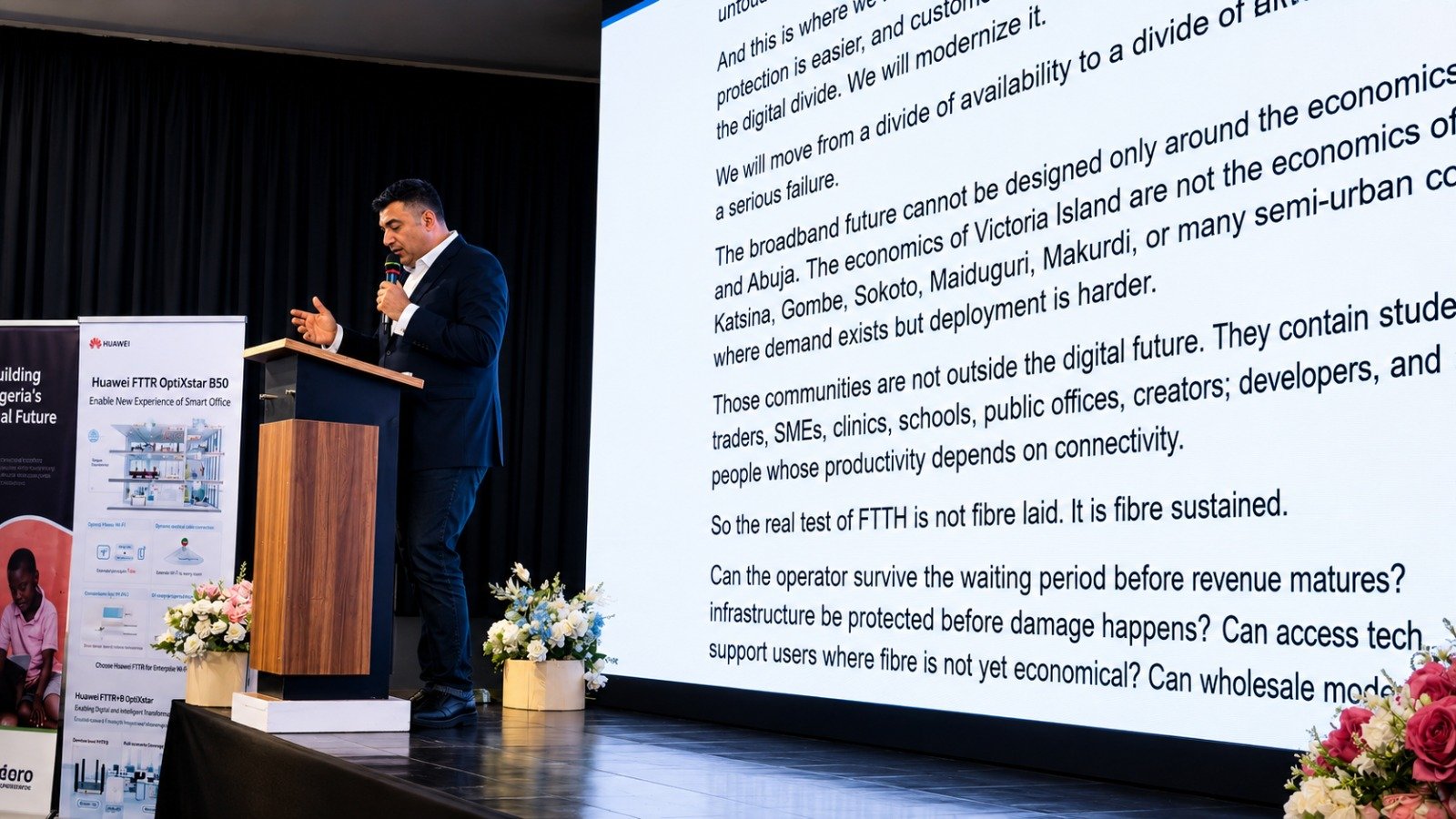
Nigeria’s drive to expand broadband connectivity will not succeed simply by deploying more fibre-optic cables unless the country addresses long-standing challenges around funding, infrastructure protection, affordability and network sustainability, Amin Dayekh, the managing director and chief executive officer of MegaMore Wireless Broadband Limited.
Speaking at the Association of Telecommunications Companies of Nigeria (ATCON) Critical Conversation Forum on Fibre-to-the-Home (FTTH) in Lagos, Dayekh said the country’s broadband ambitions risk falling short if industry stakeholders continue to measure progress only by kilometres of fibre installed.
According to him, the real test begins after deployment, when operators must keep networks running despite vandalism, road construction damage, power outages and mounting operational costs.
“The cable is not enough. Every fibre project has two lives. The first life is public and it appears in announcements, brochures, maps, targets and launch ceremonies. The second life is private. It begins the morning after deployment, when the network must face the road contractor, the vandal, the power failure, the impatient investor, the customer complaint and the repair bill,” Dayekh told industry players, regulators and investors.
He said it is this second life that ultimately determines whether broadband infrastructure delivers lasting value to citizens and businesses.
To make fibre deployment sustainable, Dayekh outlined four critical pillars that should underpin Nigeria’s broadband strategy—patient capital, infrastructure protection, realistic access models and affordability.
On investment, he warned against treating fibre projects as ventures expected to generate quick returns, noting that broadband infrastructure requires long-term financing because operators spend heavily on right-of-way approvals, network equipment, civil works and customer acquisition long before revenues begin to grow.
“If we finance fibre with impatience, we should not expect inclusion. We will get networks only where payback is fastest. We will get deployment that avoids difficult communities. And then we will wonder why the digital divide remains,” he said.
Dayekh also drew attention to the frequent damage to fibre cables during road construction and public infrastructure projects, saying operators continue to bear huge repair costs for incidents beyond their control.
He argued that the absence of coordination between road agencies and telecom operators increases operational expenses, which are eventually transferred to consumers through higher broadband prices.
“The customer does not usually say, ‘Your fibre was damaged by uncoordinated public works.’ The customer says, ‘Your Internet is unreliable,’” he said.
He called for stronger collaboration between the Nigerian Communications Commission (NCC), state ministries of works, security agencies and telecom operators through coordinated route mapping, advance notification of excavation works and improved enforcement to safeguard critical communications infrastructure.
Dayekh further stressed that wireless Internet Service Providers (ISPs) will continue to play an important role in delivering broadband to regional cities and peri-urban communities where fibre deployment remains commercially challenging.
However, he warned that congestion on licence-exempt spectrum used by many wireless operators is becoming a growing concern that policymakers must address.
On affordability, the Megamore boss cautioned that expanding fibre networks without making broadband services affordable could leave millions of Nigerians behind.
He said deploying FTTH only in high-income locations where operators can recover investments quickly would simply replace one form of digital exclusion with another.
“We will not close the digital divide. We will modernise it. We will move from a divide of availability to a divide of affordability,” he warned.
Dayekh urged stakeholders to broaden broadband investments beyond Lagos and Abuja to cities such as Kano, Katsina, Gombe, Sokoto, Maiduguri and Makurdi, where growing populations of students, traders and small businesses stand to benefit significantly from reliable internet access.
He concluded by saying that the true measure of broadband success should not be the volume of fibre laid across the country but the opportunities created through reliable and accessible connectivity.
“A fibre cable in the ground is not yet development. It becomes development when it carries opportunity,” he said.
Dayekh’s remarks reflect a growing debate within Nigeria’s telecom industry as operators invest billions of naira in fibre infrastructure while grappling with rising deployment costs, multiple fibre cuts, vandalism, right-of-way challenges and affordability concerns.
His comments suggest that the next phase of Nigeria’s broadband expansion will require not just more infrastructure, but stronger policy coordination, patient investment and consumer-focused pricing if the country is to achieve meaningful digital inclusion rather than simply expanding network coverage.

Get Newsletter Updates
Enjoying our column?
Subscribe to our specialised **Tech Pulse** feed to receive fresh reports and analyses directly in your inbox.

