

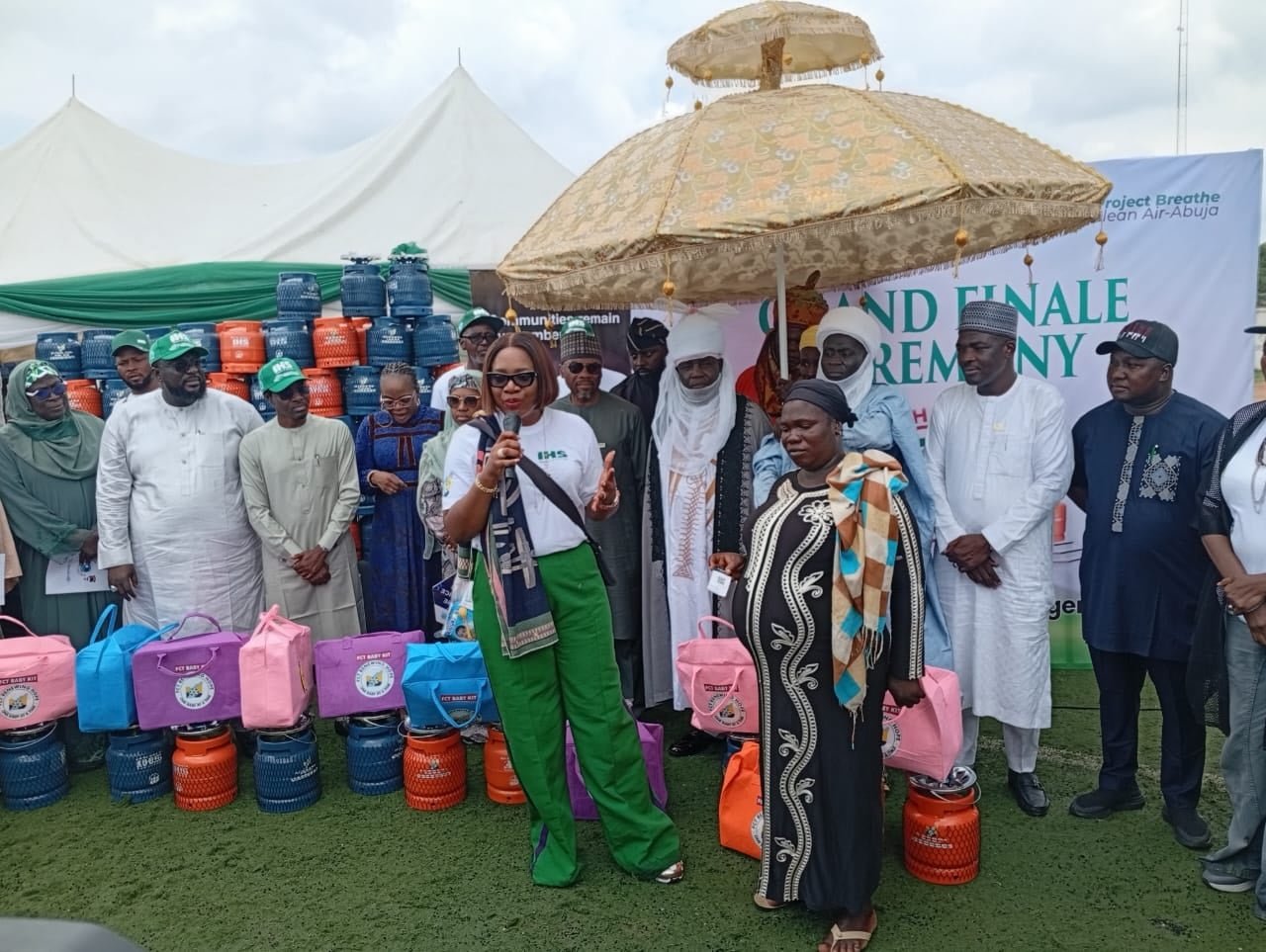
The Federal Capital Territory Administration has said its Abuja Breathe Clean Air Initiative has helped more than 12,500 households transition from firewood and charcoal to clean cooking gas as part of efforts to reduce indoor air pollution, improve public health, and protect the environment.
The Mandate Secretary for Health Services and Environment, Dr. Dolapo Fasawe, disclosed this during the finale of the Breathe Clean Air campaign, implemented in partnership with IHS Nigeria.
Fasawe said the initiative, launched under the administration of the FCT Minister, Nyesom Wike, was designed to address the widespread use of firewood for cooking, even among residents of Abuja’s city centre.
“We started this initiative two years ago to address air pollution, especially indoor air pollution. We discovered that a large percentage of Abuja residents, even within the metropolis, still cook with firewood. It is not necessarily because they cannot afford gas, but because many do not understand the harmful effects of using firewood,” she said.
According to her, firewood is a “dirty fuel” that releases harmful pollutants capable of causing respiratory illnesses, allergies, burns, and other health complications, particularly among women, children, and the elderly.
“We are promoting cooking with clean energy because firewood affects not only human health but also the environment. We found that many children suffer respiratory tract infections, allergies and burns, while older people are also affected,” she added.
Fasawe explained that rather than simply discouraging residents from using firewood, the FCT Administration opted to provide practical alternatives.
“This administration believes in being proactive. We cannot ask people to stop cooking with firewood without providing an alternative. That is why the Abuja Breathe Clean Air Initiative was established,” she said.
She noted that the programme was implemented after extensive stakeholder engagement and efforts to secure funding outside government, culminating in a partnership with IHS Nigeria.
“It is heartwarming that we have been able to replace firewood and coal in over 12,500 households. The impact goes beyond individual homes; it improves people’s health, productivity and even contributes to the economy of Abuja,” she said.
Fasawe said the FCT Administration hopes to sustain the programme and eventually institutionalise clean cooking practices across the territory.
“This is not a one-off intervention. We are already seeing results, and we hope that gradually we will be able to enforce, and perhaps even make it a policy, that everyone cooks with clean energy,” she said.
Fasawe argued that cooking gas is more economical than firewood, noting that a refill costing about ₦4,000 could last an average family of six for more than a month.
“When you compare that with spending between ₦1,200 and ₦1,500 every day on firewood, it is clear that gas is cheaper, healthier, cleaner and more sustainable,” she said.
Also speaking at the event, the Senior Vice President and Chief Corporate Services Officer of IHS Nigeria, Dapo Otunla, said the occasion marked the finale of the Breathe Clean Air campaign, under which the company donated 10,000 gas cylinders to beneficiaries across the six area councils of the FCT.
“We’re here today to celebrate the finale of the Breathe Clean Air campaign, which we partnered on with the Health Services and Environmental Secretariat of the FCT. Under the project, IHS Nigeria donated 10,000 gas cylinders to beneficiaries in different local government areas within the FCT and onboarded over 2,000 people into our Clinic Without Walls Insurance Scheme,” he said.
Otunla explained that the first 2,000 beneficiaries of the gas cylinder distribution were automatically enrolled in a one-year health insurance programme.
“The first 2,000 beneficiaries of the gas cylinders were brought into the insurance programme for one year, so they will receive free health services under the contracts we have with healthcare providers,” he said.
He said the project was aimed at reducing dependence on firewood and charcoal, lowering carbon emissions, and improving public health through the adoption of liquefied petroleum gas.
“The whole idea is to move people away from cooking with firewood and charcoal, which increases carbon emissions, and encourage them to cook with LPG. That is why we provided over 10,000 gas cylinders for the beneficiaries,” Otunla said.
He added that replacing biomass fuels with gas would significantly reduce exposure to harmful indoor smoke.
“Charcoal and firewood are usually used indoors, where people breathe in the carbon produced from these biofuels. Cooking with gas is cleaner, fresher and offers significant health benefits, particularly for the lungs,” he added.
Fasawe said beneficiaries had already reported noticeable improvements in their businesses and household welfare after switching to gas.
“People who cook and sell food have told us they are now producing much more within the same period. Families are also enjoying cleaner air in their homes. Transitioning from firewood to gas is a game-changer for health, the environment and household finances,” she said.
To encourage adoption, she said the administration distributed gas cylinders, burners, and refill vouchers redeemable at participating gas stations.
“We went a step further by providing refill vouchers so people could experience the benefits of cooking with gas firsthand. Each beneficiary receives two refill vouchers, and from the feedback we have received, after the second refill, nobody goes back to firewood,” she said.
Otunla said IHS Nigeria also provided beneficiaries with refill vouchers after distributing the 3kg cylinders to support the transition.
“In addition to giving them the initial 3kg cylinder, we also gave them vouchers for their first refill. At the end of the day, it works out to be more cost-effective than using charcoal and firewood. When you also consider the health costs associated with smoke from those fuels, switching to LPG delivers even greater benefits,” he said.
Responding to concerns about the long-term affordability of LPG, Otunla expressed confidence that beneficiaries would continue using gas after comparing the costs.
“Once they have the cylinder, it’s simply a matter of refilling it. When they compare the cost of a refill with what they have historically spent on charcoal or firewood, they will realise that gas is cheaper in the long run,” he said.
Otunla also assured that the company would continue monitoring the programme’s impact.
ALSO READ: Atiku appoints Kenneth Okonkwo as spokesperson
“With all our sustainability projects at IHS Nigeria, we always carry out monitoring and evaluation. Sustainability is our watchword, and this initiative aligns with two of our four sustainability pillars — climate and environment, and people and communities,” he said.
He added that the programme was open to ordinary residents across the six area councils without any special selection criteria.
“It was open to the general public within the communities where we worked. Nobody has to have two heads to benefit. It was meant for ordinary people who needed the support, and there was no lottery or special scheme for selecting beneficiaries,” he said.
Also speaking, the Senior Adviser to the Minister of State for the FCT, Mrs. Majeed Adamu, said the initiative would significantly reduce the health risks associated with indoor air pollution.
“Indoor air pollution is a major challenge in our environment, especially for women and children because they are usually the ones close to the kitchen. The smoke generated from charcoal and firewood poses serious health and environmental risks,” Adamu said.
She added that the initiative would help reduce dependence on solid fuels while promoting cleaner, healthier, and more environmentally friendly cooking methods.
“With the use of clean gas, this initiative reduces the use of charcoal and firewood, protects public health and benefits the environment as a whole,” she said.
WATCH TOP VIDEOS FROM NIGERIAN TRIBUNE TV