

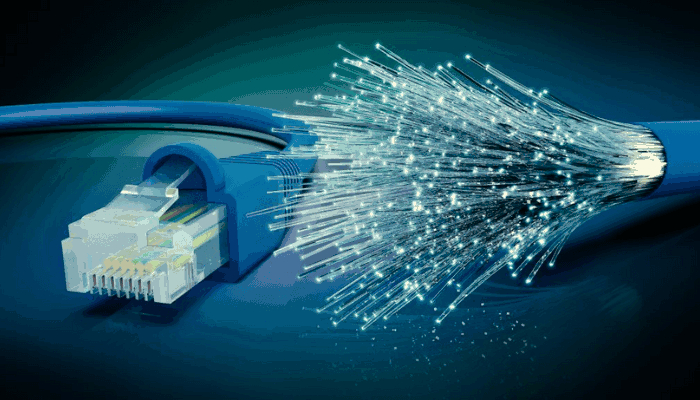
Nigeria’s impressive broadband growth is concealing a major weakness in the country’s digital infrastructure, with only about 265,000 homes connected to Fibre-to-the-Home (FTTH) services despite more than 154 million active internet subscriptions nationwide, BusinessDay findings revealed.
This stark disparity highlights a digital infrastructure paradox in that, explosive mobile-driven growth conceals severe weaknesses in fixed, high-capacity connectivity essential for the modern economy.
While overall broadband penetration climbed to 55.67 percent from 48.81 percent the previous year, and monthly data consumption surged to an average of 1.4 million terabytes, fueled by video, cloud services, e-commerce, remote work, and AI, the vast majority of users rely on mobile networks ill-suited for reliable, symmetrical high-speed needs at scale.
Read also: Broadband boom meets wallet crunch as data consumption falls
The home has evolved into a multifaceted hub for learning, work, business, and services, yet most Nigerians cannot access the stable, low-latency connections required.
Mobile broadband excels at coverage but struggles with capacity, reliability, and upload speeds during peak usage or for demanding applications. This bottleneck threatens Nigeria’s $1 trillion economy ambitions, where productivity, innovation, digital public services, and competitiveness hinge on robust fixed networks.
Underlying this gap are formidable barriers, such as high and inconsistent Right-of-Way (RoW) charges (though 13 states have waived them and 16 adopted the N145/m rate), bureaucratic delays, poor urban planning, substandard installations, vandalism, and over 27,685 fibre cuts plus thousands of thefts and access denials in 2025 alone. These issues inflate costs, deter investment, and undermine network resilience.
Aminu Maida, the executive vice chairman and chief executive officer of the Nigerian Communications Commission (NCC), during the Association of Telecommunications Companies of Nigeria (ATCON) High-Level Industry Forum on ‘Fibre to the Home in Nigeria: Addressing Challenges, Strengthening Standards, and Ensuring Sustainable Deployment’, on Tuesday, in Lagos, said internet connectivity has become an essential service for Nigerians, supporting education, business, healthcare, financial services, entertainment and government services.
However, Maida noted that the country is still relying heavily on mobile broadband while fixed fibre connectivity to homes remains significantly underdeveloped.
According to him, Nigeria recorded 154.72 million active internet subscriptions in April 2026, up from 141.99 million a year earlier, while broadband penetration increased from 48.81 percent to 55.67 percent during the same period.
He also revealed that Nigerians now consume an average of 1.4 million terabytes of internet data every month, driven by growing demand for video conferencing, cloud computing, online learning, e-commerce, remote work, artificial intelligence applications and digital entertainment.
Despite the rapid growth, Maida said only about 265,000 active FTTH subscriptions exist across the country, placing Nigeria below the African average and far behind more developed broadband markets.
“While broadband adoption has continued to grow, fixed broadband, particularly Fibre-to-the-Home, remains at an early stage of development,” he said.
He described the low number of fibre-connected homes as both a challenge and an opportunity, saying it underscores the need to accelerate investment in last-mile broadband infrastructure capable of supporting Nigeria’s long-term digital ambitions.
Maida explained that while mobile broadband has played a significant role in expanding internet access, changing usage patterns now require more reliable and higher-capacity fixed networks.
“The home is no longer only a place of residence. It is also becoming a place of learning, work, business, entertainment and service delivery. That is why Fibre-to-the-Home is so important,” he said.
He added that fibre infrastructure would become increasingly critical to Nigeria’s ambition of building a $1 trillion economy, noting that productivity, innovation, digital services and competitiveness all depend on reliable broadband infrastructure.
The NCC boss identified several obstacles slowing fibre deployment, including high Right-of-Way charges, lengthy approval processes, inconsistent state regulations, poor infrastructure planning, weak installation standards, vandalism and repeated fibre cuts.
According to him, 13 states have completely waived Right-of-Way charges, while 16 others now charge the National Economic Council’s recommended rate of N145 per linear metre. The Commission, he said, is engaging the remaining states to eliminate barriers that continue to discourage investment.
To improve transparency, the NCC has launched an Ease of Doing Business Portal that provides investors and operators with state-by-state information on Right-of-Way charges, approval procedures and infrastructure deployment requirements.
Maida also raised concerns over attacks on telecom infrastructure, revealing that operators recorded more than 27,685 fibre cuts, over 27,000 access denials and 4,210 theft incidents in 2025 alone.
He warned that such incidents disrupt services for businesses, hospitals, schools, banks and government institutions while increasing operating costs for telecom operators.
The Commission is therefore working with the Office of the National Security Adviser and other stakeholders to fully implement the Presidential Order designating telecommunications infrastructure as Critical National Information Infrastructure.
Maida also highlighted the Federal Government’s Project BRIDGE, which plans to deploy about 90,000 kilometres of additional fibre-optic cable to improve broadband availability and extend high-capacity connectivity to all 774 local government areas.
However, he stressed that expanding the national backbone alone would not solve Nigeria’s connectivity challenge without significant investment in last-mile fibre connections reaching homes, schools, hospitals and businesses.
Earlier, Tony Emoekpere, ATCON president, warned that Nigeria’s fibre rollout must be guided by proper technical standards and stronger infrastructure sharing among operators to avoid chaotic deployments and unnecessary duplication of networks.
He said poor installation practices have resulted in tangled fibre cables across cities and urged industry players to collaborate on shared infrastructure rather than building parallel networks.
Emoekpere also argued that mobile networks alone cannot deliver the level of broadband capacity required by Nigeria’s growing digital economy, insisting that widespread fibre deployment remains the country’s most sustainable path to achieving universal high-speed internet access.
He expressed optimism that the industry forum would produce practical recommendations capable of accelerating fibre deployment while improving service quality and supporting Nigeria’s broadband penetration targets.
The forum ended with participants adopting a communiqué that outlined practical steps needed to accelerate FTTH deployment across Nigeria.
According to the communiqué, stakeholders agreed that while Nigeria has made significant progress in internet subscriptions and broadband penetration, fixed fibre connectivity remains critically low, with only about 265,000 active FTTH connections, leaving enormous room for expansion.
Participants noted that reliable broadband has become essential for economic growth, education, healthcare, financial inclusion and digital public services, stressing that mobile networks alone cannot meet the country’s future broadband requirements.
The communiqué acknowledged ongoing reforms by the NCC, including the Wholesale Fixed Broadband Market Assessment, improvements in Right-of-Way policies and the Federal Government’s Project BRIDGE initiative, which aims to expand Nigeria’s national fibre backbone by about 90,000 kilometres.
Stakeholders also called for broadband infrastructure to be incorporated into urban planning, stronger enforcement of technical deployment standards and improved protection of telecom infrastructure following its designation as Critical National Information Infrastructure.
Read also: Konga-backed Stabyl raises $2.7m to fix Africa’s broken foreign exchange market
The forum further agreed that open-access infrastructure, shared ducts, pole sharing and fibre-ready buildings would significantly reduce deployment costs and speed up broadband expansion across the country. Participants also stressed the need for better outside-plant management through improved maintenance, GIS-based asset documentation, cable clean-up and adherence to international construction standards.
To accelerate deployment, the forum recommended that the NCC complete and publish its Wholesale Fixed Broadband Market Assessment, while state governments should harmonise Right-of-Way policies, legislate stronger protection for telecom infrastructure and integrate fibre readiness into physical development plans.
Operators were encouraged to deepen infrastructure sharing, participate in ATCON’s proposed Fibre Clean-Up Project, strengthen customer education and explore long-term financing models that support sustainable fibre investment.
The communiqué concluded that achieving Nigeria’s digital transformation goals will require sustained collaboration among government, regulators, telecom operators, investors and infrastructure providers to create an investment-friendly environment, improve network resilience, lower deployment costs and expand affordable broadband access nationwide.

Get Newsletter Updates
Enjoying our column?
Subscribe to our specialised **Tech Pulse** feed to receive fresh reports and analyses directly in your inbox.

