

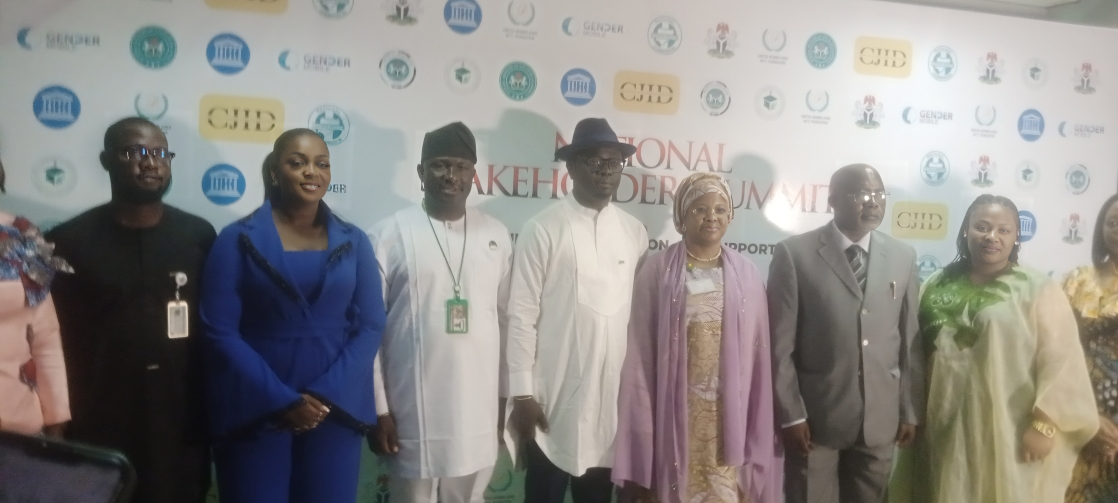
The Federal Government on Thursday declared that bullying is destructive and a killer of dreams and must not be given a place in schools across all levels in the country.
The Minister of State for Education, Prof. Suwaiba Said Ahmad; Minister of Youth Development, Ayodele Olawande; and Minister of State for Humanitarian Affairs, Hon. Yusuf Tanko Sununu, all speaking in Abuja, rejected bullying and called on students, parents, and other stakeholders to kick it out of the school environment as well as society.
They spoke at the National Stakeholders’ Summit on bullying prevention and support, with the theme: “Unite Against Bullying: A Multi-Stakeholder Approach to Legislative and Social Change,” organised by the Office of the Senior Special Assistant to the President on Student Engagement, Hon. Sunday Asefon, in collaboration with United Women Voice International Foundation.
In her speech, the Minister of State for Education, Prof. Suwaiba Ahmad, condemned the rising cases of bullying, especially among students, which she noted in some instances lead to death or students’ withdrawal from school, anxiety, and other psychological effects.
She highlighted ongoing efforts of the Federal Ministry of Education aimed at tackling the menace, disclosing that the Ministry has gone beyond policy pronouncements against bullying to setting up a taskforce for enforcement.
“Bullying in whatever form is unacceptable. It needs a multisectoral approach, combining policy, awareness campaigns, training and mental health services. The Ministry has done so much, including the launch of a national anti-bullying policy in our schools, which was launched on the 5th of May 2025,” she stated.
Minister of Youth Development, Ayodele Olawande, on his part, reaffirmed the commitment of President Bola Ahmed Tinubu to building a safer society for young people in the country, insisting that stakeholders must rise to the occasion of protecting and empowering young Nigerians.
Olawande, who insisted that bullying must not have a place in schools in Nigeria, enlisted the support of parents, teachers, traditional and religious leaders, media, and other stakeholders to address the challenge of bullying both in schools and in society, while also noting that the task is too enormous for government alone to tackle.
He called on the National Assembly to enact a law that would support the fight against bullying in the country.
Minister of State for Humanitarian Affairs, Hon. Yusuf Tanko Sununu, expressed concerns about rising cases of bullying in schools in Nigeria, saying bullying is commonly reported in Nigeria, where many studies give a rate of 21–82 per cent in terms of prevalence in the nation’s institutions.
“The most typical one that has a prevalence of almost 62 per cent is physical bullying, which can involve physical harm, such as hitting, kicking, pushing, or damaging property,” he said.
Sununu commended the Office of the Senior Special Assistant to the President on Student Engagement, Sunday Asefon, and other partners for organising the summit, which he noted was apt and timely.
Earlier, Hon. Sunday Asefon described bullying as a national crisis requiring multi-sectoral approaches to address, hence the decision to organise the summit where experts and stakeholders including partners in advocacy, educators, government officials, students, and child protection stakeholders, gathered to brainstorm on prevention, awareness, and solutions.
He said: “Across Nigeria today, bullying—whether physical, verbal, psychological, or online—has become a destructive force. It undermines mental health, disrupts academic performance, and threatens the safety of our learning environments.
“It is no longer a series of isolated incidents or unfortunate elements of ‘school culture’; it is a national challenge demanding a unified, multi-sectoral response.
“Today’s summit, themed ‘Unite Against Bullying: A Multi-Stakeholder Approach to Legislative and Social Change,’ speaks to both our shared vision and the collective action required across government institutions, educational systems, communities, and digital platforms to ensure that every child and student feels protected, valued, and empowered.
“It is our declaration that enough is enough. We are here because we believe: no child should suffer in silence; no parent should fear sending their child to school; and no school should ignore cries for help disguised as ‘discipline’ or ‘growing pains,” Asefon stated.
Hundreds of students drawn from both secondary schools and tertiary institutions across the Federal Capital Territory (FCT) participated in the summit.
One of the participants, Bessong Chikeyen Enu, from Federal Government Girls College (FGGC) Abaji, highlighted the negative impact of bullying among students, saying her school had introduced various measures to check the menace.
ALSO READ TOP STORIES FROM NIGERIAN TRIBUNE