

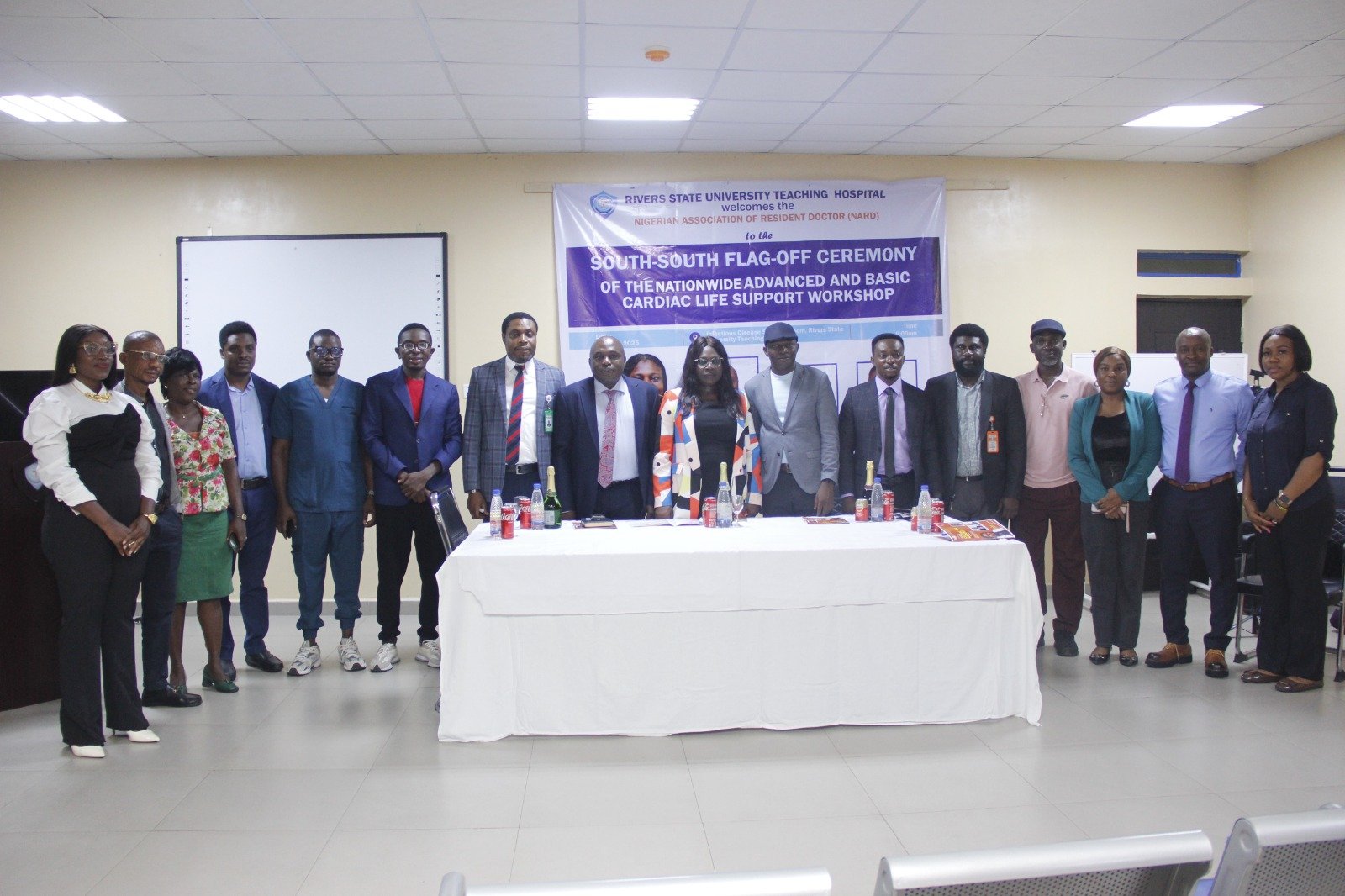
The National Association of Resident Doctors (NARD) has launched a nationwide initiative to train 10,000 medical professionals on basic and advanced life support.
The initiative aims to equip healthcare workers with the skills and knowledge needed to respond to life-threatening situations, particularly those arising from obstructive airway, pulmonary, and cardiac issues.
Speaking during the flag off ceremony in Port Harcourt, Permanent Secretary, River State Ministry of Health, Prof Chizindu Alikor, Dr Mekele Igwe, said “Whether you are a doctor or not, you can save lives and that is the importance of this gathering.
She also urged participants to engage actively, share knowledge and acquire necessary skills to improve patient outcome.
Also speaking, the NARD President, Dr. Osundara Tope, emphasized the need for the training, citing the increase in rate of sudden death.
He also cited a recent incident where a doctor slumped and died after watching a football match, emphasising the need for timely intervention to save lives in life threatening situation.
“The reason we’re doing this is because we’ve noticed a surge in sudden deaths arising from either obstructive airway, pulmonary issues, or cardiac issues,” Dr. Osundara said.
“Unfortunately, people are not sufficiently knowledgeable about what to do in cases of life-threatening situations.”
The workshop, which focuses on training doctors on advanced cardiac support, including the use of Automated External Defibrillators (AEDs), is part of NARD’s broader goal to enhance medical professionals’ skills in emergency response.
Dr. Tope highlighted the critical need for timely interventions in saving lives, particularly in cases of spinal cord injuries and cardiac emergencies, noting that the workshop was designed to provide medical professionals with the training and skills needed to respond to emergency situations effectively.
He emphasized that the programme is not limited to doctors alone but is open to all healthcare workers, including nurses, pharmacists, laboratory scientists, and physiotherapists.
“We want to train and retrain both healthcare workers and members of the public. When issues arise and there’s a medical emergency, sometimes it might not be a doctor that will save you, but if we have people who have this knowledge on what to do, it can make a difference.”
He added that the training aims to improve response times, confidence, and competence among healthcare workers, ultimately leading to better health outcomes.
He, however, urged participants to spread the word about the workshop beyond the medical community, encouraging hospital management teams to support the initiative and extend the training to other members of staff.
“We want to key into this training, it’s essential for us, it’s essential for the medical community. When we have this knowledge, you’ll be confident enough, you’ll be competent, and it’ll improve the response time and also give us the desired health outcome we’re looking for.”
Dr Tope also mentioned that NARD has taken the training to Places like FMC Azare, ATBUTH Bauchi State, UUTH Uyo, MAUTH Yola, and RSUTH Port Harcourt.
In his remarks, Chief Medical Director of UPTH, Professor Henry Ugboma, commended the National Association of Resident Doctors (NARD) for its initiative to train healthcare workers on life-saving skills.
Represented by the Chairman Medical Advisory Committee, Prof. Dantonye Alasia, Ugboma praised NARD for its efforts in advancing healthcare in Nigeria.
“We thank NARD for this very wonderful initiative,” Prof. Alasia said. “It’s essential to give it all the publicity that is required, and we hope you have adequate press and media coverage.”
He emphasised the importance of human resource and human capacity building in healthcare, highlighting that NARD’s initiative aligns with the government’s strategic objectives. “Providing the skills and competence required for people to save lives and make a big difference is crucial,” he said.
The CMD of Rivers State University Teaching Hospital (RSUTH), Prof. Chizindu Alikor appreciated the initiative from NARD and promised to train more hospital staff.
He emphasised that BLS and ACLS training will boost confidence and competence of medical practioners when responding life threatening situations.