

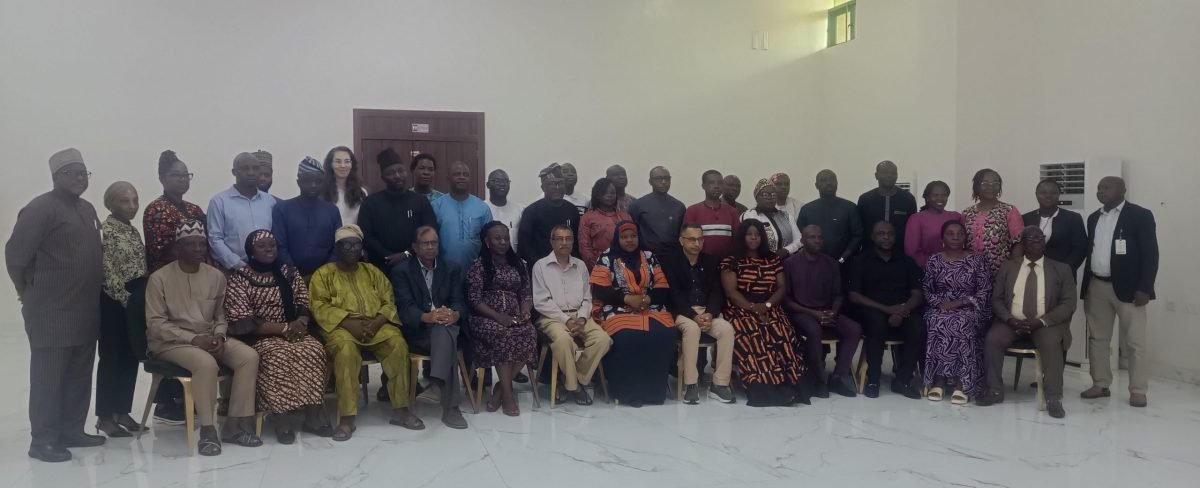
In a demonstration of its commitment to the fight against climate change and the requirements of the landmark Paris Agreement, the government of Nigeria, through the National Council on Climate Change Secretariat (NCCCS), with support from its development partner, the United Nations Development Programme (UNDP), has launched a series of multisectoral stakeholder engagements to review Nigeria’s Nationally Determined Contributions (NDCs).
The series of engagements have been held in Abuja and Lagos to ensure widespread consultation and engagement with relevant stakeholders across the country.
Speaking at the Lagos event, which began on Monday and ended on Friday, 26 to 30 May, the Director-General of NCCCS, Dr Nkiruka Maduekwe, represented by Halima Bawa-Bwari, a director at the council, stated that the revision of the NDCs and the collation of data and technical analysis are critical pillars of the country’s national climate ambition and policy planning.
She said, “The NDCs represent our country’s commitment under the Paris Agreement to reduce greenhouse gas emissions and adapt to the impacts of climate change. The revision process is not merely an update, it is a chance to raise our ambition, align our national plans with the latest science, and present the progress we’ve made since our last submission.”
Maduekwe added, “This series of consultation workshops is particularly significant because robust and credible data underpins effective climate action. As you are aware, data enables parties to access current statuses, enables the setting of ambitious, but realistic targets, while enabling monitoring of progress made in the effort to achieving climate action and aligning to the Paris Agreement.
“Accurate and timely data is therefore a key requirement that will enable government to make evidence-based decisions, track our progress, and ensure transparency and accountability in reporting. To achieve this, there is a dire need for engagement, collaboration, and partnership between governments, private sector actors, civil society, NGOs, people with disabilities, among others.
“This will facilitate the collation of a robust database that can transform our climate change commitments into tangible, progressive action.” Concluding, she said, “As we move forward, let us seize this opportunity to align our NDC with the urgent need for climate action in all the sectors of the economy, as the ambition of this government is an economy-wide NDC which has a broadened scope that leaves no one behind. Together, we can pave the way for a future where NDCs are not only policy documents but solutions driving sustainability, resilience, and prosperity for all.”
ALSO READ: Don calls for return to indigenous governance for stable Nigeria
Nigeria first submitted its NDCs in 2015 under the Paris Agreement, pledging to reduce greenhouse gas (GHG) emissions by 20 per cent unconditionally and 45 per cent conditionally by 2030.
In 2021, the country revised and submitted its NDCs (NDC 2.0) to the United Nations Framework Convention on Climate Change (UNFCCC).
Under the Paris Agreement, each party must update and resubmit its NDCs every five years. In order to enhance ambition over time, the Paris Agreement provides that successive NDCs will represent a progression compared to the previous NDC and reflect the country’s highest possible ambition. The latest edition of Nigeria’s NDCs has been tagged NDC 3.0.
Speaking at the workshop in Abuja, UNDP’s lead consultant on NDCs, Rasack Nayamuth, said Nigeria’s NDC 3.0 would align with the Paris Agreement and accelerate progress toward achieving net-zero emissions by 2060.
ALSO READ TOP STORIES FROM NIGERIAN TRIBUNE